


Seventh Grade - MATH
5: Math

Unit 1: Operations
Lesson 2
Multiplication Review
Students rewrite multiplication problems into equivalent forms using the distributive property (for example 46 × 27 written as 46(20 + 7) and then as (46 × 20) + (46 × 7)). Students use associative and commutative properties to rewrite expressions with powers of ten (for example 6 × 70 = (6 × 7) × 10 and 36 × 2.7 rewritten to (36 × 27) × 0.1). Students apply these rewrites in problem contexts (e.g., the basketball uniform cost 12 × 24 shown both as 12(20 + 4) and with the standard algorithm) and are asked to represent multiplication with a variable (e.g., four ways to show "4 times n").
Lesson 3
Division Review
Students are instructed to create equivalent division problems by moving the decimal in the divisor to make it a whole number and then moving the decimal in the dividend the same number of places (Day 2: "To keep the problem equivalent, you must multiply the dividend by this same powers of ten factor"). The lesson explicitly defines equivalent problems as equal and shows examples (1.75 ÷ 0.25 → 175 ÷ 25) and has a foldable/step that lists "Move the decimal in the divisor... Move the decimal in the dividend the same number of places." Students also add zeros to the dividend to extend it and continue the algorithm, demonstrating rewriting a numeric expression to an equivalent form to clarify the division process.
Lesson 4
Exponents and Order of Operations
Students repeatedly rewrite exponential expressions between exponential notation and expanded multiplication form (e.g., activity pages asking for expanded form and final value for expressions like 5^4, 8^2, 10^6). Students create a booklet labeling base and exponent and complete pages that convert verbal descriptions to exponential notation and vice versa (e.g., write "four to the power of 5" as 4^5 and expand 3 x 3 x 3 x 3 to 3^4). Students also evaluate expressions with exponents in different positions (exponents on a base, inside grouping symbols, and attached to grouping symbols) as part of order-of-operations practice.
Lesson 5
Factors and Prime Factorization
Students practice rewriting whole numbers into different equivalent numeric forms by finding factor pairs and producing prime factorizations (e.g., using factor trees and writing products with exponents such as 2^3 · 3). Students use those rewritten forms to solve arrangement problems (Sally's 36 piggy banks and Grayson's 60 bulbs) by selecting factor pairs that fit a contextual constraint. The activities and answer keys show students converting a composite number into another useful form (list of factors or prime factorization) and using that form to make decisions.
Lesson 6
Greatest Common Factor
Students factor numerical sums using the distributive property and "un-distribute" expressions (for example, 28 + 36 → 4(7 + 9) and 15 + 21 → 3(5 + 7)). Students use prime factorization to find the greatest common factor and then rewrite sums as a product of the GCF and a sum (e.g., GCF(24,36)=12 and 24+36 can be expressed using the common factor). Students apply these rewritten forms in context to solve distribution problems (Luisa's gumballs and lollipops, the grandfather distributing coins, snack bags), using the factor form to determine the number of equal groups and contents per group.
Lesson 7
Least Common Multiple
Students rewrite numeric expressions using prime factorization and exponential notation (e.g., 6 = 2·3 and 8 = 2^3) to compute LCMs, and they multiply the chosen prime factors to form an equivalent product (e.g., 2^3 × 3 = 24). Students rewrite a sum by factoring out a common factor in the GCF example (24 + 56 + 32 = 8·(3 + 7 + 4)). Students also rewrite fractional expressions to a common denominator using the LCM (2/3 + 3/5 → 10/15 + 9/15) to show how the quantities relate.
Lesson 8
Unit 1 Test
Students factor numeric sums and write expressions in factored form (e.g., use the distributive property to factor 84 + 120 into 12(7 + 10) and 48 + 64 into 16(3 + 4)). Students translate between distributed and undistributed forms using models (e.g., model with grids and the prompt to write the undistributed form 6(4 + 3)). Students apply GCF/LCM reasoning in word problems and then rewrite the problem quantities as factored expressions (e.g., finding 80 as the GCF of 560 and 480 and expressing 560 + 480 = 80(7 + 6) to show how items per bag relate).
Final Project
Planning a Party
Students are asked to show the total number of goody-bag items using the distributive property with a concrete example (12(5 + 3) = (12 × 5) + (12 × 3) = 60 + 36 = 96). The Spending Your Money activity (Question 5) explicitly directs students to use the distributive property to represent totals in the party context. The Parent Plan and skill list also identify as a required skill: "Use the distributive property to express a sum ... as a multiple," tying the numeric planning tasks to rewriting expressions.
Unit 2: Integers and Rational Numbers
Lesson 1
Fraction Addition and Subtraction
Students repeatedly rewrite fractions into equivalent forms by multiplying or dividing the numerator and denominator (Activity 2 and the "Things to Know" section). Students convert mixed numbers to improper fractions and vice versa with step-by-step procedures and practice problems (Activity 2 and Activity 4). Students use rewriting to find common denominators (ECD and LCD methods) and then add or subtract by making equivalent fractions (Activity 3 and the perimeter example in Activity 5).
Lesson 2
Fraction Multiplication
Students are shown that the phrase "of" can be rewritten as multiplication (for example, 2/3 of 6 = 2/3 × 6) and use an area model to see 2/3 × 1/2 = 2/6 = 1/3. Students convert whole numbers to fraction form (8 → 8/1) and convert mixed numbers to improper fractions so problems become fraction × fraction expressions to solve. Students are taught to rewrite factors by cross-cancelling or simplifying before multiplying to make computation easier.
Lesson 3
Fraction Division
Students convert whole numbers to fraction form (e.g., 4 to 4/1) and mixed numbers to improper fractions, showing explicit rewriting of expressions. Students rewrite division expressions into equivalent multiplication expressions using the Keep–Switch–Flip–Solve algorithm (for example: 4 ÷ 1/2 → 4/1 ÷ 1/2 → 4/1 × 2/1). Students use visual models and word-problem contexts to interpret the rewritten expressions as quantities (for example, counting how many 1/2 groups fit in 4 or how many 1/6 sections fit in 3/4).
Unit 3: Ratios and Percentages
Lesson 1
Introduction to Ratios
Students practice rewriting ratios in multiple forms: in words ("3 to 1"), with a colon (3:1), and as a fraction (3/1). Students create and interpret equivalent ratios by multiplying or dividing both quantities (e.g., 4/1 → 8/2 and 9:6 → 3:2) and represent ratios with images. Students apply these rewrites in context through word problems (bread recipe, cleaning solution) to compute scaled quantities while preserving the ratio.
Lesson 2
Describing Ratios in Words and Pictures
Students practice writing the same ratio in multiple forms (for example, 1 to 2, 1:2, or 1/2) as shown in the breakfast/toast-and-eggs example. Students generate and simplify equivalent ratios (for example, 12:21 to 4:7) and scale ratios (for example, 2:5 to 6:15) in the problems about boys/girls and pens. Students draw pictures and use visual representations to show how the different forms represent the same relationship (several activities ask for drawings that illustrate a given ratio and explain equivalence).
Lesson 3
Equivalent Ratios
Students practice creating and scaling equivalent ratios by multiplying both parts in tables, double number lines, and graphs (examples: 5 × 12 = 60 and 7 × 12 = 84; multiplying ratio parts by 15 to get 75 and 90). The materials show converting ratio situations into numeric equations and scaling (tables showing (1,6),(3,18),(5,30) and plotting (4,24)). The answer key includes an algebraic setup 4x + 3x = 91 that students can use to solve for x and determine each person's quantity.
Lesson 5
Percentages
Students convert between percents, fractions, and decimals throughout the lesson (examples: 15% = 15/100 = 0.15; 0.67 = 67%). Students practice moving the decimal to change percents to decimals and vice versa (shortcut method and standard method) and work with percentages greater than 100 (e.g., 115% = 1.15, 240% = 2.4). Students solve word problems that require converting percents to fractions or decimals (Annie's 10% coupon, Rory's 3/10 = 30%).
Lesson 6
Percentage Problems
Students are taught to rewrite percents as fractions or decimals and to set up multiplicative equations (e.g., "part = percent × whole", "32 = 0.64x", "x = 0.90 × 200", "n = 120/100 × 25"). The lesson shows conversion of percent to fraction and decimal to compute values (15% × 300 = 45; 45/100 × 600 = 270) and uses equivalent ratios/double number lines to represent the same relationships. Several answer keys explicitly display percent-as-decimal multiplication and percent-as-fraction multiplication to solve for unknowns.
Lesson 7
Unit Conversions
Students set up and rewrite unit conversion relationships as equivalent ratios (for example, 1 quart = 2 pints written as 1:2 or 2:1) and use those rewritten ratios to solve problems (3 quarts -> 3 x 2 = 6 pints). Students rewrite a unit relationship as a multiplicative conversion factor and apply it to scale quantities (19 cm -> 10 x 19 = 190 mm; 1 oz ≈ 28.35 g scaled to 5 oz ≈ 141.75 g). The lesson explicitly has students form equivalent ratios, reverse the order of ratios, and use double number lines to generate and apply those rewritten forms.
Lesson 8
Unit 3 Test
Students translate percent word problems into multiplicative equations (e.g., n = 28% × 200, 17 = 85% × n, 37 = n% × 50) and solve them. Students convert between percent, decimal, and fraction forms in tables (for example 13/100 → 0.13 → 13%) and use percent-as-a-multiplier to compute quantities (e.g., 84% of 25 = 21). The curriculum lists and has practice problems that ask students to ‘find a part when given the whole and the percent' and to ‘find the whole given a part and the percent,' which require rewriting the verbal context into equivalent numeric expressions.
Final Project
What's the Best Buy?
Students set up and rewrite ratio expressions to find unit prices by dividing total price by number of units (e.g., $3.38 ÷ 13 oz → $0.26/oz). They use equivalent ratios and dimensional analysis to convert units (e.g., 1 gal × 4 qt/1 gal × 2 pt/1 qt × 2 c/1 pt × 8 fl oz/1 c = 128 fl oz). Students write percent relationships as ratios or equations to compute savings (example: n = 10/100 × $200, then solve n = 20). They use equivalent-ratio reasoning to double or triple recipe ingredient amounts (multiply both parts of a ratio by 2 or 3).
Unit 4: Algebraic Expressions
Lesson 4
Positive and Negative Numbers
Students are asked to rewrite subtraction expressions as addition of the opposite (e.g., change 12 - 4 to 12 + (-4)) and then use the commutative and associative properties to rearrange and group terms (example: 3 - 5 + 4 + 2 - 13 rewritten and grouped to simplify). Student activity pages require rewriting expressions in real-world contexts (money, temperature, depths) and solving them after rewriting. The materials include explicit practice problems where students convert subtraction to addition of opposites, group positives and negatives, and interpret the numerical result in context.
Lesson 5
Equivalent Expressions
Students practice writing and recognizing equivalent expressions by rewriting numeric and variable expressions (Activity 1 examples: 4n = 2n + 2n, visual box models, matching cards). Students simplify expressions by identifying and combining like terms (Activity 2 student sheet and practice problems) and by using properties of operations to rearrange and group terms (Activities 3 and 4 show commutative and associative rearrangements and changing subtraction to adding the opposite). Students apply equivalence in simple problem contexts by writing expressions for combined quantities (candy problem: 12b + 9b + 5p + 3p + 8g + 10g = 21b + 8p + 18g).
Lesson 6
The Distributive Property
Students compare two real-world expressions for the same area (Penny's (5×4)+(5×8) vs Paul's 5(4+8)) and see they evaluate to the same value, demonstrating equivalent forms. Students rewrite algebraic expressions using the distributive property (e.g., 5(n+2) → (5·n)+(5·2) → 5n+10) and combine like terms in contextual problems (e.g., 2n+3n → 5n for Tessa's purchases). Students also evaluate original and simplified expressions with the same substituted number (Activity 3) to prove equivalence in problem contexts.
Lesson 7
Unit 4 Test
Students are asked to write equivalent expressions in context (e.g., Zane's pay: choose 12n + 5 and write an equivalent expression using the commutative property). Students use the distributive property to rewrite contextual expressions (e.g., Alana's 12(x + 6) and then write 12x + 72) and prove equivalence by evaluating both forms with x = 10. The unit repeatedly asks students to generate and prove equivalent expressions, combine like terms, and use properties (commutative, associative, distributive) on several problem pages and practice items.
Final Project
Algebra Think-Tac-Toe
Students simplify expressions and explain each algebraic step in the "Prove It! Equivalencies" activity, then evaluate both the original and simplified expressions by substituting a numerical value to prove equivalence. In the "Math Properties Trading Cards" activity students create examples and mini-lessons for the distributive property, including rewriting 15 + 5n as 5(3 + n). The unit skills list and rubric explicitly require students to "apply the properties of operations to generate equivalent expressions" and to "identify when two expressions are equivalent."
Unit 5: Algebraic Equations
Lesson 1
Algebraic Equations
The lesson has students translate word sentences into algebraic equations by changing words or phrases to variables, constants, and symbols (e.g., "Five plus a number is twelve" -> 5 + n = 12 and "The sum of a number and eight is equal to three times the number" -> n + 8 = 3n). It explicitly teaches the symmetric property of equality and has students rewrite equations by flipping sides (e.g., 6 = x - 4 can be written as x - 4 = 6). Students also practice writing equivalent equation forms in word-to-equation activities and create an Interactive Notebook page translating between forms.
Lesson 2
Solving One-Step Equations, Part 1
Students write equations from word problems (for example, n + 60 = 100) and use tape and hanger diagrams to represent the same relationship visually. The lesson has students simplify expressions by combining constants (for example, rewriting 8 + y - 2 = 14 as 6 + y = 14) and notes the commutative property (n + 3 is the same as 3 + n). Students also manipulate both sides of equations (subtracting or adding the same value) to produce equivalent forms and check solutions by substitution.
Lesson 3
Solving One-Step Equations, Part 2
Students represent multiplication and division expressions as equivalent group models (e.g., 2n = 8 shown as two equal groups of n that equal 8, and n/2 = 5 shown as a whole split into two groups each equal to 5). Students are asked to rewrite verbal situations into algebraic equations (e.g., "Five times what number is 40" → 5n = 40) and to transform equations using inverse operations (e.g., n/3 = 11 → n = 33, and 4x = 12 → x = 3). The lesson repeatedly instructs students to perform the same operation to both sides to produce an equivalent equation with the variable isolated.
Lesson 4
Solving Two-Step Equations
Students rewrite expressions using the distributive property (example: 3(n - 4) rewritten as 3n - 12) and combine like terms (example: 5 + 4n + 3 simplified to 4n + 8). Students translate word problems into algebraic expressions and equations (e.g., write 3n + 4 = 19 from a context about weekly snowfall). Students represent expressions in tape and hanger diagrams to show equivalent forms of the two sides before solving.
Lesson 6
Solving Inequalities
Students rewrite and manipulate inequality expressions using inverse operations to isolate the variable (for example, n + 6 > 8 leads to n > 2 by subtracting 6; 3n − 5 ≥ 22 is rewritten to 3n ≥ 27 then n ≥ 9 by adding 5 and dividing by 3). Students practice switching the placement of expressions while changing the inequality direction (7 > < + 2 is rewritten as n + 2 < 7). Students also write inequalities from<word problems (e.g., n + 5 < 12, 5n ≤ 75) and transform those expressions algebraically to find solution sets.
Lesson 7
Independent and Dependent Variables
Students practice rewriting two-variable equations so one variable is isolated (for example, 2x - y = 4 is rewritten to 2x - 4 = y and d = 45t is rearranged to t = d/45). Students write equations from contexts (10x = y, 5x = y, y = x - 2) and use inverse operations to rewrite expressions with the dependent variable alone. Several student tasks ask them to choose the correct rewritten form (e.g., rewrite y - 5x = 8 as y = 8 - 5x) and to interpret the rewritten equation in a word context (hours = distance/45).
Lesson 8
Unit 5 Test
Students rewrite equations into alternative forms (for example, x - y = 8 is rewritten as x - 8 = y, and y + 5 - 2x = 6 is rewritten as y = 2x + 1) and then create tables and graphs from the rewritten forms. Students identify independent and dependent variables and write equations expressing one quantity in terms of another (e.g., x - 6 = y for the bulbs problem and x - 8 = y for ages). Students also apply the distributive property to rewrite expressions (e.g., 2(y + 1/2) rewritten as 2y + 1) to solve equations.
Unit 6: 2D Geometry
Lesson 2
Working With Angles
Students write geometric situations as algebraic expressions and equations (e.g., 126 + n = 180; n + 2n = 90; 5n = n + 92). Students combine like terms (n + 2n → 3n; 2n + 3n → 5n) and rearrange equations using inverse operations (subtract n from both sides to get 4n = 92) to make the relationships easier to solve. Students substitute solved variable values back into expressions to interpret angle measures (e.g., n = 23 → 5(23) and 23 + 92).
Lesson 4
Area
Students set up and solve algebraic equations to represent area problems (for example, writing 24n = 4320 to find how many pavers are needed and writing 15 × n = 75 to find a missing height or base). Students also use algebraic reasoning when solving for unknowns in area contexts (dividing both sides to isolate the variable is shown in the answer keys). Several word problems ask students to express geometric relationships as equations and solve them.
Lesson 5
Circles
Activity 2 asks students to use inverse operations to rewrite π = C/d into C = πd and then to use d = 2r to rewrite the circumference formula as C = 2πr. Activity 4 has students start with Area = (1/2) × C × r, substitute C = 2πr, and simplify algebraically to obtain A = πr2. The activities explicitly show step-by-step algebraic rewriting (inverse operations, substitution, and simplification) and ask students to perform these steps.
Lesson 6
Scale Drawings
Students convert scale-factor ratios to percentages (e.g., 3/1 → 300%) and use percent-as-multiplier to compute new dimensions (e.g., 200% of 8 ft = (200/100)×8 = 16 ft). Students set up and use equivalent ratios and proportions (e.g., 1 in/5 ft = 6 in/n ft) to rewrite measurement relationships and solve for unknowns. Activities ask students to express scale factors as ratios and as percents and then multiply dimensions by those factors to get scaled lengths and areas.
Lesson 7
Unit 6 Test
Students write and solve algebraic equations from geometric contexts (e.g., Question 5: n + 2n + (3n + 12) = 180, which is rewritten as 6n + 12 = 180 in the answer key). Students also solve equations by rewriting to isolate a variable (e.g., Question 6: 3n = 2n + 35 is rewritten/subtracted to get n = 35). Multiple problems require students to translate geometric relationships into algebraic expressions and then manipulate those expressions to find unknown measures.
Unit 7: 3D Geometry
Lesson 1
Three-Dimensional Solids
Students write an equation using Euler's formula (F + V - E = 2) with a letter for the unknown and manipulate it algebraically (e.g., F + 5 - 8 = 2). They change subtraction to adding the opposite, combine like terms to get F + (-)3 = 2, and add the inverse to both sides to isolate the variable and find F = 5. These steps show students rewriting an expression into equivalent forms to solve for an unknown in a problem context.
Lesson 2
Surface Area
Students compute and add the areas of repeated congruent faces (for example 60 + 60 + 50 + 50 + 30 + 30 = 280) and then see that this sum can be written compactly as SA = 2(10×6) + 2(10×5) + 2(6×5) = 2LW + 2LH + 2WH. Students also add six identical square face areas (9 + 9 + 9 + 9 + 9 + 9 = 54) and then write the same total as SA = 6s^2, with numeric and symbolic examples shown. Activity pages and notebook tasks ask students to label face areas, add them, and use the formulas, making the equivalence between expanded sums and factored/multiplicative forms explicit in the context of surface area.
Lesson 3
Volume
Students convert mixed numbers to improper fractions and multiply them when finding volume (e.g., 1 1/2 -> 3/2 and V = 3/2 x 2 x 2). Students rewrite repeated multiplication of a side length (5 x 5 x 5) into exponential form (s^3) to compute cube volume. Students also reason that counting fractional unit cubes times the volume of one cube equals the prism's volume and then use the formula V = l x w x h to show the two forms are equivalent.
Lesson 5
Problem Solving With Solids
Students set up and manipulate algebraic expressions to find missing dimensions (e.g., 54 = L × 4 1/2 × 2 is simplified step-by-step to 54 = 9L to solve for L). Students rewrite and solve surface-area equations (e.g., 864 = 6s2 is divided to 144 = s2 and solved for s). Students also combine like terms and rewrite expressions (e.g., 4x + 3x - 9 + x + 16 is simplified to 8x + 7) and solve percent equations (18 = (n/100) × 50) to find n.
Lesson 6
Unit 7 Test
Students set up and manipulate equations using formulas: the answer key shows F + V − E = 2 being rewritten and solved for V (5 + V − 8 = 2 → V = 5). Students use volume formulas symbolically and solve for a missing variable by dividing both sides (182 = 6.5 × h; h = 28). Students compute volumes and surface areas using algebraic formulas with fractional and decimal values (V = l × w × h and V = B × h).
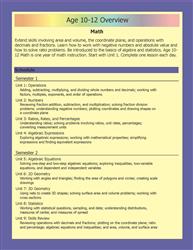
Unit 9: Skills Review
Lesson 1
Decimals, Factors, and Multiples
Students practice rewriting numeric expressions using the distributive property when they factor 36 + 88 and when they rewrite 15 × 32 as 15(30 + 2). Students use prime factorization and factor-finding skills to find GCF and LCM, showing manipulation of numerical expressions. Students solve contextual word problems about batches and grouping (cookies, bottles) that require choosing operations and reasoning about number relationships.
Lesson 2
Fractions, Ratios, and Coordinates
Students are asked to write the ratio of carrots to peppers in three forms (3 to 4, 3:4, 3/4) and to identify ratio types, with the answer key showing those equivalent representations. Students practice finding and using equivalent ratios in word problems (e.g., dogs at the park, making necklaces) and use division to find unit rates (train speed, unit price of apples). Students convert between improper fractions and mixed numbers and combine fractional amounts in contextual problems (e.g., total hours worked, area of a rug), showing practice rewriting numeric expressions into equivalent forms to solve problems.
Lesson 3
Expressions, Equations, and Percentages
Students simplify and generate equivalent linear expressions using the distributive property and combining like terms (Activity 1 Problem 4: 3(n + 6) + 4n - 10 → 7n + 8). Students translate word phrases and contexts into algebraic expressions and evaluate them (Activity 1 Problem 2: four times a number increased by five → 4n + 5; Problem 5: write 9n + 3 for Marie's earnings and evaluate for n = 7). The Parent Plan skills explicitly list applying properties of operations to generate equivalent expressions and to factor and expand linear expressions.
Lesson 4
Geometry
Students write and solve an algebraic equation for vertical angles (3n = 2n + 16) and substitute the solution to find angle measures. Students convert scale measures between fractional, decimal, and percent forms (e.g., 4/12 = 1/3 and 1/3 = 33 1/3%) when finding scale factors. Students use equivalent ratios/percent reasoning to find a resized measurement (the lighthouse problem uses 100/800 = 2/n to determine the new height).
3: Math
Unit 1: Numbers
Lesson 1
Positive and Negative Rational Numbers
Students are asked to explain a multiplication fact using the distributive property or a number line (Challenge Problem: explain (−3)×(−4) using the distributive property). The Parent Plan and activity text explicitly reference the distributive property as the basis for sign rules (e.g., explaining ((-)1)((-)1)=1 and using distributive reasoning). Students also rewrite subtraction as adding a negative in Activity 1 (e.g., 3−3 = 3 + (−3)) when modeling real-world scenarios with equations.
Lesson 3
Properties of Exponents
Students repeatedly rewrite exponent expressions into equivalent forms: they apply a^m × a^n = a^{m+n}, a^m ÷ a^n = a^{m-n}, (a^m)^n = a^{m·n}, (ab)^m = a^m b^m, and x^{-n} = 1/x^n in Activities 1–5 and the Mixed Review. Students fill in and use a "Properties of Exponents Notes" page and complete practice problems that require converting between expanded repeated-multiplication, exponent form, and simplified numeric answers. Several activities require converting negative exponents to reciprocals and changing nested-power forms to single exponents, demonstrating explicit practice rewriting expressions.
Lesson 4
Square and Cube Roots
Students convert repeated multiplication into exponential form in the bacteria word problem (3 × 2 × 2 × 2 × 2 = 3 × 2^4) and complete practice that simplifies exponent expressions ((2^3)^2, 3^4 · 3^2). Students also work problems that require choosing between using an exponent or a root in real-world contexts (area, volume, growth), and they practice calculator commands to compute and check equivalent numeric forms of powers and roots.
Lesson 5
Irrational Numbers
Students are explicitly instructed to square each number in a set (e.g., square (√30)2 = 30, 5^2 = 25, 6^2 = 36) and then use those squared values to determine ordering (Activity 3 and the 'Things to Know' steps). The lesson shows the algebraic equivalence (√n)^2 = n and has students perform that transformation to compare irrational square roots with integers and place them on a number line (Activities 3 and 5). The student tasks require rewriting root expressions by squaring and using the rewritten form to draw conclusions about relative size and placement.
Lesson 6
Scientific Notation
Students convert between standard form and scientific notation (e.g., 56,000 → 5.6 × 10^4 and 0.000045 → 4.5 × 10^-4) and convert scientific notation back to standard form. Students rewrite numeric expressions to perform operations, for example rewriting 2 × 10^6 as 20 × 10^5 so (4 × 10^5) + (2 × 10^6) becomes 24 × 10^5 and then 2.4 × 10^6. Students convert between units and rewrite quantities (e.g., 5,000 kg → 5,000,000 g → 5.0 × 10^6 g) to see how the same quantity appears in different forms. Students also convert decimals to scientific notation (0.0003 → 3 × 10^-4) to add with numbers already in scientific notation.
Lesson 7
Arctic Marine Research
Students rewrite numbers into different forms when they convert cell lengths (0.0000042 and 0.0000065) into scientific notation (4.2 × 10^-6 and 6.5 × 10^-6) and compare sizes. Students convert decimals to fractions (0.375 → 3/8, 0.875 → 7/8) and work with expressions using integer exponents and exponential forms (use and evaluate N = 2^t and compute 2^10 = 1024). Students calculate ratios and differences (how many times larger one cell is than another and differences in cell counts), which requires rewriting numeric results in comparable forms.
Lesson 8
Unit 1 Test
Students simplify and rewrite exponential expressions (e.g., problems asking for 5^3 × 5^2, 4^5 ÷ 4^3, and 4^(−2)), and they rewrite growth situations using exponents (population problems that move from 2^4 to 2^(4+3) to show growth). Students convert between forms of numbers (e.g., 0.25 to 1/4 and doubling it to 1/2, converting 3.2 × 10^4 to standard form, and converting large numbers into scientific notation). The answer keys explicitly show equivalent rewritten forms (adding/subtracting exponents, moving decimal places, and expressing repeated multiplication as a single exponent).
Final Project
Mars Station Test Mission
Students are asked in Task 3 to convert the expression 7 × 10^2 kWh into a whole number (700 kWh), which requires rewriting a number in scientific notation to decimal form. In Task 2 students are given distances expressed with square roots and instructed to determine the distance to the nearest hundredth without a calculator, which requires rewriting radical expressions as decimal approximations. The Parent Plan and activity descriptions explicitly list practicing properties of exponents and using scientific notation and converting rational numbers to decimal form.
Unit 2: Proportions
Lesson 2
Unit Rates
Students rewrite complex fractions (for example 3/4 ÷ 1/2) as a division expression and then use Keep‑Change‑Flip to convert it to multiplication (3/4 × 2/1) and simplify to 3/2 miles per hour. Students rewrite quantities as unit rates (e.g., 2 cups/4 people → 0.5 cups per person) and then multiply that ‘‘per one'' rate to find amounts for a different number of people. Students also rewrite proportional situations into equations (e.g., 2/4 = n/10 and 2×10 = 4×n) and solve by cross‑multiplication to reveal the relationship between quantities.
Lesson 3
Constant Rate
Students practice rewriting equations into the form y = kx to reveal the constant of proportionality (Activity 5 shows examples such as 4y = 8x → y = 2x and y = 6x/12 → y = (1/2)x). In real-world problems (Day 3) students compute k = y/x and write equations like y = 60x or y = (1/12)x for speed/rate contexts. Several activities require students to isolate y algebraically and simplify coefficients so the multiplicative relationship is explicit (worksheets and answer keys show these steps).
Lesson 4
Graphing Proportions
Students repeatedly translate between tables, graphs, and equations by writing relationships in the form y = kx and finding k from the point (1,k). Activities ask students to build tables from equations, plot points from tables, and write equations that express constant rates (for example, y = 12x for Jim or y = 4x and y = 5x examples). The lesson also emphasizes interpreting the unit rate (k) in context and locating it at (1,k) on the graph.
Lesson 5
Proportional Relationship Equations
Students are asked to rewrite proportional situations in equation form (y = kx) using different variable names, e.g., the lesson explicitly states y = kx is the same as t = pn and has students write t = 12n, t = 15n, a = rh, and c m = t for various contexts. Students convert percent discounts into multiplicative factors in context (Answer Key and Challenge problems show t = 50 × n × 0.9 and Final Price = 0.75 × Original Price). Activities require students to write equivalent equations for word problems and to use those rewritten forms to compute totals, unit rates, and to decide proportionality from tables and graphs.
Lesson 6
Taxes, Tips, and Commissions
Students set up and solve equations that rewrite an added percent as a single multiplicative factor (e.g., the sales-tax reverse example: 1.08 × original price = 212.00, solved for x). Multiple challenge problems and answer keys show students writing p × 1.06 = 374.40 or 1.055 × p = 529.95 and then dividing to find the pre-tax price. Tip and commission backward problems use the same form (e.g., 1.15 × x = 53.50 and 0.20 × I = 9,000), and students convert percents to decimals and combine terms when finding totals (original + percent = (1 + rate)×original).
Lesson 7
Markups and Discounts
Students set up and solve backward problems using multiplicative factor forms (for example answer keys show equations like x × (1 − 0.40) = 18 → x × 0.60 = 18 and x × 1.60 = 208 → x = 208 ÷ 1.60). Examples of percent-change use show students dividing differences by the original value and converting to a decimal (e.g., (100→80 gives 20 ÷ 100 = 0.20 → 20%) and (80→100 gives 20 ÷ 80 = 0.25 → 25%)). Multi-step discount examples use multiplicative factors directly (e.g., 120 × 0.70 then × 0.90 for successive discounts).
Lesson 8
Simple Interest and Percent Error
Students use the formula I = Prt to set up equations in context and solve problems (e.g., I = 600 × 0.04 × 5). Students also rearrange the formula to solve for unknowns: examples show rewriting I = Prt to 250 = 2500 × r × 2 and then solving for r, and rewriting I = Prt to solve for t in a later problem. Students compute balance as Principal + Interest in context (e.g., Balance = 600 + 120 = 720).
Lesson 9
Unit 2 Test
Students solve multiple percent increase/decrease and tax/markup problems that require rewriting percents as multiplication factors (for example, the answer key shows 6% tax represented as 1.06p = 212 and solved as p = 212 ÷ 1.06). Several practice items ask for final prices after markups or discounts (e.g., 25% markup on $40, phone bill +8% to find next-year cost) which require using 1 + rate or 1 - rate multipliers. Students also write and use proportional equations in the form y = kx, identifying constants of proportionality and interpreting points like (1, r), connecting symbolic forms to context.
Final Project
Lemonade Stand
Students write equations modeling proportional relationships in the form y = kx (Part 2) and represent cost relationships as t = pn in the skills list. Students calculate selling prices using multiplicative markups (selling price = unit price × 2, ×2.5, ×3) and compute discounts and taxes by multiplying by decimal factors (Answer Key shows $1.28 × 0.7 for a 30% discount and ×0.07 for tax). Students set up proportions and convert ingredient requirements into equations and graphs, then use those equations to compute unit costs and per-cup prices.
Unit 3: Expressions
Lesson 1
Equivalent Expressions
Students practice rewriting expressions by rearranging, regrouping, expanding, and simplifying using the Commutative, Associative, and Distributive Properties (Activities 1–5). Students apply the Distributive Property in a bake-sale context (3 × (2 + 4) → (3 × 2) + (3 × 4)) and use fruit/snack contexts to show equivalent ways of combining quantities. Multiple activity pages require students to transform expressions (e.g., distribute, combine like terms, simplify multiplication of variables) and map simplified results to answers in the Properties Quest.
Lesson 2
Rewriting Expressions
Students convert two-step percent calculations into one-step multiplicative forms: Total Price = Original Price × (1 + Sales Tax Rate) is demonstrated with the $40 hoodie and 5% tax (40 × (1 + 0.05) → 40 × 1.05 = 42). Students rewrite discount situations using Discounted Price = Original Price × (1 − Discount Rate), shown with the $80 jacket and 25% discount (80 × (1 − 0.25) → 80 × 0.75 = 60). The lesson explicitly shows rewriting a + AB as A(1 + B) using the distributive property in reverse for markups (Selling Price = Wholesale Price + Wholesale Price × Markup Rate → Wholesale Price × (1 + Markup Rate)), and Activity 3 has students use variables (P, D) to set up and solve equations for original price or discount rate.
Lesson 3
Algebraic Expressions
Students factor and expand expressions in Activity 1 by using the Distributive Property in reverse (e.g., rewriting 6x + 12 as 6(x + 2)). In Activity 2 students rewrite perimeter expressions both as sums (P = l + l + w + w) and as factored forms (P = 2(l + w)) and solve problems using both forms to show they are equivalent. The review quiz and pricing problems use multiplicative rewrite forms for percentages and tax/markup (e.g., Total = Price × (1 + tax rate) and 60 × 1.07 = 64.20), and Day 2 has students compare ax + b and a(x + b) to see how grouping changes relationships.
Lesson 4
Graphing Proportions
Students convert between graphs, tables, and equations by creating tables from equations (e.g., y = 3x → (0,0),(1,3),(2,6)) and by deriving equations from graphs by picking a point and computing k = y/x to write y = kx. Students identify the unit rate/constant of proportionality from points on a graph and interpret that multiplier as how much y changes per 1 unit of x. Activities ask students to decide if a relationship is proportional and to write the corresponding proportional equation in the form y = kx.
Lesson 8
y = mx + b
Students convert equations written in other forms (for example 3x + 2y = 8 and 5x − y = 5) into slope-intercept form y = mx + b (Activity 4) so they can identify m and b. Students solve for b by substituting a point and the slope into y = mx + b (Activity 6) and write the full equation from two points. Students rewrite contextual situations into y = mx + b (Activity 8) so that the slope (m) represents a rate and the intercept (b) represents a starting value.
Lesson 9
Unit 3 Test
The Parent Plan explicitly lists the skill: "Understand that rewriting an expression in different forms in a problem context can shed light on the problem..." which names the standard directly. Students solve multiple percent and money problems (e.g., jacket 25% off, item taxed at 8.25%, sales tax and discount problems) and set up and solve contextual equations (e.g., 30 + 10x = 80; 24 + 3x = 66). Students also write equations from situations (earn $12/hour plus $20 bonus → y = 12x + 20) and identify slope and y-intercept in contextual scenarios.
Final Project
Planes, Trains, and Automobiles
The Parent Plan explicitly lists the skill of rewriting expressions in different forms (example: a + 0.05a = 1.05a). Students are directed to write speed equations in the form y = mx (y = 60x, y = 80x, y = 400x) and to write cost equations in the form y = mx + b (car: y = 0.15x + 31.50, train: y = 0.20x + 20.75, plane: y = 0.50x + 63.25). Students set cost expressions equal to each other to find a break-even distance (0.15x + 31.50 = 0.20x + 20.75 → x = 215) and compute percent adjustments (tax/tip and a 10% discount shown in answer keys).
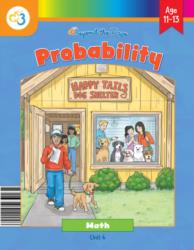
Unit 4: Probability
Lesson 2
Observing Probability
Students compute experimental probability from counts and rewrite that probability as a fraction, decimal, and percent (e.g., 59/100 → 0.59 → 59%). Students then use the decimal form in an expression to predict counts by calculating Prediction = Experimental Probability × 600 (example: 0.59 × 600 = 354). The activity explicitly guides students to convert between representations and apply a multiplicative expression to relate probability to expected frequency.
Lesson 3
Probability Models
Students simplify fractions and rewrite numeric probabilities in equivalent forms (e.g., 3/6 = 1/2, 2/6 = 1/3) and convert between fraction, decimal, and percent representations (e.g., 1/2 → 0.5 → 50%). Students use the probability formula Probability = number in group / total and rewrite that numeric expression to compute expected counts (e.g., 1/6 × 120 = 20; 75 × 1/2 = 37.5). The lesson has multiple examples where students express the same quantity in different numeric forms to make predictions or interpret results.
Final Project
Happy Tails Dog Shelter
Students compute probabilities by writing each size/color count over 60 and converting that fraction to a percentage using the formula (number/60)×100 (examples shown for 3/60→5% and 9/60→15%). Students place events on a probability line labeled 0, 0.5, and 1, which requires them to interpret and use probabilities as fractions, decimals (0.5), and percents (50%). Students run simulations and compare observed frequencies to the model probabilities, reinforcing translation between counts, fractions, decimals, and percents.
Unit 5: Functions
Lesson 1
What Is a Function?
Students translate verbal rules into algebraic equations (Activity 2 Section 1 asks them to write equations from phrases like "The sum of twice a number and three" and examples show y = 2x + 6 and y = (x+3)/2). Students apply those equations to produce input/output tables and generate outputs for given inputs (multiple input/output machine exercises). Students then use those same equations to plot points and connect them on graphs (Activities 3 and 4), showing they move between verbal descriptions, symbolic expressions, tables, and graphs.
Lesson 5
Slope
Students are given explicit instruction and practice rewriting equations into slope-intercept form (Activity 6), e.g., 4x + 2y = -8 is rearranged to y = -2x - 4 and y + 2 = -2(x - 3) is expanded and solved for y = -2x + 4. The Student Activity Page asks students to rewrite given equations into y = mx + b and identify the slope (m) and y-intercept (b). Multiple examples and guided steps show distributing, moving terms, and dividing to isolate y so students can read off how the coefficient of x relates to the rate of change.
Lesson 6
Slope-Intercept Form
Students rewrite linear equations from standard form to slope-intercept form by isolating y (for example, 2x + 3y = 6 becomes y = -2/3 x + 2). Students convert graphs, tables, and pairs of points into the form y = mx + b and identify m and b directly (e.g., finding slope from two points and substituting to solve for b). The lesson explicitly states that slope-intercept form makes the slope and y-intercept visible and gives step-by-step practice rewriting different representations into an equivalent algebraic form.
Lesson 7
Creating Functions
Students practice writing linear relationships in the form output = slope × input + starting value from stories, tables, and graphs (e.g., A = 6c + 12 for chores, P = 15h from a table). Students rename variables to match context (y → A or x → c) and substitute values for m and b when building equations. Students also simplify trivial expressions (for example P = 15h + 0 is simplified to P = 15h) and produce direct-proportion functions in activities like the cooking task (F = 0.5s).
Lesson 8
Comparing Functions
Students compare functions presented as graphs, tables, equations, and verbal descriptions and compute and compare rates of change (e.g., converting Alex's "1.5 miles every 30 minutes" to 0.05 miles/min and finding Bella's slope from the graph). Students identify slope and y-intercept from equations (e.g., y = -3x + 100, identifying slope -3 and starting value 100) and find slopes from tables by choosing two points and dividing Δy by Δx. Multiple activities ask students to determine which situation changes faster or which starts higher using these different representations.
Lesson 9
Unit 5 Test
Students are asked repeatedly to translate verbal situations into algebraic equations (e.g., E = 12h; y = 2x + 17; y = 4x - 3) and to construct linear functions from descriptions (several problems ask for equations from word rules). Students compare and interpret different representations of functions (skills list and many tasks ask students to compare graphs, tables, and equations and determine slope and intercept). The introduction and project description also ask students to transform equations, graphs, tables, and real-world scenarios into game cards, implying practice moving between representations.
Lesson 10
Final Project
Students write equations from real-world descriptions on the Yellow cards (e.g., Emma earns $10 per hour, write an equation and compute earnings). Students create Blue cards that ask them to match equations to graphs or stories and to identify slope and y-intercept from given equations. Students create Green cards requiring them to write an equation for a table of values and to match tables to stories or graphs, practicing translation between representations.
Unit 6: Geometry
Lesson 2
Translations
The lesson introduces the algebraic translation notation Ta,b → P'(x + a, y + b) and has students complete notes that fill in the formula P(x,y) → P'(x + a, y + b). Students practice by applying rules to points (e.g., M(6, -2) with T(-5, 3) to get M'=(1,1)) and by translating entire shapes using the algebraic form (e.g., T(-4,1) applied to triangle vertices). Several activity problems ask students to compute new coordinates from a given T_a,b and to identify the translation rule that maps originals to images, requiring algebraic addition of a and b to x and y coordinates.
Lesson 6
Dilations
The lesson has students use and apply the equation new length = original length × scale factor and multiply coordinates by a scale factor when performing dilations. Students calculate scale factor as new ÷ original (for example, Scale factor = A′B′ ÷ AB) and solve for unknowns using equations such as x = 8 × 2.5. Numerous activities ask students to compute new lengths, multiply coordinates, and determine scale factors in context (performing dilations on the coordinate plane).
Lesson 9
Using the Pythagorean Theorem
Students set up and manipulate the equation a^2 + b^2 = c^2 to solve for unknowns (e.g., plugging values and finding c in Example 1, and isolating a^2 by subtracting 25 from both sides in the Missing Side example). Activity 3 has students substitute side lengths into a^2 + b^2 = c^2 and compare values to determine whether a triangle is right. Day 4 Grid Problems has students form right-triangle leg expressions from coordinate differences and then compute the hypotenuse, showing use of equivalent equation forms to find distances.
Lesson 10
Volume
Students derive the sphere formula by rewriting V_sphere = (2/3) × V_cylinder, substituting V_cylinder = πr²h and h = 2r, and simplifying to V = (4/3)πr³. Students rearrange volume formulas to solve for missing measurements (e.g., 314 = 3.14×25×h → 314 = 78.5h → h = 4). The cone discussion states and uses the relationship that a cone holds one-third of a cylinder with the same base and height and writes the cone volume as V = (1/3)πr²h.
Unit 7: Linear Equations
Lesson 2
Multi-Step Equations
Students rewrite expressions using the distributive property (for example 3(a+4)=21 rewritten to 3a+12=21) and combine like terms (for example 12+15 -> 27 in the Grocery Budget) as shown in multiple worked examples. Students translate word descriptions into algebraic expressions (e.g., 4(y+2)=16, 12+15+3c=45, and 3(x+10)+50=410) and then rewrite those expressions into simpler forms to solve. Multiple student activity pages ask learners to distribute, combine, and isolate terms in real-world contexts (worksheets titled Reviewing the Distributive Property, Real-World Equations, Advanced Real-World Equations).
Lesson 3
How Many Solutions?
Students repeatedly rewrite and simplify algebraic expressions and equations (for example, distributing and combining like terms in 2(3x + 4) + __ = 6x + 8 + 10 and simplifying 14y = y + 9y). They transform equations to equivalent forms that reveal solution types (for example reducing 5y + 2 = 5y + 2 to y = y and 3x + 4 = 3x + 7 to 4 = 7). Activities ask students to fill in missing coefficients or constants so both sides match, requiring them to produce identical expressions to create infinite-solution cases.
Lesson 4
Multi-Step Word Problems
Students set up and solve equations from word problems (e.g., 25 + 15x = 130, 18x + 20 = 146) and perform algebraic manipulations such as subtracting from both sides and dividing to isolate the variable. The materials include problems requiring the distributive property and collecting like terms (e.g., 5(2 - 3x) = 2x - 10; 6(b + 2) - 3b = 15). A comic-strip example shows a student rewriting an equation to reflect a contextual change (10x + 40 → 10x + 40 - 20) when a sibling contributes money. Several tasks require setting two expressions equal to compare situations (e.g., phone plans: 25 + 7x = 10 + 8x).
Lesson 5
Intersection and Graphing
Students are repeatedly asked to rewrite equations into slope-intercept form (y = mx + b) and then compare slopes and intercepts to decide whether a system has one, none, or infinite solutions (Activity 6 and multiple Student Activity Pages). The lesson shows the specific algebraic simplification 4x - 2y = 8 and 2x - y = 4 being converted to y = 2x - 4 to demonstrate that two equations simplify to the same equation (infinite solutions). Several activities require students to convert given systems into slope-intercept form and use those rewritten forms to determine solution types without graphing.
Lesson 6
Substitution and Elimination
Students are directed to rewrite equations into slope-intercept or standard form ("rewrite both equations in slope-intercept form", "put the equations in the same form and align") and then use those rewritten forms to solve. In substitution activities students isolate a variable (e.g., y = x + 1), substitute that expression into a second equation, and simplify (2x + (x+1) -> 3x+1) which shows how rewriting clarifies the relationship between quantities. In elimination activities students multiply an equation to create matching/opposite coefficients and then add or subtract, demonstrating that creating equivalent forms makes relationships between terms visible and solvable. The Choosing a Method checklist asks students to decide whether to rewrite or multiply equations based on which form makes the work easier, reinforcing that different algebraic forms shed light on problem-solving options.
Lesson 7
The Point of It All
Students repeatedly rewrite pairs of points into equations in slope–intercept form (y = mx + b) when they find the equation of a line from two points (Do These Lines Intersect? and Intersection Challenge). Students set expressions equal (for substitution) — e.g., 2x = -2x + 8 — and combine like terms to simplify to 4x = 8, and they rearrange equations for elimination (e.g., y + x = 6 and y - 2x = 0) to cancel a variable. Students are asked to pick the "best method" (substitution or elimination) based on how the equations are written, showing use of different forms to make the problem easier to solve.
Lesson 8
Linear Algebra In the Wild
Students translate real-world situations into algebraic equations (for example, writing Total Cost = Rate × Quantity + Fixed Amount and mapping it to y = mx + b). Students write systems from word problems (e.g., E + L = 75 and E = L + 15) and perform algebraic rewrites such as substituting J + 5 + J = 65 and combining like terms to get 2J + 5 = 65. Students also create equivalent equations by multiplying and adding equations during elimination (for example, multiplying 3x + 2y = 19.70 by −2 to produce −6x − 4y = −39.40).
Lesson 9
Unit 7 Test
Students are asked to apply the distributive property and combine like terms to simplify equations before solving (for example, problems such as 4(2x-3)=20, 5x-2x+6=12, and 2x+3x→5x). Students translate real-world situations into algebraic expressions and equations (for example, 12h+50=122 for wages with a bonus, ticket-price systems, and lemonade sales problems) so they represent relationships between quantities. The answer keys show step-by-step rewriting and simplification (expanding, combining like terms) used to reach solutions.
Final Project
Getting Ready for College
Students are asked to simplify and compare algebraic expressions in the Phone Plans activity where Plan B is written as y = (10x + 40)/2 and students simplify it to y = 5x + 20, revealing it is the same as Plan A. In Transportation and Streaming activities, students rewrite quantities (annual fixed costs divided by 12; 20 = 5 + 1.5h rewritten to isolate h) and set expressions equal to find break-even points. In Housing and Meal Plan tasks, students write cost expressions in different equivalent forms (e.g., C = 1500 + 1050m and C = 1200m; C = 100 + 50w and C = 80w) and interpret those forms to compare options.
Unit 8: Data
Lesson 6
Unit 8 Test
Students are asked to write and choose linear equations that model scatterplots (e.g., questions offering choices like y = 2x + 4 vs. y = 4x + 0, prompts to write equations such as y = 4x + 2, and other items with equations like y = 2x + 60 or y = -8x + 40). The parent notes and tasks ask students to use the equation of a linear model to solve problems and to interpret slope and intercept in context. Multiple activities require students to identify linear relationships and then express those relationships with an equation.
Unit 9: Semester Exams
Lesson 2
Proportions Review
Students solve numerous percent problems (tax, tip, markups, markdowns, simple interest, percent error) in Activity 4 that require expressing totals in terms of rates and bases. Activities 2 and 3 ask students to write and use proportional equations (for example, y = kx and t = pn) and to identify constants of proportionality from tables and graphs. Several student pages prompt students to write equations from situations (e.g., graphing y = 6x, matching tables to y = 3x or y = x + 3), which connects verbal/contextual situations to algebraic forms.
Lesson 3
Expressions Review
The Parent Plan Skills section explicitly states the target skill and even gives the example a + 0.05a = 1.05a. Activity 1 asks students to simplify expressions, use the distributive property, factor, and write equations for sales tax, discounts, and fees, and the answer key includes contextual rewrites (e.g., C = 9t + 6) with an explanation of the parts. Student prompts ask students to write equations from word problems (gym classes, movie tickets, delivery service) and to explain how rewriting an equation shows the relationship between parts of a total cost.
Lesson 5
Semester Exam
Students are asked to rewrite and simplify algebraic expressions (e.g., "Rewrite and simplify: 4x + 9 + 6x + 1"), to distribute and simplify (3(y + 5) - y), and to factor expressions (24m + 12), which gives practice changing expression form. Students also solve contextual percent and rate problems (sales tax, tip, 25% markup, unit rates, y = 4x, write equation for k = 3/2) where algebraic equations are used to represent relationships in real situations.
Lesson 6
Functions Review
Students rewrite verbal situations as algebraic expressions (e.g., "The sum of a number and three times the number is 28" is written as x + 3x = 28 and then combined to 4x = 28). Students convert verbal rules into function form (e.g., "Multiply by 2, then subtract 1" to y = 2x - 1) and write context equations such as y = 12x + 10 for a fixed fee plus rate. Students interpret those rewritten forms to identify and explain quantities (e.g., identifying y-intercepts as starting fees and slopes as per-unit rates).
Lesson 8
Linear Equations Review
Students practice combining like terms and using the distributive property in Activity 1 when solving multi-step linear equations, which requires rewriting expressions into simpler equivalent forms. In Activity 4 students translate word problems into algebraic equations (for example, 25 + 15m = 100 and 6 + 2m = 34), connecting contextual situations to symbolic expressions. The Parent Plan explicitly states students will "successively transform" equations into simpler equivalent forms (x = a, a = a, or a = b), indicating practice with rewriting equations to reveal solution types.
Lesson 10
Semester Exam
Students write functions from contexts (Problem 8 asks for a function for earnings: y = 10x). Students translate verbal rules into algebraic equations (Problem 10: "The difference between twice a number and 4 is 7" leads to 2x - 4 = 7). Students set up and solve contextual linear equations (Problem 35: a tutor charging $18/hour plus $30 leads to 18h + 30 = 138 and solving for h).