


Sixth Grade - MATH
5: Math

Unit 1: Operations
Lesson 4
Exponents and Order of Operations
Students are given equations with blanks and a specified set of candidate numbers to use (Day 2, Activity 3 Problems 8–10), where they must choose and place numbers (for example, use the numbers 2, 4, and 5 to make 8 + __ × (3 + 4) − __ − 2 × __ = 25). Several problems ask students to fill in missing numbers from a limited set (e.g., use 2, 3, and 5; use 3, 8, and 9) so that the equation becomes true. The answer key shows placements and verifies which choices make the equations true, indicating students practice substitution to test candidate values.
Unit 2: Integers and Rational Numbers
Lesson 8
Unit 2 Test
Students practice comparing numeric expressions and inequalities by filling in >, <, or = (for example, problems that ask students to verify statements like -2 < | -7 | and |12| = | -12 |). Students evaluate absolute values and compare positive and negative numbers on number lines and in word problems (temperature and distance problems require interpreting and comparing signed numbers). The parent/skills list and some activities explicitly mention understanding and solving problems involving inequalities and absolute value.
Unit 3: Ratios and Percentages
Lesson 6
Percentage Problems
Students translate percentage word sentences into number sentences and set up equations in the form part = percent × whole (e.g., 75 = 15/100 × n). The activity pages and answer key require students to solve for an unknown variable n in many problems (for example, solving 75 = 0.15n to find n = 500 and 32 = 0.64x to find x = 50). The lesson briefly introduces a variable as a way to show an unknown and uses equation-solving procedures to find that unknown.
Lesson 8
Unit 3 Test
Students translate word problems into number sentences and solve for unknowns using equations (e.g., n = 28% × 200; 17 = 85% × n; 37 = n% × 50). Students set up and solve simple algebraic equalities in percentage problems and in ratio problems where they solve for a missing value (e.g., using multiplication to find Marco and Stanley's cars, and using tables to complete missing entries). Several answer keys show the algebraic form of the equation and the computed solution, indicating students practice solving for unknowns.
Final Project
What's the Best Buy?
Students set up and solve ratio equations when they compute unit price by dividing total price by number of units (e.g., $3.38 ÷ 13 = $0.26/ounce). The answer key example for the 10% coupon shows students writing and solving an equation n = 10/100 × $200 (and the proportion 10/100 = n/200) to find the savings. Students use equivalent-ratio computations and dimensional analysis to convert units (e.g., gallons → fluid ounces) which involves manipulating equalities to find unknown quantities.
Unit 4: Algebraic Expressions
Lesson 1
Introduction to Algebra
Students are asked to write math sentences and choose which value from a set makes the equation true (e.g., Activity 2 STANDARD 5: "Write the math sentence 20 + n = 35. Which value of n makes the math sentence true? 10, 15, or 20"). Students solve simple equations for a variable (e.g., Jackson: a + 3 = 8, find a = 5) and the answer key shows the substitution/checking process. Students also evaluate expressions for given variable values (e.g., 20n with n = 2 or n = 10) which uses substitution to determine numerical results.
Lesson 3
Working With Expressions
Students repeatedly substitute given numerical values for variables and evaluate expressions (Activity 3 examples: evaluate 5 + 4y when y = 6; evaluate (n − 3)^2 + 4 for n = 4, 7, 12). The student activity pages ask learners to evaluate expressions for specified values (n + 7 when n = 13; 5x when x = 6; multi-variable substitution x + y + z). Explanations show the process of replacing a variable with a number and computing the resulting value, and the parent notes emphasize practicing evaluation by substitution.
Lesson 6
The Distributive Property
Students are asked to substitute given numerical values into expressions and evaluate them (for example, evaluating 5(x+3)+2x-12 and 7x+3 with x=5 to show both equal 38). The Student Activity Pages require students to replace variables with specified values (e.g., x=2, a=1, y=3, m=5) and decide whether pairs of expressions are equivalent by comparing evaluated results. The lesson explicitly describes the substitution/evaluation process and provides step-by-step examples of substituting a number for a variable and computing the numerical result.
Lesson 7
Unit 4 Test
Students practice substitution by evaluating expressions for given variable values in multiple items (e.g., "evaluate each expression if x = 5", "evaluate each expression if x = 2", and "evaluate each expression if n = 5"). Students use substitution to test equivalence of expressions by evaluating both forms with a specific value (e.g., Problem 14b asks students to prove equivalency by evaluating both expressions with x = 10; other items ask students to evaluate two expressions at the same value and determine if they are equivalent). Several practice problems explicitly direct students to compute numerical results after substituting a specified number, showing explicit use of substitution to check numeric truth.
Final Project
Algebra Think-Tac-Toe
The Prove It! Equivalencies activity asks students to simplify expressions and then "evaluate both expressions by substituting a numerical value for the variable," with an explicit example evaluating at n = 2. The Make a Quiz task includes writing equation-style problems (example: 4m + 6 = 2m + 8) and creating answer keys, which requires manipulating and checking expressions. Several project descriptions (e.g., Design a Book Cover, Exponent Matching, PEMDAS Flyer) require students to evaluate expressions and show correct numerical results.
Unit 5: Algebraic Equations
Lesson 1
Algebraic Equations
The Parent Plan lists the skill explicitly: "Understand solving an equation as a process of answering a question: which values from a specified set, if any, make the equation or inequality true? Use substitution to determine whether a given number in a specified set makes an equation true." Activity examples show substitution in action (evaluate 2x + 12 = 18 for x = 2 and x = 3; evaluate 36 - 4n = 12 for n = 8 and n = 6). Student activity pages require students to substitute or select from given answer choices (specified sets) to determine which value makes each equation true (multiple-choice and circle-the-answer tasks).
Lesson 2
Solving One-Step Equations, Part 1
Students are repeatedly asked to substitute a proposed solution back into the original equation to verify it (for example, n + 2 = 5 checked with 3 + 2 = 5 and 2x + 4 = x + 6 checked with x = 2 producing 8 = 8). Activity pages and answer keys include explicit "check your work" prompts that require students to plug their value into the equation (e.g., boxes showing 8 + □ = 13 or 72 = 24 + □). Tape diagram and hanger diagram examples explicitly instruct students to "substitute this value back" into the diagram or equation to confirm the solution is true.
Lesson 3
Solving One-Step Equations, Part 2
The lesson repeatedly has students substitute candidate solutions back into original equations to verify correctness (e.g., Evaluate 2n = 8 if n = 4; Evaluate n/2 = 5 if n = 10; many "Check your work" items). Students practice solving one-step equations using inverse operations and visual models (tape and hanger diagrams) and then check their answers by substitution on activity pages and examples. Activity prompts explicitly ask students to find a variable and then "Check your work" by substituting the value into the equation.
Lesson 4
Solving Two-Step Equations
The lesson repeatedly models and asks students to check solutions by substitution (e.g., substituting n = 3 into 2n + 5 = 11 and verifying 11 = 11). Several worked examples and 'Check' steps show students substituting their found value back into the original equation (decimals: 8n + 0.6 = 3 with n = 0.3; distributive example: 3(n - 4) = 15 with n = 9; fractions: 2n + 1/4 = 3/8 with n = 1/16). Parent/Student directions explicitly tell students to check their solutions by substituting into the original equation.
Lesson 5
Inequalities
Students practice substitution directly when the lesson evaluates the inequality 2x + 6 > 10 by substituting x = 4, 3, 2, and 1 and marking which substitutions make the statement true or false. Students are asked to choose or circle values from given option sets on worksheets (e.g., p + 1 ≥ 5, 20 > y, 2n ≥ 8) to determine which specific numbers make each inequality true. The Parent Plan and review sections explicitly state that students will 'Use substitution to determine whether a given number in a specified set makes an inequality true' and include guess-and-check activities and number-line graphing to identify solution sets.
Lesson 6
Solving Inequalities
The lesson explicitly tells students to "check your answer by choosing a value from the solution set and substituting it into the original inequality" and includes activity directions that require selecting a value from the solution set and substituting it to show the inequality is true. The lesson explains that a resulting statement like x > 3 "shows the set of values that make the inequality true" and has multiple word-problem activities where students write an inequality, solve it, and list a reasonable solution set (e.g., Heather's shirts, Farmer Joe's chickens). The student pages and parent notes repeatedly ask students to graph solutions and choose values from the solution set to verify correctness.
Lesson 7
Independent and Dependent Variables
Students practice substitution to check values in equations: the Kevin example shows substituting x = 20 into 10x = y to find y = 200, and other examples show solving for x when y is given (10x = 240 -> x = 24). Activity pages ask students to choose which ordered pair makes equations true (e.g., "Which solution makes the equation true? x + y = 16" and similar multiple-choice items). Students also use input/output tables to substitute input values for x and compute outputs for y (e.g., tables for 2x - 4 = y and 2x + 4 = y).
Lesson 8
Unit 5 Test
The lesson's Skills list explicitly includes: "Understand how to solve an inequality by determining which values from a specified set, if any, make the inequality true" and "Understand that a variable can represent any number in a specified set." Student activities ask students to solve inequalities, graph solution sets, and produce "Reasonable solution set" selections for word problems (e.g., Bryan's windows and Leah's photographs). Activities also require students to name a point that is and is not a solution to equations (e.g., x - y = 8 and other linear equation tasks), which asks students to decide whether particular values satisfy a given equation.
Final Project
All About Me
The Parent Plan Skills list explicitly states students should "understand how to solve an inequality by determining which values from a specified set, if any, make the inequality true" and to "use substitution to determine whether a given number in a specified set makes an equation or inequality true." Step 3 directs students to check each solution for accuracy by plugging the answer into its original equation or inequality, providing explicit substitution practice. The Project Checklist requires answers to be whole numbers and asks students to graph inequalities on number lines, so students work with a specified set (whole numbers) and represent solution sets. The activities require creating and solving equations/inequalities (including px + q > r forms) and making an answer key, which has students verify candidate values against the original expressions.
Unit 6: 2D Geometry
Lesson 2
Working With Angles
Students set up and solve algebraic equations that represent angle relationships (e.g., 126 + n = 180; n + 2n = 90; 5n = n + 92). Students use inverse operations to isolate a variable and then substitute the found value into expressions to compute angle measures (for example, solving 5n = n + 92 to get n = 23 and then computing 5(23) and 23 + 92). The lesson explicitly shows students checking solutions by substitution (e.g., verifying 126 + 54 = 180 and confirming both vertical-angle expressions evaluate to 115°).
Lesson 3
Triangles
Students are asked to circle which candidate side lengths from a given list satisfy the triangle inequality (e.g., "Circle the lengths that the other short side could be" and the activity that asks which of the listed lengths could n be). Students evaluate engineering plans by checking whether two shorter sides sum to more than the longest side to decide if a triangle can be formed. A quiz item has students set up and solve a simple equation for a supplementary angle (104 + n = 180, n = 76°).
Lesson 4
Area
Students set up and solve simple linear equations to find unknown dimensions or counts (e.g., Omar: 15 × n = 75, solve n = 5; James: 24n = 4320, solve n = 180). The materials prompt students to "write and solve an algebra equation to find the missing side" in triangle/area problems and show algebraic steps (multiply/divide both sides). Students also substitute numeric measurements into area formulas repeatedly (for rectangles, parallelograms, triangles) to compute values.
Lesson 5
Circles
Students are shown algebraic manipulation when the lesson derives C = πd from π = C/d using inverse operations and the symmetric property. Students repeatedly substitute numeric values into formulas to compute circumference and area (examples: C = 3.14 × 6, A = π × 9^2, classroom problems with given radii and diameters). The student activity pages and answer keys require students to plug given measurements into formulas and compute numerical results for many practice problems.
Lesson 7
Unit 6 Test
Students are asked to write and solve equations for angle measures in multiple problems (e.g., problems with expressions like n, 2n, and 3n + 12 where directions say to "write and solve an equation"). The answer key shows students substituting the found value of n back into expressions (e.g., "substitute 35° for n in 3n and in 2n + 35 to get 105°"). Some tasks require choosing a correct numeric option from a short list (e.g., selecting which number could represent a triangle side length), which requires checking candidate values against an inequality (triangle inequality).
Unit 7: 3D Geometry
Lesson 1
Three-Dimensional Solids
Students substitute numerical values into Euler's formula to verify it (for example, substituting F=6, V=8, E=12 to show 6 + 8 - 12 = 2). Students write an equation with a letter for an unknown (F + 5 - 8 = 2), perform algebraic manipulation (combine like terms, add inverses) and solve for the variable (F = 5). Several problem answers show substitution of given numbers into F + V - E = 2 (for example, F + 8 - 12 = 2 leading to F = 6).
Lesson 2
Surface Area
The Basic Skills Review asks students to evaluate an expression when n = 3 (n^2 − (−5)), which requires substituting a specific value into an expression. The Basic Skills Review also includes solving the equation 4x + 12 = 24, which has students find the value of x that makes the equation true. The Getting Started section and several activity pages explicitly note evaluating expressions at specific variable values (including exponential expressions).
Lesson 3
Volume
Students repeatedly substitute numerical measurements (including fractions and mixed numbers) into the volume formula V = l × w × h to compute volumes (e.g., V = 3 1/2 × 2 × 2 and V = 1 1/2 × 3/4 × 4). Activity instructions and answer keys show students converting mixed numbers to improper fractions and then multiplying them in the formula. Student activity pages ask students to 'plug in the values' for length, width, and height and carry out the arithmetic to find volume.
Lesson 5
Problem Solving With Solids
Students represent unknown dimensions with a variable and form algebraic equations (e.g., 54 = L × 4 1/2 × 2) and follow step-by-step algebraic procedures to isolate the variable and solve (54 = 9L → L = 6). Students also use formulas with variables (SA = 6s^2; 864 = 6s^2 → s = 12) and write-and-solve equations in contextual problems (e.g., 5n + 10 = 130 for Lucas's mowing fee). Multiple activity pages ask students to set up and solve for missing dimensions using substitution of known measures into geometric formulas.
Lesson 6
Unit 7 Test
Students substitute numeric values into formulas to compute quantities (e.g., V = l × w × h and SA = 6s^2 problems asking for volume and surface area). Students also apply Euler's Formula F + V − E = 2 by substituting given F and E values and solving algebraically for V (the answer key shows the step-by-step substitution and solving).
Final Project
Building With Solids
Students are given explicit formulas for area and volume (e.g., A = l × w, V = l × w × h, s^3) and instructed to measure dimensions and compute surface area and volume for selected nets. The Day 2 instructions and the Volume/Surface Area activity pages direct students to write measurements and use those numbers in the provided formulas. The answer key shows numeric substitution into formulas (for example, rectangular prism volume: 7 × 4 × 2 = 56).
Unit 8: Statistics
Lesson 2
Populations and Samples
Students practice substitution when they evaluate 4n + 12 for n = 5 on the Basic Skills Review. Students solve an equation by isolating the variable in the problem where Rico's score gives the equation n + 26 = 102 and they solve for n. Students solve and graph an inequality in the problem n + 3 < 5, showing they find solution sets for inequalities.
Lesson 8
Making Inferences
The Basic Skills Review includes problems that require evaluating an expression with a given value (Evaluate 6p + 12 if p = 4) and solving an equation (4n - 3 = 17 → n = 5). The review also contains an inequality problem where students set up and solve 4 + n ≤ 9 and identify possible values for n (n ≤ 5, listed as 1 to 5). These items show students practice substitution to evaluate an expression and perform algebraic steps to find values that satisfy an equation or inequality.
Unit 9: Skills Review
Lesson 3
Expressions, Equations, and Percentages
Students evaluate expressions at specific variable values (Activity 1, Problem 3 asks them to compute 32 - 3x when x = 6 and 4(y - 3) + 3 when y = 3). Students solve several equations for unknowns (e.g., 9n = 63, x - 1.3 = 5.8, m/4 = 5) and use inverse operations to find the solution values. Students solve an inequality (n + 2 > 5), write its solution (n > 3), and graph the solution on a number line; they also write and solve an inequality for a contextual problem (4 + n ≤ 10) and list reasonable numeric solutions.
Lesson 4
Geometry
Students are asked to write and solve an equation for vertical angles in Problem 2 (3n = 2n + 16) and to use the solution to find the measure of the angles. The answer key shows students substitute n = 16 back into the expressions (3(16) and 2(16)+16) to verify both equal 48. This requires students to form an equation from a context, solve for the unknown, and perform substitution to check the result.
3: Math
Unit 1: Numbers
Lesson 2
Fractions and Decimals
Students set a repeating decimal equal to a variable (x) and perform algebraic steps (multiply by 10 or 100, subtract, and solve for x) to find the fractional equivalent (e.g., x = 0.̄3 leads to 10x - x = 3.3 - 0.3, 9x = 3, x = 1/3). Multiple examples and practice problems require students to carry out these equation-solving steps and show their work. The activities ask students to convert repeating decimals into fractions using this algebraic method.
Lesson 5
Irrational Numbers
Students repeatedly substitute candidate decimal values into squared expressions to check inequalities (e.g., Activity 6: test 5.4^2 = 29.16 < 30 so √30 > 5.4, and 5.5^2 = 30.25 > 30 <o √30 < 5.5). In Activity 3 and other tasks students square numbers to compare and order values (e.g., square each number in the se< to d<cide 5 < √30 < 6). Students place square roots on number lines and use inequali<ies (<or example, 4 < √20 < 5) based on those substitution checks.
Final Project
Mars Station Test Mission
Students substitute numeric radii into the formula A = πr^2 to compute drop zone area and cost (Task 1). Students plug sunlight hours, wind speeds, and counts of solar panels and wind turbines into given formulas to calculate daily and annual energy production (Task 2). Students compute heater energy from temperature differences and compare produced energy to required energy to determine energy shortfalls and whether backup fuel is needed (Tasks 1 and 3).
Unit 2: Proportions
Lesson 3
Constant Rate
Students practice rewriting equations into y = kx (Activity 5) and isolate y by dividing both sides (examples: 4y = 8x → y = 2x; y = 6x/12 → y = (1/2)x). Students substitute numeric x-values to compute y in multiple activities and examples (Activity 6 example substitutes x = 4 into y = 60x; real‑world problems ask students to compute y for specified x such as minutes or hours). Several student pages require using k = y/x and then plugging in a given x to find y (tables, graphs, and word problems).
Lesson 4
Graphing Proportions
Students repeatedly substitute chosen x-values into equations of the form y = kx to build tables and graphs (e.g., Day 2 Activity 3 with y = 4x and other examples like y = 5x, y = 8x). Directions explicitly tell students to "choose some values for x and use the equation to find y" and to plot the resulting ordered pairs. Several activities also have students compute y/x (rate of change) for given points to check if the equation holds for those pairs.
Lesson 5
Proportional Relationship Equations
Students substitute numerical values into equations and solve for unknowns in multiple places (e.g., 156 = 10m with t = 156 and c = 10, and 100 = 20h for the fence problem), showing step-by-step division to find the variable. Students compute predicted outputs by substituting inputs into proportional equations (e.g., t = 12n and t = 15n) to fill tables and compare predicted versus actual costs (movie tickets and pizza scenarios). The Review Quiz asks students to find y when x = 8 in y = 2.5x and to compute unit rates from equations (e.g., d = 4.5t), which requires direct substitution and evaluation.
Lesson 6
Taxes, Tips, and Commissions
Students set up and solve simple equations that represent tax and commission situations (for example, 0.012 × V = $2,400 to find property value, 0.20 × I = $9,000 to find income, and 1.08 × x = $212 to find pre-tax price). Activity pages ask students to 'let p = price before tax' or 'let i = income' and then divide to solve for the unknown, and answer keys show the algebraic steps used. Several 'work backward' problems require writing an equation from a real-world context and solving it for the variable.
Lesson 7
Markups and Discounts
Students set up and solve equations to find unknown prices in work-backward problems (e.g., x * 1.20 = 72 → x = 72 ÷ 1.20 = 60; x × (1 − 0.40) = 18 → x = 30). Answer keys and activity pages direct students to 'Let x be the original price' and perform algebraic steps to isolate x. Multiple review problems require students to write and solve simple one-step equations to determine original price or cost from a final price.
Lesson 8
Simple Interest and Percent Error
Students repeatedly use the equation I = Prt to compute interest by substituting given values (e.g., I = 600 × 0.04 × 5 = $120) and to compute balances (Principal + Interest). The activity pages include worked examples that solve for unknowns by rearranging the equation (e.g., 250 = 2500 × r × 2 → r = 250/5000 = 0.05; 108 = 600 × 0.06 × t → t = 3). Directions explicitly tell students to use the formula and show work, providing multiple problems where students plug numbers into the formula or solve for P, r, or t.
Lesson 9
Unit 2 Test
Students set up and solve linear equations in context, shown by problems and answer key that solve 1.06p = 212 (finding price before tax) and 0.012p = 1,728 (finding property value). Students write and use proportional equations such as y = (3/5)x and y = (2/7)x and find constants of proportionality from tables. Students determine whether tables or graphs represent proportional relationships (e.g., circling "Yes"/"No" for tables and checking whether a graph is a straight line through the origin).
Final Project
Lemonade Stand
Students write equations in the form y = kx for the lemonade recipe (y = 2x for lemon juice, y = 1.5x for sugar) and use those equations to complete tables and graphs. Students set up and solve proportions in Part 3 to find the number of lemons and pounds of sugar needed for a gallon, and they substitute numeric values into cost formulas (e.g., (Number of lemons × Unit price) + (Amount of sugar × Price per pound) = Total Cost). The activity pages also ask students to compute selling prices using formulas (selling price = unit price × 2, ×2.5, ×3), which requires plugging in the calculated unit price and computing results.
Unit 3: Expressions
Lesson 2
Rewriting Expressions
Students substitute numeric values into expressions to compute and check results (e.g., Total Price = 40 × (1 + 0.05) and multiple one-step sales tax/discount problems where students plug in prices and rates). Students set up and solve equations for unknowns using substitution and algebraic steps (e.g., 31.50 = P(1.05) solved for P; 48.75 = 65(1 − D) solved for D; 58 = 25 + 3r solved for r). Student activity pages and answer keys show practice problems where students write equations from contexts and evaluate expressions with specific numbers.
Lesson 3
Algebraic Expressions
Students set up and solve equations in the forms ax + b = c and a(x + b) = c in multiple activities (e.g., perimeter problems like 54 = 2(l + 6) and the Follow the Rules worksheet with pairs such as 3x + 2 = 11 and 3(x + 2) = 11). Students solve for x step-by-step by combining like terms, subtracting, and dividing, and they practice these procedures across word problems (markers, rides) and the review quiz. Students also compare arithmetic and algebraic solutions, showing they can produce the value of the variable that makes the equation true in context.
Lesson 4
Graphing Proportions
Students are asked to make tables and "plug them into the equation" (Day 2 Activity 3: y = 3x example) and to fill missing y-values for equations such as y = 2x, y = 1/2 x, and y = 4x on the student pages. The "Walk the Graph" activity and several graphing tasks require students to pick x-values and compute corresponding y-values (e.g., tables for Equation 1 and 2, and plotting points from y = 3x). These tasks require students to perform substitution of specific x-values to find y and then check those ordered pairs on a graph.
Lesson 5
More Graphing Proportions
Students repeatedly evaluate equations of the form y = mx for specific x-values to build tables and graphs (e.g., book stacks y = 3x, marbles/jar problems, faucet and car examples). The lesson explicitly states that the unit rate is the y-value when x = 1 and asks students to find y for given x (create tables of values and plot points). Several activity pages require students to compute outputs from inputs (plugging x into y = mx) to compare rates and slopes.
Lesson 6
Intercepts
Students are instructed to find x-intercepts by setting y = 0 and solving for x and to find y-intercepts by setting x = 0 and solving for y (e.g., example 2x + 4y = 8 is solved by substituting y = 0 to get x = 4 and x = 0 to get y = 2). Multiple activity pages require students to substitute 0 for a variable and solve equations such as 3x - 6y = 12, y = 5x + 10, and x + 5y = 10 to compute intercepts. Guided problems ask students to plot the points they find after substitution, reinforcing the act of replacing a variable with a specific number and checking the resulting equation.
Lesson 8
y = mx + b
Students practice substituting numerical values into y = mx + b to solve for an unknown: for example, they plug (x,y) = (2,5) and m = 2 into 5 = 2(2) + b to find b = 1 in Activity 6. Students also pick a point from a table (e.g., (1,3) with m = 2) and substitute x and y into y = mx + b to determine the intercept and write the equation y = 2x + 1. Multiple activity pages ask students to substitute coordinates and slopes to compute missing parameters and write the full linear equation.
Final Project
Planes, Trains, and Automobiles
Students write linear equations for distance and cost (e.g., y = 60x, y = 0.15x + 31.50). Students fill tables by plugging specific time values (0–4 hours) into y = mx to compute distances, which involves substituting given x-values to find y. Students also solve contextual equations for an unknown (e.g., 500 = 60x to find travel time, and 0.15x + 31.50 = 0.20x + 20.75 to find a break-even distance).
Unit 5: Functions
Lesson 1
What Is a Function?
Students repeatedly substitute input numbers into function rules to produce outputs (e.g., Activity 2 examples y = 2x + 6 and y = (x + 3)/2 show step-by-step substitution and resulting outputs). Multiple student pages (Exercises 7–10, Input/Output Machines, Graphing Data, Graphing Functions) require students to fill tables by plugging given x-values into equations and compute corresponding y-values. Activities ask students to compute outputs, complete tables, and plot points based on substitution (e.g., tables in Graph Example 1 and Example 2 where students evaluate y for specified x-values).
Lesson 2
Linear and Nonlinear
Students are given explicit equations (for example y = 2x + 4 and y = x^2) and a specified set of x-values and are instructed to "plug in each x-value to the equation to find the y-value" and fill in tables. Students complete Student Activity Pages that require evaluating expressions for given x-values and recording the resulting y-values. Students use these substitutions to decide whether the relationship is linear or nonlinear by examining the computed outputs and rates of change.
Lesson 4
Intercepts
Students are instructed to find intercepts from equations by substituting 0 for one variable and solving for the other (e.g., 2y + 3x = 4: set x = 0 to find y = 2; set y = 0 to find x = 4/3). Student activity pages repeatedly direct students to "set y = 0 to find the x-intercept" and "set x = 0 to find the y-intercept." Activities and tables explicitly ask students to look for rows where x = 0 or y = 0 to identify intercepts, which requires substituting those values into the relationship.
Lesson 6
Slope-Intercept Form
Students are asked to substitute known numbers into y = mx + b to find missing parameters (Activity 5: Slope Intercept Form from Slope and Point shows students plug x, y, and m into y = mx + b to solve for b). Multiple activities ask students to evaluate equations for given x-values (e.g., tables and quiz items require finding y when x = 4 or filling a table for y = 3x + 1). Activities that convert standard form to slope-intercept form show students isolating y by performing substitution-like algebraic steps.
Lesson 8
Comparing Functions
Students work with linear equations like y = -3x + 100 to identify the starting value by evaluating y when x = 0, and multiple examples ask students to compute y-intercepts from equations. Students compute rate of change by applying the slope formula to two points from graphs or tables (e.g., using (0,0) and (30,2) to get m = 0.067) and use those numeric results to compare functions. In at least one table example (Max) students use known point(s) and slope to find the value at x = 0 (e.g., computing 10 − 2×2 = 6).
Lesson 9
Unit 5 Test
Students complete function tables by substituting x-values into rules (e.g., Problem 17: "Rule: y = 4x − 1; x-values: [0,1,2,3] y-values: [...]"), and they write function expressions from verbal descriptions (e.g., E = 12h, E = 15h) which requires forming and evaluating algebraic expressions. Several tasks ask students to compute outputs or intercepts from equations or tables (e.g., finding x- and y-intercepts for 3x + 2y = 12 and using tables of time/distance to calculate rates), which involves substituting specific values to find corresponding results.
Lesson 10
Final Project
The Blue Cards include a category "Plug in a value and solve" and an example asking "If x = 4, what is y...", requiring students to substitute a given number into an equation. Yellow card examples ask students to write an equation from a story and compute values (e.g., Emma earns $10 per hour; calculate earnings for 5 hours), which requires substituting a specified input. Green cards ask students to "Complete a missing value" in a table, prompting students to use a rule to find a particular input or output.
Unit 6: Geometry
Lesson 9
Using the Pythagorean Theorem
Students are given sets of three side lengths and asked to test whether a² + b² = c² holds (e.g., 6, 8, 10 and 7, 10, 12 examples), showing they substitute the given numbers into the equation and check equality. Activity pages prompt students to "Place a square right-angle marker in each right triangle" and to answer whether each listed triple of side lengths is a right triangle by computing a² + b² and comparing to c². Examples repeatedly show step-by-step substitution (plugging known numbers into a² + b² = c²) and deciding yes/no based on the result.
Lesson 10
Volume
Students repeatedly substitute numeric values into volume formulas to evaluate equations (e.g., V = 3.14×(3 in)^2×4 in and V = 3.14×(4 in)^2×10 in). Students set up and solve algebraic equations for missing measurements (e.g., 314 = 3.14×25×h then divide to find h = 4; 600 = (1/3)×3.14×36×h solved for h; 268.1 = (4/3)×3.14×r^3 solved for r). Activity pages ask students to compute volumes and to work backward from a given volume to find a missing radius or height, demonstrating equation manipulation and substitution.
Unit 7: Linear Equations
Lesson 1
Linear Equations With One Variable
The lesson repeatedly models substitution to check solutions: Example 1 (x+6=14) shows substituting x=8 and verifying 8+6=14, and the two-step example (3x−6=12) similarly substitutes x=6 to confirm 18−6=12. Activity directions and multiple student pages explicitly instruct students to "check your solutions" after solving equations. Fraction and decimal examples also demonstrate substituting the found value back into the original equation to confirm both sides are equal.
Lesson 2
Multi-Step Equations
Students solve many multi-step equations to find the value of the variable (numerous activity pages and worked examples). In the grocery example and the painter example, students substitute the found value back into the original equation to check that the equation is true (e.g., 12+15+3×6=45 and 3(110+10)+50=410). The lesson repeatedly prompts students to "check your answer" by plugging the solution into the original equation.
Lesson 3
How Many Solutions?
Students practice simplifying linear equations to forms x = a, a = a, or a = b (false) in multiple activities and notes, including step-by-step examples that show how to transform and classify equations. Activity directions and examples explicitly tell students to check choices by trying specific numbers (for example: "You can check your answer by trying a number that is not 6 — like 2"), and students complete worksheets where they solve and classify each equation. Several tasks ask students to fill in missing numbers or coefficients so both sides match and then test their answers by simplifying, which involves substituting values to verify outcomes.
Lesson 4
Multi-Step Word Problems
Students are prompted to check solutions by substitution in multiple places (the gym example shows substituting x=7 back into 25+15x=130 and verifying 130=130). The student activity pages include worked examples (Netflix example: 18x+20=146, then substitute x=7) and explicit directions: "Check Your Answer: Plug in your variable to check your math." The review quiz and answer keys require students to solve equations and identify solution types (one solution, no solution, infinite solutions), reinforcing the idea of testing values to see if they make an equation true.
Lesson 5
Intersection and Graphing
Students are shown step-by-step substitution of coordinates into equations (e.g., substituting (1, 3) into y = 2x + 1 and y = -x + 4) to verify that the point makes both equations true. The lesson also shows substitution of (1, -2) into 2x - y = 4 and 4x - 2y = 8 to demonstrate that every point on the same line satisfies both equations. Activity pages and worked examples explicitly instruct students to substitute given x and y values to check whether those values satisfy the equations.
Lesson 6
Substitution and Elimination
Students are taught the substitution procedure step-by-step (isolate a variable, substitute into the other equation, back-substitute, check your answer) and work through multiple examples that substitute expressions and numeric values. In examples students substitute the found numeric values (x = 2, y = 3) back into both equations to verify that the ordered pair makes each equation true. Activity pages ask students to solve systems by substitution and explicitly include steps to check solutions by plugging numbers into equations.
Lesson 7
The Point of It All
Students are asked to use substitution to solve systems: the lesson includes worked examples that set two expressions for y equal (e.g., 2x = -2x + 8) and solve for x, then substitute back to find y. The lesson explicitly shows plugging a specific x-value into both equations to verify a point (for example, plugging x = 1 into both line equations to get y = 4). Activity pages direct students to use substitution for Problems 1–3 in the Intersection Challenge and provide space for showing the substitution steps and writing the ordered-pair solution.
Lesson 8
Linear Algebra In the Wild
Students solve systems by substitution in multiple examples (Dog Walkers: substitute J+5 for S; Candy Shop: substitute x = 4 into 2x+4y=23.40) and they substitute the found values back into original equations to check answers (35 = 30+5; 3(4)+2(3.85)=19.70). Break-even examples set two expressions equal (30x = 20x+50; 5x = 2x+15) and then substitute the solved x into one equation to find y. Student activity pages explicitly prompt students to "Use Substitution / Elimination" and to "write a conclusion" after substituting values to check results.
Lesson 9
Unit 7 Test
Students solve one-step and multi-step linear equations (Problems 1–7, reciprocal problems) and determine the number of solutions for given equations (e.g., 2x+4=2x+4 and 3x+11=3x+5). Several tasks ask students to 'solve using substitution' for systems of equations, giving practice in substituting expressions for variables into other equations. The review also directs students to 'use algebraic strategies to check the accuracy of your solution.'
Final Project
Getting Ready for College
Students write linear cost equations and evaluate them at specific values (e.g., the housing table asks students to compute dormitory and apartment costs for 9, 10, and 12 months). Several activities ask students to set two expressions equal and solve for the variable (housing, transportation, streaming) to find break-even points, and the transportation activity explicitly instructs students to "Use substitution" and to solve the resulting equation. The phone-plans task has students complete a table of values for x = 0,1,2,3,4 and compare outputs, which requires substituting given numbers into each equation to check whether the outputs match.
Unit 8: Data
Lesson 4
Linear Models
Students explicitly substitute a given x-value into a linear equation to compute y (for example, the ice cream example substitutes x = 10 into y = 2x + 50 to find y = 70). Students repeatedly write equations in y = mx + b form from scatterplots and then evaluate those equations to answer context questions (plant growth: y = 3x + 10 with x = 5 → y = 25; car fuel, ice packs, tickets sold examples show substitution to compute numerical answers). Multiple activity pages prompt students to identify variables, find slope and intercept, form the equation, and then use that equation to calculate specific predicted values.
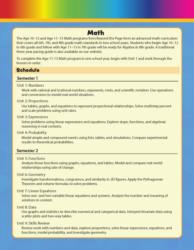
Unit 9: Semester Exams
Lesson 2
Proportions Review
Students write and match proportional equations (Activity 2 asks students to match tables with equations such as y = 10x, y = 3x and includes an "Equation Check" prompt to write equations to solve for y). Activity 3 has students graph the equation y = 6x, label points (0,0) and (1,6), and interpret what those points mean in context. The Parent Plan and activities ask students to represent proportional relationships by equations (e.g., y = kx) and to compute y-values from given x-values in tables and graphs.
Lesson 3
Expressions Review
Students write and use linear equations in context and evaluate them for specific input values (e.g., Babysitting Pay table leading to y = 14x and questions asking for slope and graphing, Plan A and Plan B where students compute which plan costs more after 4 months, Job A/Job B where students compute earnings after 3 hours). Students solve for unknowns in equations in Activity 1 (e.g., finding the width w = 12 cm from a perimeter equation and solving px + q = r type problems). Several tasks require students to compute output values for given inputs, which involves substituting a given number for the variable to find the resulting value.
Lesson 6
Functions Review
Students substitute specific x-values to find outputs in tables and rules (e.g., the "Multiply by 2, then subtract 1" table with x = 0,1,2,3). Students set x = 0 and solve for y to find y-intercepts (e.g., finding y = 4 from y = 3x + 4 and using 2x + 3y = 12 to find the y-intercept). Students write and solve an equation from a verbal problem (x + 3x = 28 → 4x = 28 → x = 7), and they identify an x-value in a table that makes y = 0 when finding the x-intercept (x = 4).
Lesson 7
Geometry Review
Students write and solve an equation in Activity 3 Problem 8 where they model complementary angles with A = 2B and set up 2x + x = 90 to find angle measures. In Activity 4 Problem 2 students are asked to determine whether the triple (8, 15, 17) is a right triangle by substituting the side lengths into a^2 + b^2 = c^2 and checking equality. Activity 4 Problem 6 has students compute the distance between two points by substituting coordinates into the Pythagorean relation, showing use of substitution to evaluate an equation.
Lesson 10
Semester Exam
Students solve for x in several single-variable equations (Problems 23–27) and determine the number of solutions for given equations (Problems 28–31), which requires recognizing when equations have one, none, or infinitely many solutions. Students also use substitution as a solution method in a system of equations (Problem 33). These items require students to find values that make equations true and to reason about solution sets.