


Seventh Grade - MATH
5: Math
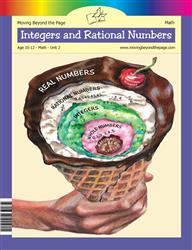
Unit 2: Integers and Rational Numbers
Lesson 8
Unit 2 Test
Students are explicitly told learning goals that include "Solve inequalities that involve positive and negative numbers and absolute value," and the Parent Plan repeats "Understand and solve problems involving inequalities." Student Activity 16 asks students to fill blanks with >, <, or = for expressions including absolute values, and several practice items ask students to compare signed numbers and evaluate absolute value expressions. The teacher notes also refer to Lesson 5 covering inequalities and indicate those comparison skills were included on the review.
Unit 5: Algebraic Equations
Lesson 5
Inequalities
Students translate simple contexts into inequalities (Casper's neighbor: n > 11; José paid more than $5: x > 5; Violet owns more than 8 and less than 12 hats). Students work with an algebraic inequality of the form 2x + 6 > 10, use substitution/guess-and-check to find values that make it true, and list the solution set {3,4,5,...}. Students graph inequalities on number lines (open/closed dot, arrow direction) and are asked to interpret graphs in context.
Lesson 6
Solving Inequalities
Students are asked to write inequalities from word problems such as n + 4 < 10, n - 4 > 2, 2n + 4 < 16, and 5n ≤ 75, which place quantities into px + q<> r / < r form. Students solve those inequalities using inverse operations (for one- and two-step cases), graph the solution sets on number lines (open/closed dots and arrows), and check solutions by substituting values from the solution set. Several problems (e.g., Mateo, Ellie, Missy, Gabriel, Mayor Johnson, Farmer Joe) require students to interpret the solution set in context and select reasonable integer answers.
Lesson 7
Independent and Dependent Variables
The lesson includes one-variable inequality examples and practice: an image contrasts the equation 4x + 3 < 11 with its solution x < 2 on a number line, and Activity 4 provides problems such as p + 7 > 5 and 2a + 4 ≤ 4 for students to solve and graph. Student pages ask learners to solve each inequality and graph the solution on a number line, and the parent/answer key shows worked solutions and number-line graphs for those inequalities.
Lesson 8
Unit 5 Test
Students write and solve word problems that lead to inequalities such as 2n + 20 > 240 (Naomi fundraising) and n - 3 < 6 (Bryan washing windows). Student activity pages require students to write the inequality, solve it, and list a reasonable solution set for the context. Multiple activity pages provide number lines and ask students to graph solution sets; the answer key shows open/closed dot graphs and contextual interpretations for those solutions.
Final Project
All About Me
Students are asked to create 4–6 inequalities from real personal facts and to write and solve those word problems (Project Checklist and Activities). The Parent Plan explicitly lists solving word problems of the form px + q > r or px + q < r, graphing the solution set, and interpreting it in context. The lesson provides example inequalities such as 2n - 6 > 4 and requires that at least one inequality solution be shown on a number line and that students produce an answer key checking solutions by substitution.
Unit 6: 2D Geometry
Lesson 2
Working With Angles
Students are asked to solve and graph the inequality 4y - 7 < 5 on the Basic Skills Review #11 (Problem 10), which requires isolating the variable and drawing the solution on a number line. The activity explicitly instructs students to graph the solution set and the answer key gives the solution y < 3 and describes the graph with an open dot at 3 and an arrow left. The lesson provides worked examples and practice of solving linear equations and similar algebraic manipulations that students apply when solving this inequality.
Lesson 6
Scale Drawings
Students are asked in Basic Skills Review Problem 8 to write and solve an inequality for Mickey: they set up n + 4 ≥ 12, solve for n, and identify the least number of trophies (n ≥ 8, least = 8). The prompt explicitly uses a variable to represent an unknown quantity and asks students to construct and solve the inequality from a word problem context.
Unit 8: Statistics
Lesson 8
Making Inferences
The Basic Skills Review #16 includes a word problem where students let n represent the number of fish Josie bought and write the inequality 4 + n ≤ 9, then solve to get n ≤ 5. The answer key explicitly shows forming and solving that inequality using a variable to represent an unknown quantity. Additional review problems have students solve linear equations, reinforcing solving for a variable.
Unit 9: Skills Review
Lesson 3
Expressions, Equations, and Percentages
Students write and solve the inequality n + 2 > 5 (Activity 2, Problem 7), graph the solution on a number line (open dot at 3 with arrow to the right), and label the solution. Students also write an inequality for a real-world spending situation (4 + n ≤ 10 in Activity 2, Problem 8), solve it (n ≤ 6), and interpret the solutions in context (listing reasonable spending amounts and noting negative amounts are not reasonable). Several problems use variables to represent quantities in word problems (Naomi, Jayne, Marie), requiring students to translate context into algebraic statements.
3: Math
Unit 3: Expressions
Final Project
Planes, Trains, and Automobiles
Students write and use linear equations with variables to model cost and time (e.g., y = 0.15x + 31.50, y = 0.20x + 20.75, y = 0.50x + 63.25) and graph these equations on a cost vs. distance graph. Students are prompted to find the break-even point by setting two cost equations equal (0.15x + 31.50 = 0.20x + 20.75) and interpret the result: "Driving becomes cheaper than the train when the distance is greater than 215 miles." The materials also ask students to compare which option is cheaper for given distances (e.g., 500 miles) using the equations and graphs.
Unit 7: Linear Equations
Lesson 8
Linear Algebra In the Wild
Students write linear models of costs (y = mx + b) and solve for break-even points by solving equalities in multiple examples (Cleaning Crew, Streaming Showdown, apples vs. bag). Students then interpret the numerical break-even solutions by stating which option is better for values less than or greater than that point (e.g., "If you watch fewer than 5 movies, choose StreamMore; if you watch more than 5 movies, choose CinemaNow"). Several activity pages prompt students to decide which option is cheaper depending on the number of items or hours.
Final Project
Getting Ready for College
Students write linear cost equations (e.g., Dorm: C = 1200m; Apartment: C = 1500 + 1050m) and set them equal to find break-even points (m = 10). Students repeat this process in multiple contexts (transportation: C = 225 + 0.60x vs C = 1.25x, find x ≈ 346.15; streaming: 20 = 5 + 1.5h, h = 10; meal plans: derive y-intercepts and slopes from a graph and solve 80w = 100 + 50w). Students graph both lines for each comparison, mark intersections, and interpret which option is cheaper before or after the break-even point for given values (e.g., compare costs at 9 and 12 months).