


Seventh Grade - MATH
5: Math
Unit 3: Ratios and Percentages
Lesson 1
Introduction to Ratios
Students represent ratios in three forms (words, colon, fraction) and write equivalent ratios by multiplying or dividing both quantities, as shown in the Equivalent Ratios activities and examples (e.g., 4/1 -> 8/2, 9:6 -> 3:2). Students solve real-world scaling problems that use multiplication or division of quantities (bread recipe scaling, floor cleaner mixing, and piano/soccer hours problems). Students complete tables and image-based tasks that require converting and scaling ratio quantities.
Lesson 2
Describing Ratios in Words and Pictures
Students solve a scaling problem: given a boys-to-girls ratio of 2:5 and 6 boys, students compute there are 15 girls, using division and multiplication to scale the ratio. Students find an equivalent reduced ratio by dividing 12:21 to 4:7, practicing division of integers to produce an equivalent ratio. Students write ratios as fractions and part-to-whole values (for example 5/12, 1/2, 9/14) and compute totals when forming part-to-whole ratios (e.g., 5 + 9 = 14).
Lesson 3
Equivalent Ratios
Students solve ratio word problems by using multiplication and division to find parts of a whole (e.g., Jason and Zeke split 144 cards using a 5:7 ratio; boys/girls 2:3 with total 45; goldfish 2:7 with total 54). Students use double number lines and tables to compute unit rates and scale up or down with multiplication/division (e.g., 2 sodas cost $5, find cost of 6; 2 sandwiches every 3 minutes to find time for 12 or 40). The Basic Skills Review asks students to perform decimal subtraction (13.70 − 11.94), mixed-number subtraction, integer addition (8 + 5), and integer division (1,216 ÷ 4), showing practice with multiple operations on rational numbers.
Lesson 4
Unit Rates
Students write ratios as fractions and divide to find unit rates and unit prices (e.g., 216 ÷ 4 = 54 miles/hour; 156 ÷ 12 = 13 calories/chip; $5.25 ÷ 3 = $1.75/quart). Students multiply a found unit rate to solve new quantity problems (e.g., 13 calories × 25 chips = 325 calories; $2.09 × 10 = $20.90). Students compare prices using subtraction to find savings (e.g., $1.75 − $1.45 = $0.30).
Lesson 6
Percentage Problems
Students convert percentages to fractions or decimals and multiply to find a percent of an amount (e.g., 15% of 300 rewritten as 15/100 × 300). Students use division to find the whole given a part and a percent (e.g., 560 = 80/100 × n) and to find what percent a part is of a whole (e.g., 12 = n/100 × 25 rewritten as n = 12/0.25). Students solve real-world word problems (discounts, sales tax, test scores, attendance) and practice modeling with double number lines and equivalent ratios.
Lesson 7
Unit Conversions
Students set up and solve unit conversion problems by multiplying and dividing by conversion factors (examples: 3 quarts ×2 = 6 pints; 7000 meters ÷1000 = 7 kilometers). Students use equivalent-ratio methods and double number line diagrams to convert decimals and mixed rational quantities (examples: 8.5 kg → 8,500 g; 5 oz × 28.35 ≈ 141.75 g). The activity problems ask students to compute conversions across customary and metric systems using multiplication or division of rational numbers.
Lesson 8
Unit 3 Test
Students solve many real-world problems requiring multiplication and division of rational numbers, for example finding unit price ($5.16 ÷ 4), unit rate (19 miles ÷ 2 hours), percent-of calculations (28% of 200 = 56), and unit conversions (16 oz × 7 = 112; 2.54 × 8 = 20.32). Students convert between fractions, decimals, and percents (table completion problems) and use ratio reasoning with tape diagrams, double number lines, tables, and graphs to solve proportional problems (model cars, Farmer Ned, apples and pies).
Final Project
What's the Best Buy?
Students set up and compute unit prices by dividing total price by quantity (e.g., $3.38 ÷ 13 oz = $0.26/oz). Students multiply to convert units (e.g., gallons → quarts → pints → cups → fl oz) and to scale quantities in recipes (doubling/tripling) and to compute total ounces for multi-packs (12 × 8 = 96 fl oz). Students solve percent problems and savings calculations by using ratios and multiplication/division (10% coupon savings, monthly/annual savings) and perform subtraction to find price differences between options. Students also apply multiplication/division in currency conversion and constant-speed rate problems (distance and time conversions).
Unit 4: Algebraic Expressions
Lesson 1
Introduction to Algebra
Students translate word phrases into algebraic expressions that use addition, subtraction, multiplication, and division (e.g., Carlee has 12 board games + n; Jane bikes 20 + n = 35). Students evaluate numerical expressions that include fractions and decimals (e.g., (2/5)^2, (1.5)^3, (2.1)^2 - (0.4)^2) and complete PEMDAS problems combining multiplication, division, addition, and subtraction with rational numbers. Students use real-world contexts (area of a square, batting/practice time, money/packs of pencils, Nina's lunch) to write or evaluate expressions involving rational quantities.
Lesson 3
Working With Expressions
Students translate real-world situations into algebraic expressions in multiple activities (e.g., Milo, Jade, Yuji, and the Student Activity Page problems such as Damien, Kendyll, Martin, Piper, Benjamin, Lindy, Braeden and the Challenge about Tamika). Students evaluate expressions by substituting numeric values (Activity 3 examples: 5 + 4y when y = 6; evaluating (n − 3)^2 + 4 for n = 4,7,12; the chart evaluating expressions for 4, 9, 12). The Basic Skills Review and other problems require students to compute with fractions and decimals (4/5 + 3, 5.5 × 2.7, fraction word problems) and division with non-integer results (p ÷ 2 showing 9 ÷ 2 = 4.5).
Lesson 4
Positive and Negative Numbers
Students practice rewriting subtraction as adding the opposite and using number lines (Activity 2 and 4) to evaluate expressions such as 12 - 4, 3 - 5, and -5 - 6. Students apply rules for combining positive and negative numbers (Activity 3) and solve real-world problems involving sums and differences (Activity 5) like temperatures, bank balances, diving depths, and game scores. Multiple student activity pages require students to write expressions from scenarios and compute answers (e.g., 10 - 7, -275 + 500, 0 - 5).
Lesson 5
Equivalent Expressions
Students perform arithmetic with rational numbers in several places: they simplify numerical expressions such as 8 + 4 + 2 - 5 and are taught to change subtraction to adding the opposite when combining like terms (e.g., 6x - 3 + 2x + 7 -> 6x + 2x + -3 + 7). The Basic Skills Review #8 asks students to solve real-world problems using rational-number operations (divide 23.7 by 15 for box weight, compute push-ups per minute and in a given time, and calculate a 25% discount on $24) and to multiply fractions/mixed numbers (e.g., 18/5 × 12/9 and 3 2/3 × 4 1/5). Students also practice combining positive and negative numbers and applying order of operations in arithmetic expressions that involve multiplication, addition, and subtraction.
Lesson 6
The Distributive Property
Students translate real-world situations into expressions and evaluate them (e.g., Tessa: 2n + 3n → 5n, Cesar: 18y for baskets). Students use multiplication and addition when applying the distributive property (e.g., 5(n+2) = 5n + 10, 5(x+3) + 2x − 12 → 7x + 3). Students simplify and evaluate expressions by substituting numbers (e.g., evaluate 4n − 3 at n = 5; evaluate 3a + 2 + 4 + a at a = 2). The materials show combining like terms and adding/subtracting integers (including using opposites) in multi-step simplifications.
Lesson 7
Unit 4 Test
Students translate real-world situations into algebraic expressions and evaluate them (e.g., Tasha: n + 7, Kelsey: n - 12, Jeremiah: 5x + 3, Zane: 12n + 5, Alana: 12(x + 6)). Students perform and evaluate addition, subtraction, and multiplication with integers and coefficients (e.g., combining like terms, distributive property, evaluating expressions for given variable values). Students work with negative numbers and learn to change subtraction to adding the additive inverse (e.g., problems like 20 - 36, -14 - (-9)) and evaluate decimal/fraction powers in exercises (e.g., (0.2)^3, (2/3)^2).
Final Project
Algebra Think-Tac-Toe
Students create and solve word problems that use positive and negative integers (Make a Quiz) and practice adding and subtracting integers in real‑world contexts (examples and rubric references). Students apply multiplication when using the distributive property (Prove It! Equivalencies, Math Properties Trading Cards) and evaluate exponential expressions including fractional and decimal bases (Exponent Matching). The skills list explicitly asks students to understand subtraction as adding the additive inverse and to use positive and negative numbers to represent real‑world quantities.
Unit 5: Algebraic Equations
Lesson 1
Algebraic Equations
Students compute with fractions, decimals, multiplication, and division in Activity 1 (e.g., 5 1/2 + 3 5/6; 98.6 - 39.75; 7.2 × 0.4; fraction multiplication 3/7 × 4/9; blanks for division like ___/4 = 25). Students solve real-world word problems by translating them into equations that use the four operations (e.g., 32 + p = 48 for stuffed animals, m/6 = 20 for marbles, 3x = 24 for notebooks, 72/3 = y for candies). Students practice substituting values to check solutions (guess-and-check) on multiple activity pages that require performing the arithmetic with rational numbers, and the answer key shows work with negative results where appropriate.
Lesson 2
Solving One-Step Equations, Part 1
Students represent and solve real-world and mathematical problems by writing and solving one-step equations using addition and subtraction (e.g., n + 60 = 100, 48 = 21 + x, 16 + n = 72). Students use tape diagrams and hanger diagrams to model equality and perform inverse operations (subtracting or adding the same value to both sides) to isolate the variable. Multiple student activity pages and word-problem sets require students to form equations from context and check solutions by substitution.
Lesson 3
Solving One-Step Equations, Part 2
Students set up and solve one-step equations that use multiplication and division (examples: 2n = 8, n/2 = 5, 5n = 40) using tape diagrams and hanger diagrams. Students practice solving and checking solutions by substitution on multiple activity pages and answer keys. Students translate real-world situations into equations (Antonia's plant, Emma's plates, canoeing, Alex washing cars) and solve them using multiplication or division.
Lesson 4
Solving Two-Step Equations
Students solve two-step equations that involve integers, decimals, and fractions (Activities: "Two-Step Equations: Integers and Decimals", "Equations with Fractions"), including worked examples that show subtracting/addition and multiplying/dividing with rational numbers (e.g., 8n + 0.6 = 3; n/0.5 - 7 = 8; 2/3 n - 2/5 = 1/10). Students also translate and solve real-world word problems by writing two-step equations (e.g., 5n + 12 = 92, n/2 + 10 = 35, 3n + 4 = 19) and check solutions by substitution. The lesson includes review pages and practice problems for computing with decimals and fractions prior to solving equations.
Lesson 5
Inequalities
Students substitute numbers into expressions such as 2x + 6 > 10 and evaluate using multiplication and addition (e.g., 2(4) + 6 > 10) and use a table of test values to determine which make the inequality true. Students work with real-world contexts that use inequalities (Casper's neighbor age n > 11; José paying more than $5; roller coaster height n ≥ 3) and practice selecting values that satisfy inequalities. The lesson explicitly notes that solution sets include decimals and fractions and has students represent solution sets in set notation and on number lines.
Lesson 6
Solving Inequalities
Students set up and solve inequalities that require addition, subtraction, multiplication and division with rational numbers (for example, n/3 ≤ 1 is solved by multiplying both sides by 3; x<- 2.6 < 2.4 involves adding 2.6 to both sides; 3n<- 4.3 < 10.7 requires adding 4.3 then dividing by 3). Students solve real-world word problems that produce inequalities with rational coefficients and constants (examples: Gabriel's earnings 5n ≤ 75, jelly beans n/3 "<5; 25, shirts n + 5 < 12). Students also graph solution sets and check solutions by substitution, demonstrating use of rational-number arithmetic in context.
Lesson 7
Independent and Dependent Variables
Students set up and solve two-variable word problems that use multiplication and division (e.g., Kevin earns $10/hour: 10x = y; Ron bikes 5 mph: 5x = y; t = d/45). Students solve equations that require addition and subtraction (e.g., y = x - 2, x + y = 8, finding y when x is given) and work with decimals and fractions in solution pairs (examples include x = 4.5 and y = 3.5, 2 3/4 and 5 1/4). The materials include tasks to isolate variables using inverse operations (2x - 4 = y → solve for x or y) and a Basic Skills Review that practices decimal multiplication and fraction problems.
Lesson 8
Unit 5 Test
Students solve one- and two-step equations that require addition, subtraction, multiplication, and division of rational numbers (e.g., x - 2.4 = 7.6; 6m = 42; 2(y + 1/2) = 13; a/7 - 5 = 9). Students solve and graph inequalities that produce solutions with negative and positive rational values (e.g., 4 < n + 6 leading to n > -2; 2n - 5 ≤ 1). Students translate and solve real-world word problems using equations and inequalities with rational quantities (books, money, hours, weights) and check solutions by substitution or graphing.
Final Project
All About Me
Students are asked to write and solve at least 10 number problems about themselves, including 5–7 equations and 4–6 inequalities, and to provide an answer key checking solutions by plugging answers back into the original equations/inequalities. The project checklist requires inclusion of one example of each operation (addition, subtraction, multiplication, and division) and explicitly calls for one equation with a fraction and one with a decimal. Students are also asked to graph an inequality on a number line and to create and interpret a two-variable equation (independent/dependent variable) with a table.
Unit 6: 2D Geometry
Lesson 1
Lines and Angles
Students compute angle measures using addition and subtraction of whole-number degree measures (for example, complementary angles: 25° + 65° = 90°; supplementary angles: 180° - 110° = 70°; reflex angles: 360 - 70 = 290). Student activity pages ask students to calculate missing angle measures and to draw angles of specified degree measures (e.g., 90°, 55°, 170°, 340°), which requires numeric operations to find or construct those values. Several practice problems require students to add or subtract degree measures to solve for unknown angles.
Lesson 2
Working With Angles
Students set up and solve equations such as 126 + n = 180, n + 2n = 90, and 5n = n + 92, using addition, subtraction, multiplication, and division to find unknown angle measures. Students combine like terms (e.g., 3n = 90), divide to isolate variables (n = 30), and substitute values back into expressions to compute degree measures (2(30) = 60). The Basic Skills Review includes real-world arithmetic with fractions, decimals, percentages, and ratios (e.g., pan price with 15% off, dog weight with decimal addition, fraction subtraction), which requires the four operations on rational numbers.
Lesson 3
Triangles
Students compute sums and differences of angle measures to find missing angles (e.g., 40 + 65 = 105 and 180 - 105 = 75; checking 75 + 75 + 75 = 225 to reject an impossible triangle). Students add side lengths and compare them using the triangle inequality (examples: 4 + 5 > 7, checklist activity selecting possible side lengths such as 6 cm, 8 cm, 10 cm). Students apply arithmetic to decide constructability in real-world contexts (engineering truss and roof planning use sums of angles and sums of side lengths to evaluate proposed designs).
Lesson 4
Area
Students solve real-world area problems that require multiplication, addition, subtraction, and division of rational numbers: e.g., the pool problem where students multiply 52 × 40, subtract the 6 × 6 platform area, and get 2,044 ft2. The pavers/walkway task has students convert units (feet to inches), multiply to find areas (120 × 36), and divide by the paver area (24) to find 180 pavers. The sailboat and picture-frame problems require multiplication by 1/2 (fraction) for triangle areas and summing areas of multiple shapes. Student Activity Pages include decimal and fractional measurements (e.g., 10.5 in, 1.5 in, 1/2 factor) that students compute with in context.
Lesson 5
Circles
Students measure circles and compute C/d to discover pi, which requires dividing decimal measurements (division with rational numbers). Students use C = πd and C = 2πr to calculate circumference by multiplying diameters or radii by 3.14 (multiplication with decimals) and find radius by dividing a diameter by 2 (division). In challenge tasks for semicircles and perimeter of a semicircle, students add arc lengths and straight-edge lengths to get total lengths (addition of rational numbers).
Lesson 6
Scale Drawings
Students compute and use scale factors expressed as ratios and percentages (Activity 3 and the "Scale Factor" pages) and solve proportions to find unknown lengths (e.g., Luca's fort: 1 in/5 ft = 6 in/n ft). Students multiply dimensions by scale factors to create enlargements (200% × 8 ft = 16 ft) and reduce drawings using fraction scale factors (1/3 of 18 = 6). Students compute perimeters and areas of original and scaled figures and relate area change to the square of the scale factor (Activity 5).
Lesson 7
Unit 6 Test
Students solve real-world geometry problems that require addition, subtraction, multiplication, and division of rational numbers: e.g., computing perimeter and area of a parallelogram (perimeter = 12+5+12+5; area = 12×4), finding circumference and area of circles (C = πd, A = πr^2) and dividing area by 3.5 to find number of sandbags. Students use fractional and decimal operations in scale-factor and area problems (use of 1/2 for triangle area, scale factors 1/3 and 5:1, and decimal π ≈ 3.14). Multiple word problems (quilting, kite area, patio bricks, fire ring, sandbags) require students to set up and compute using the four operations in real-world contexts.
Final Project
Geometry Stations
Students create and solve 'Real-Life Area Problem' activities that ask them to calculate the area of various shapes, indicating they will apply area formulas in problem contexts. Students plan and execute scale drawings using a given scale factor, which requires adjusting numerical measures. The sample station 'Measure a Reflex Angle' instructs students to measure an angle and subtract its measure from 360° to find the reflex angle.
Unit 7: 3D Geometry
Lesson 1
Three-Dimensional Solids
Students set up and solve equations using Euler's Formula (F + V - E = 2) to find unknown counts; for example, they write F + 5 - 8 = 2 and solve to get F = 5. Students complete problem pages that require computing numbers of faces, vertices, and edges by performing addition and subtraction (e.g., F + 8 - 12 = 2 to find F = 6). Several activity problems ask students to compute counts and verify equations, which involves combining like terms and adding or subtracting integers to solve for unknowns.
Lesson 2
Surface Area
Students compute areas using multiplication and add them to find surface area in multiple worked examples (e.g., rectangle 5×4 = 20, triangle 1/2×3×4 = 6, and nets where face areas are added to get SA = 184 cm2). Students apply formulas that use multiplication and addition with rational numbers (SA = 2LW + 2LH + 2WH and SA = 6s2) and use them in real-world contexts (wrapping paper: 190 in2; roof painting: compute lateral triangle areas and subtract the base). The Basic Skills Review and word problems require operations with rational numbers including decimal multiplication (grapes cost $1.58×2.5), fraction addition, and unit-price division (24 oz for $3.12 → $0.13/oz).
Lesson 3
Volume
Students compute volumes of rectangular prisms and cubes using multiplication of whole numbers, fractions, mixed numbers, and decimals (e.g., V = 1/2 × 1/2 × 1/2; V = 1 1/2 × 3/4 × 4; V = 7/2 × 2 × 2). Students count fractional unit cubes and multiply the count by the fractional cube volume to find total volume (examples with 1/2-inch and 1/4-inch cubes). Real-world word problems require multiplying and dividing rational numbers to solve (e.g., finding how many 1/4-inch cubes fill a box, and dividing aquarium volume by 5-cubic-foot containers).
Lesson 5
Problem Solving With Solids
Students compute volumes and surface areas using multiplication and addition of rational numbers (e.g., V = 5 x 4 x 4 = 80 in^3, then 80 x 8 = 640 in^3 for eight mugs). Students divide to find quantities in real contexts (e.g., 528 ÷ 275 = 1.92, rounded to 2 packages of paper; 45,000 ÷ 600 = 75 boxes). Problems require operations with fractions and mixed numbers (e.g., SA with 1 1/2 ft, V = (1/2 x 5 x 3) x 12 = 90 cm^3) and with decimals (e.g., 724 ÷ 1.6). The Basic Skills Review and activity pages ask students to add/subtract integers and negatives, work with mixed fractions, percents, and perform multi-step arithmetic in word-problem contexts.
Lesson 6
Unit 7 Test
Students compute volumes and surface areas using fractional and decimal dimensions (e.g., V = 3/4 × 1/2 × 4 4/5 = 1 4/5; Kareem's paint problem uses 3 1/2 × 1 1/2 × 2 and then divides surface area by 10 to find number of cans). Students solve for unknowns with division of decimals (Bella's flute case: 182 ÷ 6.5 = 28) and use formulas that require multiplication and addition of face areas (SA = 2LW + 2LH + 2WH; SA sums like 220 cm2). Students also apply Euler's formula and algebraic manipulation involving subtraction and addition (F + V − E = 2) when finding missing vertices or edges.
Final Project
Building With Solids
Students measure pre-printed nets and use formulas (V = l × w × h, V = B × h, SA = 2lw + 2lh + 2wh, area formulas for triangles/rectangles) to calculate surface area and volume for selected solids. Students round measured dimensions to the nearest half unit and perform arithmetic with fractions and mixed numbers, as shown in examples and the answer key (e.g., 1/2 × 6 × 4 for triangular prism area, 1/2 × 5 1/2 × 4 1/2 for tetrahedron face area, and volumes like 7 × 4 × 2). Students add areas of faces to find total surface area and multiply fractional dimensions when computing volumes.
Unit 8: Statistics
Lesson 2
Populations and Samples
The Basic Skills Review #15 asks students to compute with rational numbers: e.g., evaluate 4n+12 for n=5, compute 8/15 ÷ 4/9 (answer key shows the fraction division algorithm), and perform integer arithmetic 4 + 7 - 13 + 1 - (-2). Applied problems require multiplication and decimals: find pieces produced (85 pieces/min × 12 min = 1,020) and use π≈3.14 to compute circumference and area (multiplication with a decimal). Students also compute volume (6 × 4 × 3) and find a greatest common factor, all of which involve operations on rational numbers.
Lesson 3
Frequency Tables and Dot Plots
Students add frequency counts to find totals (e.g., "To find the total number of campers... she just needs to add all the frequency numbers. Eighty campers responded."). Students compute differences to compare categories (e.g., "How many more campers voted for pizza than spaghetti? (4)"). Multiple activity pages ask students to sum frequencies (total runners, total cars sold, total games bowled) and to identify highest/lowest frequencies from tables and dot plots.
Lesson 5
Histograms
Students compute differences and totals of frequencies (for example, finding that 17 - 5 = 12 to compare age intervals and adding 17 + 18 + 10 + 5 + 2 = 52 to find the total number of campers). Students complete activity questions that require summing frequencies (e.g., determining that 77 employees work at the factory) and determine interval sizes (e.g., each temperature interval has size 5 degrees). Students create frequency tables and count data values to populate histograms.
Lesson 6
Measures of Center
Students compute means by adding all data values and dividing by the number of values (for example, 219 ÷ 15 = 14.6 for the swim team and 418 ÷ 20 = 20.9 for movies watched). Students use multiplication with frequency counts to form sums (e.g., 12×2 + 13×2 + ... = 219) and then divide to find averages. Students also use subtraction to find range (subtract smallest from largest) and apply these computations to real-world contexts like swim team ages, flights, allowances, movies watched, and number of chickens owned.
Lesson 7
Measures of Variability
Students compute measures that require addition, subtraction, and division with data values: they find sums and distances from the mean, calculate the mean by summing and dividing by the count, and compute mean absolute deviation by summing absolute distances and dividing by the number of values. The student pages and answer keys show students finding range and interquartile range by subtracting minimum, maximum, and quartile values. Students apply these calculations to real-world contexts (orchard harvests, babies born, houses, cars parked on Main Street) and record intermediate arithmetic (tables for distances, sums, and quotients).
Lesson 8
Making Inferences
Students compute means by adding data values and dividing by the count (food truck sales: 600 ÷ 24 = 25; word‑length mean 655 ÷ 183 ≈ 3.6). Students convert ratios to percentages and use equivalent ratios in the candy activity (e.g., 3:10 → 30%). Students multiply and work with fractions in real contexts (Tobias: 3 1/4 × 4 = 13 cups) and use subtraction to find variability (IQR = 34 − 17 = 17). The Basic Skills review and coordinate distance questions require division, multiplication, addition/subtraction, and percent computations in applied problems.
Lesson 9
Comparing Populations
Students are prompted to compute means by summing data values and dividing by the sample size (e.g., pumpkin and zucchini means shown and blanks for mean calculations). Students calculate mean absolute deviation by finding distances from the mean, summing those distances, and dividing by 10 (the activity tables and worked examples show these additions and divisions). Students subtract the two means and divide that difference by the larger mean absolute deviation to produce a quotient used to judge overlap (the worked example shows 9.0 - 7.5 = 1.5 and 1.5 ÷ 1.2 = 1.25).
Lesson 10
Unit 8 Test
Students compute means, medians, modes, ranges, interquartile ranges, and mean absolute deviation on multiple real-world data sets (e.g., fishing rodeo ages, bagel sales, movie-theater preferences). Students add data values and divide by the count to find means, subtract to find deviations and ranges, and create dot plots, stem-and-leaf plots, histograms, and box plots to analyze real-world contexts. Several practice problems ask students to perform these calculations and interpret results in context.
Final Project
Statistical Study
Step 4 and the presentation requirements ask students to compute the mean, median, mode, range, interquartile range, and mean absolute deviation and to create a box plot and dot plot/histogram. Students are prompted to organize numeric data, list values, and show the five-number summary, which requires finding minimum, maximum, quartiles, and median. The instructions for mean and mean absolute deviation require students to sum values, find differences from the mean, take absolute values, and divide by the count (explicit addition, subtraction, and division work).
Unit 9: Skills Review
Lesson 1
Decimals, Factors, and Multiples
Students solve explicit computation problems that use all four operations with whole numbers and decimals (Problems 1–5: addition, subtraction, multiplication, and division of decimals and whole numbers). Students solve real-world word problems that require addition, multiplication, division, and subtraction with decimals and whole numbers (Problems 6–9 involve money, totals, repeated groups, and remainders). The Parent Plan and activity descriptions explicitly state fluency expectations for adding, subtracting, multiplying, and dividing multi-digit decimals and whole numbers.
Lesson 2
Fractions, Ratios, and Coordinates
Students solve explicit problems that require adding, subtracting, multiplying, and dividing fractions and mixed numbers on the "Operations with Fractions" page (e.g., 11 3/15 + 6 3/4, 5 1/4 ÷ 2 2/3, 2 5/6 × 4 3/5). Students apply those operations in real-world word problems such as adding hours and multiplying by an hourly rate (Mario), finding area by multiplying mixed-number side lengths (rug), subtracting fabric used from total fabric (Bart), and dividing a 1/2‑pound bag into equal portions (trail mix). Students also solve ratio and rate problems that use division with decimals and unit rates (unit price of apples, train speed, necklaces/time).
Lesson 3
Expressions, Equations, and Percentages
Students solve one-step and two-step equations that require multiplication, division, addition, and subtraction with whole numbers and decimals (e.g., 9n = 63; x - 1.3 = 5.8; 2(n + 3) = 16; m/4 = 5). Students set up and solve real-world word problems that use operations with rational amounts (Naomi: 5h + 3 = 18; Pedro dividing toy cars into bins; Jayne modeling spending with 4 + n ≤ 10). Students evaluate and simplify expressions that use multiplication and addition of terms and coefficients (evaluate 32 - 3x, simplify 3(n + 6) + 4n - 10). The Parent Plan and activities explicitly ask students to practice percents, unit conversions, and operations on linear expressions with rational coefficients.
Lesson 4
Geometry
Students find complements and supplements (90 - 36 = 54, 180 - 36 = 144), showing subtraction. Students solve a vertical-angle equation (3n = 2n + 16) and use arithmetic to find n and angle measures. Students multiply decimals and fractions to compute area (3.5 × 2.8 = 9.8; (9/2) × (9/2) = 81/4) and add component areas when decomposing the trapezoid (9 + 6 + 6). Students use division and multiplication in circle and scale problems (divide diameter by 2 to get radius, compute circumference/area with π, and compute scale factors such as 4/12 = 1/3 and 2 inches × 8 = 16).
3: Math
Unit 1: Numbers
Lesson 1
Positive and Negative Rational Numbers
Students write and solve addition/subtraction problems with signed numbers (e.g., jellybeans, scuba diver scenarios) by composing equations like 10 + (−8) and drawing number-line or zero-pair representations. Students practice multiplication of integers and explain rules using number lines and the distributive property (Activity 2) and extend those rules to multiply positive and negative fractions and decimals in real-world contexts (Day 2, Activity 3). Students solve real-world division problems with signed integers (Activity 5 and the Integer Division Mystery Puzzle), interpreting quotients in context (e.g., splitting debt, average temperature change).
Lesson 2
Fractions and Decimals
Students practice division when they convert fractions to decimals using long division (Activity 1 and the practice worksheet). Students use multiplication and subtraction in the algebraic method to convert repeating decimals to fractions (Activities 5 shows setting x, multiplying by 10 or 100, subtracting, and solving). The Review Quiz asks students to add a positive and its negative, compute a diver's net movement (addition/subtraction of signed numbers), multiply negatives, and compute a decimal rate over hours (multiplying a decimal by an integer), giving some applied instances of operations with rational numbers.
Lesson 3
Properties of Exponents
Students practice multiplication and division of numbers through exponent rules: Product of Powers, Quotient of Powers, and Power of a Product require them to compute products and quotients and simplify to numeric answers. Students convert negative exponents into reciprocals and compute fractional results (for example, (3·2)^{-2} = 1/36) and use calculators to simplify large powers to numerical rational numbers in the Mixed Review. Activity pages and answer keys include many problems where students multiply or divide resulting rational values produced by exponent manipulation.
Lesson 4
Square and Cube Roots
Students solve real-world word problems in Activity 3 that require using exponents and roots to compute population growth, area, and volume (e.g., bacteria growth 3 × 2^4 = 48 and √225 = 15). Students complete a Review Quiz (Activity 4) that includes the four basic operations with positive and negative numbers (addition, subtraction, multiplication, division) and problems converting between fractions and decimals. Students also practice calculator procedures for positive and negative exponents and roots in Activity 2, producing rational-number results such as 0.125 for 2^(-3).
Lesson 5
Irrational Numbers
Students solve several real-world and mathematical problems that require operations with rational numbers: e.g., the review quiz asks students to compute (-30) + 18 (integer addition/subtraction with negatives), $12 × 4 (multiplication in a money context), and ((-2.5) × 6) (multiplying a decimal by an integer). Students also multiply fractions (-(2/3) × 3/5), convert decimals to fractions (0.625 → 5/8), and convert a repeating decimal to a fraction (0.3̅ → 1/3), which requires using arithmetic and algebraic manipulation of rational numbers.
Lesson 6
Scientific Notation
Students convert between standard form and scientific notation and practice adding and subtracting numbers in scientific notation by matching exponents and combining coefficients (multiple examples and problems). Students multiply and divide numbers in scientific notation by multiplying/dividing coefficients and adding/subtracting exponents, including worked examples and practice problems. Students solve real-world word problems (e.g., grains of rice, water flow, tanks, spaceship distances) that require using multiplication, division, and some addition/subtraction with quantities expressed in scientific notation or mixed decimal/scientific forms.
Lesson 7
Arctic Marine Research
Students convert decimal cell measurements to scientific notation and compute how many times larger one cell is than another (division of decimals/scientific notation). Students find the difference in cell densities (subtraction) and compute temperature range and average daily temperature (subtraction and division). Students calculate a submarine's final depth using positive and negative numbers (addition/subtraction of signed rational numbers) and compute populations from exponential models (repeated multiplication via powers).
Lesson 8
Unit 1 Test
Students solve integer addition, subtraction, multiplication, and division with signed numbers (e.g., -6 + 6; -4 × -3; -20 ÷ 4; -30 ÷ 5) and explain sign reasoning. Students work real-world word problems that use these operations with rational numbers (submarine/diver depths, company profit/loss, recipe scaling). Students convert and operate with fractions and decimals (convert 3/8 to 0.375, convert 0.75 to 3/4, double 0.25 to 1/2, convert 0.6 to 3/5) and perform operations involving exponents and scientific notation (simplify 5^3×5^2, 4^5÷4^3, multiply numbers in scientific notation).
Final Project
Mars Station Test Mission
Students calculate heater energy per hour, per day, and per year from temperature differences (Task 1 answer key shows kWh/hour, kWh/day, kWh/year), which uses multiplication and unit conversion. Students compute energy produced by solar panels and wind turbines and combine those outputs (Task 2 answer key shows per-day and per-year solar and wind outputs and a total energy output), requiring multiplication and addition. Students find energy shortfalls by subtracting produced energy from needed energy, convert scientific notation to a decimal (7 × 10^2 → 700), divide the shortfall by 700 to determine how many fuel cells are needed, and multiply fuel cell area by quantity to get storage area; supply tasks multiply weights by cost per kg, add delivery and supply costs, and use area formulas (A = πr^2) and square roots to find radii.
Unit 2: Proportions
Lesson 1
Proportional Relationships
Students set up and solve proportions in multiple real-world contexts (recipes, travel, shopping) by writing ratios as labeled fractions and solving for an unknown using the Eyeball Method, multiplication/division, and cross-multiplication. Activity pages require students to perform multiplication and division to isolate variables (for example, multiplying both sides by 12 to find x = 18 blue beads and using cross-multiplication to find n = 36 days). Students complete numerous word problems where they compute scaled quantities (miles, cost, eggs, paint coverage) and write/solve proportions with fractional or decimal answers.
Lesson 2
Unit Rates
Students repeatedly set up and compute unit rates by dividing totals by quantities (e.g., $4.99 ÷ 6 for cost per apple, 300 miles ÷ 5 hours for miles per hour). Students solve complex fraction problems by rewriting as division of fractions and using Keep-Change-Flip (e.g., (3/4) ÷ (1/2) = 3/2 miles per hour) and then multiply to simplify and interpret labels. Students apply unit-rate reasoning and multiplication to solve multi-step, real-world problems (e.g., scale a unit rate to new quantities for recipes, gas mileage, bricks per hour, and create/compare real-world scenarios).
Lesson 3
Constant Rate
Students compute k = y/x in multiple activities (Activity 2, Activity 3, and Activity 6) to find unit rates, which requires dividing rational numbers (including fractions and decimals). Students rewrite and solve equations in the form y = kx (Activity 5 and Activity 6), which requires multiplying k and x to find y. The review quiz and real-world problems ask students to compute prices per unit, speeds, and rates using division and multiplication with rational numbers and to simplify fractional and decimal answers.
Lesson 4
Graphing Proportions
Students calculate unit rates by dividing y by x and test for equivalent ratios in tables (examples: movie tickets, ice cream, and the "Is it a Proportional Relationship?" activities). Students write and use equations of the form y = kx and compute values by multiplying the unit rate k by chosen x values (examples: Jim's $12/hr with y = 12x, y = 4x, y = 5x, and multiple graphing-equation activities). The Skills Review and answer key include explicit rational-number calculations such as (3/4) ÷ (2/3) = 9/8 and converting fractions to decimals.
Lesson 5
Proportional Relationship Equations
Students set up and use equations like t = pn and y = kx to solve real-world problems (movie tickets, pizza, theme-park tickets) and complete tables by multiplying the unit rate by quantity. Students solve division problems with rational numbers to find unit rates or unknowns (e.g., 156 = 10m leading to m = 15.6, and the quiz problem (3/4) ÷ (1/2) = 1.5). Students work with decimals and percents in context (unit price $0.125 per ounce, 25% discount modeled as multiplication by 0.75) and compute cumulative totals in scenarios that require addition of produced items.
Lesson 6
Taxes, Tips, and Commissions
Students convert percent rates to decimals and multiply by prices to find tax, tip, and commission amounts (e.g., $15 × 0.07 = $1.05 for sales tax; Commission = Sales × Rate). Students add computed amounts to original prices to find totals (e.g., Original Price + Tax or Bill + Gratuity). Students also work backward using division to find original amounts from totals (e.g., 1.08x = 212 → x = 212 ÷ 1.08) and solve multi-step real-world problems with these operations.
Lesson 7
Markups and Discounts
Students calculate discounts by converting percentages to decimals and multiplying by the original price, then subtract the discount to find the final price (multiplication and subtraction). Students compute markups by multiplying cost by a markup percentage and then add the markup to find selling price (multiplication and addition). Students find percent change using subtraction to get the difference, division by the original value, and multiplication by 100, and they solve backward problems by dividing to recover original prices (division). Multiple activities require multi-step arithmetic with decimals and percents in real-world contexts (stacked discounts, successive markups/markdowns).
Lesson 8
Simple Interest and Percent Error
Students apply the simple interest formula I = Prt to compute interest and then add interest to principal to find balances (examples: I = 600 × 0.04 × 5 = $120 and Balance = 600 + 120 = $720). Activity pages require students to rearrange I = Prt and perform division to solve for unknowns such as rate and time (e.g., r = 250/5000 = 0.05; t = 108/36 = 3 years). In the percent error section, students compute the absolute difference, divide by the actual value, and multiply by 100 to produce a percentage (example: |30 − 25| ÷ 30 × 100 = 16.67%). Problems use decimals and percentages in real-world contexts (savings accounts, loans, weights, prices, measurements) so students perform multiplication, division, addition, and subtraction with rational numbers.
Lesson 9
Unit 2 Test
Students solve unit-rate problems that require dividing fractions (e.g., 3/4 mile in 1/2 hour, 5/6 mile in 2/3 hour). They compute and reverse-percent problems for tax, markup, discounts, and tips (e.g., find pre-tax price from total with 6% or 7% tax, markups of 25–30%, 15% discounts), which require multiplication and addition/subtraction of decimals. Students calculate simple interest and percent error (multiplication, division, and subtraction) and solve tables and equations for constants of proportionality (multiplication and division). Multiple real-world word problems (property tax, phone bill increases, meal tips, item pricing) require applying these operations with rational numbers.
Final Project
Lemonade Stand
Students compute unit prices by dividing total cost by number of items (unit rate calculations for lemons, sugar, and cups). They scale the recipe using proportional reasoning and multiplication (tables, graphs, and equations y = kx for lemon juice and sugar). They calculate total cost per gallon and cost per cup using multiplication and addition, and apply percent operations for markups, discounts, sales tax, and gratuity (multiplying by decimal rates and adding/subtracting results).
Unit 3: Expressions
Lesson 1
Equivalent Expressions
Students practice using the Commutative, Associative, and Distributive Properties to rearrange, regroup, expand, and simplify algebraic expressions (Activities 1–5). Student activity pages require students to combine like terms, add and subtract terms, multiply coefficients and variables (Activity 3 and the distributive practice problems), and show step-by-step use of properties to simplify expressions (example: 2(n+4)+3n → 2n+8+3n → 5n+2). The parent/skills notes explicitly state applying properties to add, subtract, factor, and expand linear expressions with rational coefficients.
Lesson 2
Rewriting Expressions
Students set up and compute sales tax problems by multiplying prices by decimal tax rates and either adding the tax or using Total = Price × (1 + rate) (examples and practice problems show 40 × 1.05 = 42 and many One-Step Formula exercises). Students compute discounts by multiplying by (1 − discount rate) and by subtracting discount amounts (examples: 80 × 0.75 = 60 and problems that use both two-step and one-step methods). Students solve for unknowns using division and inverse operations (finding original price by dividing by 1.05 or 0.9 and solving 25 + 3r = 58 to find r). Students use profit/markup and fixed-plus-variable cost contexts that require multiplication, addition, subtraction, and division with decimals in real-world scenarios and practice problems.
Lesson 3
Algebraic Expressions
Students set up and solve real-world word problems (markers, fair rides, shopping, tickets, perimeter and area problems) by writing equations like t = cp + s and P = 2(l + w) and then use addition, subtraction, multiplication, and division to solve for unknowns. Activities explicitly require solving equations of the form px + q = r and p(x + q) = r, producing fractional answers (e.g., 7/2, 20/3) and decimal computations (sales tax 1.07 and markup 1.30). The practice pages and answer keys show students subtracting known amounts, distributing multipliers, combining like terms, and dividing both sides of an equation to isolate variables.
Lesson 4
Graphing Proportions
Students compute unit rates by dividing y by x in multiple places (e.g., $10 per hour example, 6 miles in 3 hours → 6/3 = 2, 3 pounds for $9 → 9/3 = 3). Students generate and use equations of the form y = kx to find unknown values by multiplying k times x (e.g., y = 3x, y = 2.5x, y = 4x). Students apply these computations in real-world contexts such as earnings, speed (miles per hour), and price per item.
Lesson 5
More Graphing Proportions
Students calculate unit rates by dividing y by x in tables (e.g., finding miles per hour or price per candy). Students write and use equations of the form y = mx to represent proportional relationships, applying multiplication to model real-world rates (e.g., y = 4x, y = 60x). Students compute slope with the Two-Point Formula m = (y2 - y1) / (x2 - x1), using subtraction to find differences and division to find the rate of change in graphs and tables.
Lesson 6
Intercepts
Students set y = 0 and x = 0 and solve linear equations to find x- and y-intercepts (e.g., work with 2x + 4y = 8, 3x - 6y = 12, y = 5x + 10, y = -0.5x + 1). Students perform algebraic steps—adding/subtracting terms and dividing or multiplying by coefficients—to compute intercept coordinates (examples show solving 2x = 8 to get x = 4, and -10 = 5x to get x = -2). Activities require students to plot those rational-number results (including negatives and a decimal coefficient) and connect points to graph the line.
Lesson 7
Rise Over Run
Students pick two lattice points, draw right triangles, and count the vertical and horizontal changes to compute rise and run, explicitly using subtraction to find y2−y1 and x2−x1. Students form the ratio rise/run and simplify fractions (examples: +4/+4 = 1; (−)1/+2 = (−)1/2; 5/3, 3/4) and apply sign rules for direction. Students set up and compare proportions of triangle side ratios to determine similarity (e.g., checking 2/2 = 4/4).
Lesson 8
y = mx + b
Students compute slope using m = (change in y)/(change in x) with integer and negative examples (e.g., (1,2) and (3,6) → m=2; (−2,5) and (4,−1) → m=−1) and use division to produce fractional slopes (e.g., −3/2, 1/2). Students isolate y by subtracting and dividing when converting standard-form equations to slope-intercept form (examples show subtracting 3x and dividing by 2, or dividing by −1). Students set up and solve real-world linear situations (e.g., y = 10x + 50, parking/phone-plan scenarios) that require multiplying the rate by x and adding the y-intercept, and they work with decimals and fractions in those contexts (0.75, 0.15, 2.5).
Lesson 9
Unit 3 Test
Students solve real-world financial problems by computing discounts and sales tax (e.g., $90 - 30% = $63; $120 + 8.25% = $129.90). Students set up and solve linear equations involving rational numbers to find unknowns (e.g., 30 + 10x = 80 → x = 5; 24 + 3x = 66 → x = 14). Students perform the four operations when working with rates and proportional relationships—finding unit rates, computing slope as change in y/change in x (including negative values), and writing equations like y = 10x or y = 12x + 20.
Final Project
Planes, Trains, and Automobiles
Students set up and solve equations like 500 = 60x, 500 = 80x, and 500 = 400x to find travel time (division of distance by rate). They compute total costs using multiplication of per-mile rates and addition of fixed fees and taxes (for example y = 0.15x + 31.50 and y = 0.50x + 63.25) and use subtraction to compare totals (8.96 - 4.75 = 4.21). Students also calculate stops and convert minutes to hours (500 ÷ 200 = 2.5 stops; 2.5 × 0.25 hr) and use percentages (5% tax, 10% discount) to modify prices.
Unit 4: Probability
Lesson 1
What Is Probability?
Students compute theoretical probability by using the formula "number of favorable outcomes / total outcomes" (division) in the spinner and sample-space activities. Students convert fractions to decimals and percentages (e.g., 6/10 → 0.6 → 60%) in the coin-flip example and in tables for spinners. Students record experimental probabilities across trials and compare them to theoretical values, requiring calculation and comparison of rational-number results.
Lesson 2
Observing Probability
Students compute experimental probability using the formula Number of times it happened / Total number of spins, converting results to fractions, decimals, and percents. Students use multiplication to predict future counts by computing Experimental Probability × 600 to estimate outcomes. Students record tallies and totals for each color, which requires summing counts to verify totals for 10, 50, and 100 trials.
Lesson 3
Probability Models
Students compute probabilities as fractions and convert them to decimals/percentages (e.g., P = 1/6, 3/12 = 0.25). Students use division to calculate relative frequency (count/total) and simplify fractions (e.g., 3/6 → 1/2). Students multiply probabilities by the number of trials to make predictions (e.g., 1/6 × 30 = 5) and add probabilities when combining outcomes (e.g., band + orchestra, cat + dog).
Lesson 4
Compound Events
Students compute probabilities as fractions and convert them to decimals and percents (for example P(Blue and Tails)=1/8=0.125=12.5%). Students find proportions by dividing counts from a sample (14/60 = 0.233) and then multiply that decimal by a population size to estimate counts (0.233 × 1143 ≈ 266.3). Students multiply probabilities by numbers of trials to predict expected frequencies (e.g., 1/6 × 120 = 20) and build probability models that use fractional counts (repeating outcomes like blue twice to make 6 total outcomes).
Lesson 5
Simulations
Students run repeated trials, record outcomes, and compute averages by adding trial results and dividing by the number of trials (e.g., average number of rolls to hear an Instrumental). Students express frequencies as fractions (count/20) and convert those fractions to percents by performing division and multiplying by 100. Students assign percentages to digit ranges (e.g., 40% → digits 0–3) and use those percentages to model real-world playlist and shelf distributions.
Lesson 6
Unit 4 Test
Students compute theoretical and experimental probabilities by dividing counts by totals (e.g., 15/60, 20/100, 5/10). Students add and combine probabilities (e.g., find probability of red or green = Blue + Green = 5/10) and use complements (finding probability of not drawing a red marble, subtracting from 1). Students also use multiplication to predict expected frequencies (example: predict about 200 threes or sixes in 600 rolls given a probability of 1/3).
Final Project
Happy Tails Dog Shelter
Students compute probabilities by dividing counts by 60 and multiplying by 100 to find percentages (e.g., (Small, Brown): 3/60 × 100 = 5%). Students add counts across categories to find combined probabilities (e.g., totaling medium dogs 30/60 = 50% and totaling all white dogs 14/60 ≈ 23.33%). Students also calculate averages from simulation trials (summing trial counts and dividing by the number of trials) when comparing rolls until a black dog appears. The activities require forming fractions, converting to percentages, and using addition and division in real-world contexts.
Unit 5: Functions
Lesson 1
What Is a Function?
Students write equations from verbal rules (e.g., "the sum of twice a number and three" → y = 2x + 3) and evaluate those formulas for given inputs. Students compute outputs by performing addition, subtraction, multiplication and division (examples include y = 2x + 6, y = (x+3)/2, and y = −x + 6) and fill input/output tables with negative and decimal results. Students complete tables and graphs by calculating y-values from x-values, demonstrating practice with the four arithmetic operations when producing outputs.
Lesson 2
Linear and Nonlinear
Students plug given x-values into equations such as y = 2x + 4, y = x^2, y = x^3 - x and complete tables of x and y, showing arithmetic work (multiplication and addition) to find y. Students compute differences between y-values and use the rate-of-change formula (y2 - y1)/(x2 - x1), which involves subtraction and division. Students also plot computed points on coordinate planes and read graph shapes to decide linear vs. nonlinear.
Lesson 3
Understanding Functions
Students calculate and plot positions from given rates and times (e.g., Sylvia the Sloth: 4 ft/hr for 3 hours, nap for 2 hours, then 5 ft/hr for 2 hours), marking points and connecting them to show the function. Multiple graphing scenarios (Timmy the Turtle, Bella's Balloon, and the Student Activity Pages) require students to use rates and elapsed time to determine heights or distances and to interpret increases, decreases, and constant sections. Students also match and describe real-world situations to graph shapes, explaining when quantities rise, fall, or remain steady.
Lesson 4
Intercepts
Students set x = 0 or y = 0 and solve the resulting equations to find intercepts, with worked examples such as 2y + 3x = 4 (giving y = 2 and x = 4/3) and y = 2x + 3 (giving x = -3/2). Student activity pages ask students to solve eight equations for x- and y-intercepts and include mixed practice with an equation (3x + 2y = 12) and real-world word problems (a $50 prepaid card and walking vs. water) that require computing intercepts. The materials require students to perform addition, subtraction, multiplication, and division with integers, negatives, and fractions while solving for intercepts.
Lesson 5
Slope
Students use the slope formula m = (y2 − y1)/(x2 − x1) to compute differences in y and x (subtraction) and then divide to find slope in multiple worked examples (e.g., slope = 14/−7 = −2, slope = 1/2). Students calculate slope from tables by selecting two rows and performing subtraction and division to simplify to a rational number (example table yielding slope = 2). Students rearrange equations (e.g., 4x + 2y = −8 and y + 2 = −2(x − 3)) using subtraction, the distributive property, and division to isolate y and identify slope and intercept.
Lesson 6
Slope-Intercept Form
Students compute slope using the formula m = (y2 - y1) / (x2 - x1), which requires subtracting y-values and dividing by the difference of x-values. Students solve for the y-intercept by substituting a point into y = mx + b and using addition/subtraction to isolate b. Students rearrange standard-form equations to isolate y (subtracting terms and dividing by the coefficient of y) to produce y = mx + b. Students work with tables and unit-rate examples (e.g., 1/5 = 0.2 miles per minute and converting to miles per hour), showing division and multiplication with rational numbers.
Lesson 7
Creating Functions
Students compute slopes using the slope formula m = (y2 - y1) / (x2 - x1) (for example m = (8−5)/(1−0) = 3 and m = 1/4 in Graph 2), which requires subtraction and division of rational numbers. Students write and evaluate linear functions such as A = 6c + 12 and T = 10n + 20, applying multiplication (slope × input) and addition (adding the starting value). The materials include negative rates (S = −3f + 30, P = −2s + 50) and decimal/fractional rates (y = 0.25x, M = 0.33s), so students work with negative and non-integer rational numbers in context.
Lesson 8
Comparing Functions
Students compute rates of change by dividing change in distance by change in time (Alex: 1.5 miles ÷ 30 minutes → 0.05 miles/min). Students calculate slope by subtracting y-values and x-values and then dividing (Bella: m = (2−0)/(30−0) = 0.067; Taylor: m = (261−275)/(4−0) = −3.5). Students interpret and use linear equations (Jordan: y = −3x + 100) to identify slope and y-intercept and apply those values to real-world contexts (money lost per week and starting amount).
Lesson 9
Unit 5 Test
Students write and evaluate linear functions for real-world situations (E = 12h, E = 15h + 25, Liam: y = 2x + 17), showing multiplication and addition with rational numbers. Students compute rates of change and slopes from tables and graphs (rate = 60 mph; slope calculations such as (11−5)/(4−2) = 3 and slopes given as decimals like −1.5 and 0.25), demonstrating subtraction and division of rational numbers. Students find intercepts by solving linear equations (e.g., 3x + 2y = 12 leading to x = 4 and y = 6) and solve distance problems that require multiplying speed by time and adding segment distances (40 mph × 2 hr, 60 mph × 3 hr).
Lesson 10
Final Project
Students create and solve real-world description cards (yellow) that ask them to write equations and calculate values (e.g., Emma earns $10 per hour; temperature dropping 3°F per hour). Students make and answer blue equation cards that require plugging in values and solving one-step equations and green table cards that ask them to complete missing values or identify rules from numeric data. During gameplay, students roll, draw a card, solve the problem using scratch paper, and check answers, practicing arithmetic to evaluate functions and equations.
Unit 6: Geometry
Lesson 1
Congruence and Similarity
Students compute scale factors by dividing side lengths (example: 6 ÷ 3 = 2) and then use multiplication to find missing side lengths (example: 5 × 2 = 10). The materials give numeric examples of similar triangles with whole-number and fractional/decimal scale factors (e.g., scale factor 2, 1/2, 0.4) and practice problems require solving for unknown side lengths using these operations. Activity pages and worked examples (triangles with side lengths 4→8, 5→10, problems with x = 14 ÷ 2, x = 10 ÷ .4) make students perform division and multiplication with rational numbers.
Lesson 2
Translations
Students compute new coordinates using the algebraic translation rule (x + a, y + b) in multiple examples and activities (e.g., M(6,-2) with T(-5,3) → M'=(1,1); X(0,0) with T(-4,1) → X'=(-4,1)). Students perform addition and subtraction with negative integers when translating points, line segments, and triangles on coordinate grids (several student activity problems and answer keys show these calculations). Students also describe and record real-world moves as translations in the checkers activity, mapping start and end coordinates and naming the translation rule.
Lesson 5
Sequences of Rigid Transformations
Students are given explicit translation rules (for example T_{1,-1}, T_{-2,1}, T_{2,-1}, moves of 4 units right, and translations of 2 right and 1 down) and asked to apply them to coordinates. Students are asked to reflect points (e.g., A(2,1) -> A'(-2,1)) and perform rotations (for example 90° and 180° about the origin) that require changing and negating coordinate values. Several activities require students to compute new vertex coordinates after each move and label the images.
Lesson 6
Dilations
Students multiply coordinates by given scale factors to perform dilations (e.g., A(1,2) → A'(2,4) by multiplying x and y by 2). Students multiply side lengths by scale factors to find new lengths (e.g., C'B' = 3.6 × 3 = 10.8 and X'Y' = 8 × 0.5 = 4). Students solve for unknowns by dividing or multiplying to find scale factors or new lengths (e.g., scale factor = A'B' ÷ AB, x = 8 × 2.5). The activities include work with decimals and fractions as scale factors (examples using 0.5, 0.25, 0.33, 5/3, 2.5).
Lesson 7
Sequences of Transformations
Students compute new coordinates by multiplying both x and y by a scale factor when performing dilations (examples show scale factors 2, 1.5, 0.5, and 0.25). Students add and subtract values to coordinates when performing translations (e.g., T3,1 and translations 3 right, 2 up). Students apply sign changes and coordinate swaps for reflections and rotations, which require using negative numbers and coordinate arithmetic to find image points.
Lesson 8
Triangles and Transversals
Students practice adding angle measures to reach a total (for example using the Triangle Sum Rule that interior angles add to 180°) and compute a missing angle by subtraction (180° − 55° − 75° = 50°). Students use addition when applying the Exterior Angle Rule (exterior angle = sum of two opposite interior angles) and identify supplementary (sum 180°) and complementary (sum 90°) angle pairs. Students complete practice problems and tables where they fill in numeric angle measures using these additive and subtractive computations.
Lesson 9
Using the Pythagorean Theorem
Students solve many real-world and mathematical problems (ladder, flagpole, city blocks, billboard diagonal, cube diagonal, pyramid height) that require computing squares (multiplication), adding squares (addition), subtracting to isolate a² or b² (subtraction), and taking square roots. Students find distances on coordinate grids using differences in x and y (subtraction of possibly negative coordinates) and then apply the Pythagorean calculation, and they compute half the base (10 ÷ 2 = 5) in pyramid problems (division). The activities include numerical examples with integers, decimals, and rounding, and provide repeated practice applying these arithmetic steps to solve for unknown lengths in context.
Lesson 10
Volume
Students solve real-world volume problems by multiplying decimal approximations of pi with squared and cubed radii (e.g., V = 3.14×(3 in)²×4 in and V = (4/3)×3.14×3³) in the cylinder, cone, and sphere examples. Students use fractions in coefficients (1/3 and 4/3) when computing cone and sphere volumes and apply division to work backward for missing measurements (e.g., 314 = 3.14×25×h then h = 314÷78.5). Multiple contexts (pencil cup, paint can, traffic cone, tennis ball, ice cream party, and a design challenge) present real-world mathematical problems where students compute and manipulate rational numbers.
Lesson 11
Unit 6 Test
Students solve volume problems for cylinders, cones, and spheres using numeric values and π = 3.14, which requires multiplication and division with decimals and fractions. Students compute hypotenuses and check right triangles by squaring side lengths and adding results, which uses multiplication and addition of rational numbers. Students apply scale factors (e.g., 0.5, 2, 3) to side lengths and coordinates, performing multiplication and division to find image lengths. Students translate and reflect coordinates (e.g., T5,−3, sign changes, and coordinate additions/subtractions), practicing addition and subtraction with integers and negative values.
Final Project
Abstract Art Gallery
The 3D Sculpture Volume Worksheet asks students to measure diameters, divide by 2 to find radii, and use pi = 3.14 along with standard volume formulas for a cylinder, sphere, and cone to compute individual and total volumes. The worksheet provides a table for recording radius, height, and calculated volume, and the answer key shows decimal volume results (e.g., 75.36 in³, 113.04 in³, 16.75 in³). Students are explicitly directed to perform these numeric computations and record the total combined volume of the sculpture.
Unit 7: Linear Equations
Lesson 1
Linear Equations With One Variable
Students solve one-step equations that require addition, subtraction, multiplication, and division (examples: x+6=14, x−9=5, 4x=32, x/5=7). Students solve two-step equations and equations with fractions by multiplying by reciprocals (examples in Activity 2 and Activity 3: 3x−6=12, (2/5)x=6, (3/4)x+3=7). Students solve two-step decimal equations that require dividing by decimal coefficients and adding/subtracting decimals (examples in Activity 4: 0.4x+2=6.8, 0.25x−3.5=5.25). The problems are presented in real-world contexts (repair lab, space station) so students apply these operations while solving for unknowns in situational problems.
Lesson 2
Multi-Step Equations
Students solve multi-step equations that include fractions, decimals, negative coefficients, and distributive multiplication (e.g., 0.5(6y−4)+3y=12, 1/2(x+8)=6, and problems with −7x, −8+6k−2k). Students translate real-world contexts into equations and solve them (e.g., catering cost 50+8.75g=312.50, phone bill 29.99+0.15t=47.24, rental cost 50(3)+0.25m=180). Multiple activity pages require students to distribute, combine like terms, and use inverse operations (add/subtract, multiply/divide) to isolate variables and check solutions.
Lesson 3
How Many Solutions?
Students simplify and solve many algebraic equations by adding/subtracting and multiplying/dividing both sides (e.g., subtract 4 and divide by 3 in 3x+4=10 to get x=2). Students apply distribution and combine like terms in problems such as 2(3x+4)+__ = 6x+8+10 and 4(2y−3)=8y−6. Some tasks include fractional coefficients and expressions (e.g., 3/4 z, 3/2 a, 2a/3) so students perform operations with rational numbers while solving equations.
Lesson 4
Multi-Step Word Problems
Students translate real-world situations into equations and solve them using addition, subtraction, multiplication, and division of rational numbers (e.g., 25 + 15x = 130 and 18x + 20 = 146). Students solve equations with decimal coefficients and rates (e.g., 40 + 0.30x = 94) and fractional coefficients (e.g., (3/4)x + 4 = 10) on the review quiz. Students work with multi-step equations and use the distributive property (e.g., 5(2 - 3x) = 2x - 10) and check solutions, including negative and fractional results (e.g., x = -6, x = 8 1/3).
Lesson 6
Substitution and Elimination
Students solve systems using substitution and elimination where they perform addition and subtraction of equations to eliminate variables, multiply entire equations (including by negatives) to create opposite coefficients, and use back-substitution that requires division to find a variable. Examples and activities explicitly include problems with negative numbers, fractions, and decimals (e.g., "fractions and decimals" practice, Advanced Substitution, and elimination with multiples where an equation is multiplied by -2). Worked examples show students distributing when substituting (distributive property) and checking answers by substituting numbers into both equations.
Lesson 7
The Point of It All
Students solve single-variable equations and word problems that use division and subtraction of rational numbers (for example x/3 = 7 and x/2 - 7 = 3 in Part 3). Students compute and interpret intersection solutions that are rational numbers (for example solutions given as 4/3 ≈ 1.33 in Mixed Practice and answers like (4/3, 4/3) appear in the answer key). Students also solve real-world one-step word problems (delivery miles, babysitting hours) that require basic arithmetic with rational numbers.
Lesson 8
Linear Algebra In the Wild
Students set up and solve real-world word problems involving money, rates, and motion (e.g., Dog Walkers, Candy Shop, numerous student activity problems) where they write equations and solve systems using substitution and elimination. The lesson includes arithmetic with decimals (e.g., $23.40, $19.70, $10.40, $5.60) and uses multiplication, addition/subtraction, and division when isolating variables and computing prices or rates. The Break-Even Analysis tasks students with writing linear cost equations (y = mx + b) and solving for the intersection, requiring them to perform all four arithmetic operations with rational-number coefficients.
Lesson 9
Unit 7 Test
Students solve equations that require multiplying and dividing by rational numbers (for example (3/4)x = 12, (5/6)x = 15 and similar "solve using reciprocals" problems). Students perform addition and subtraction of terms when combining like terms and solving multi-step equations (for example 5x−2x+6=12 and 4(2x−3)=20 which requires distributive property then combining like terms). Students solve real-world word problems involving rates, bonuses, and prices that use rational numbers and decimals (for example 12h+50=122, gym/class and ticket price problems with dollar amounts like $3.50).
Final Project
Getting Ready for College
Students set up and solve real-world cost equations using addition and multiplication (e.g., Dormitory: C = 1200m and Apartment: C = 1500 + 1050m) and solve for the break-even point by subtracting like terms and dividing to get m = 10. In the transportation task students form and solve 225 + 0.60x = 1.25x, isolating x and dividing by 0.65 to find the break-even miles (x ≈ 346.15). In streaming, meal-plan, and phone-plan activities students write C = 20 and C = 5 + 1.5h, compute 20 = 5 + 1.5h, and solve h = 10, and simplify expressions such as (10x + 40)/2 to 5x + 20, using addition, subtraction, multiplication, division, and simplification with rational numbers.
Unit 8: Data
Lesson 1
Statistics Review
Students calculate means by adding all data values and dividing by the number of values (examples: {5, 7, 8, 10} mean = 7.5 and multiple practice problems like test scores and earnings). Students compute MAD by subtracting the mean from each value, taking absolute values, summing those distances, and dividing by the number of values (turtle ages example yields MAD = 1.31). Students use subtraction for range and IQR (range example 52 - 38 = 14; IQR = Q3 - Q1 with worked examples) and use multiplication when applying 1.5 × IQR to test for outliers in the box-plot activities.
Lesson 4
Linear Models
Students calculate slope with the formula m = (y2 − y1)/(x2 − x1) by picking two points on scatterplots, which requires subtraction and division. Students substitute values into linear equations y = mx + b to make predictions (for example y = 2×10 + 50 and y = 2×10 + 50 = 70), practicing multiplication and addition/subtraction. Multiple problems use negative slopes and intercepts (e.g., y = −6x + 180, y = −10x + 100), requiring operations with negative rational numbers. The bird‑count example computes a noninteger rate (10 ÷ 4 = 2.5) and uses that decimal in a prediction, showing division yielding rational (decimal) results in context.
Lesson 5
Categorical Data
Students add counts in two-way frequency tables to find row, column, and overall totals. Students compute relative frequencies by dividing a cell frequency by a row or column total and convert those fractions to decimals or percentages (for example, 18/90 = 0.20 and 10/30 = 0.33). Students use these computed proportions in real-world survey contexts to compare groups and answer questions about likelihoods and associations.
Lesson 6
Unit 8 Test
Students compute means, medians, and modes for multiple data sets (e.g., quiz scores, snack prices, heart rates) which requires adding values and dividing by a count. Students calculate range and interquartile range by subtracting values and find mean absolute deviation by taking absolute differences and averaging them. Students select and write linear equations (examples: y = 4x + 2, y = 2x + 60) and use equations to make numeric predictions, involving multiplication by a slope and addition of an intercept.
Final Project
Collecting and Organizing Data
Students record counts and add tally marks to total responses when they complete the categorical tally chart and two-way table. Students calculate relative frequencies and percentages by converting tallies into percentages in the two-way relative frequency table (Step 2: Calculate Percentages). Students plot numerical pairs on scatterplots and are prompted (in the Parent Plan skills and scatterplot activity) to informally fit a straight line and interpret slope and intercept, which involves working with ratios of changes in the numerical variables.
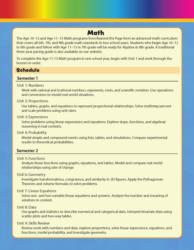
Unit 9: Semester Exams
Lesson 1
Numbers Review
Students solve addition and subtraction problems with integers in real-world contexts (e.g., 9 + (−9) = 0 for hiking, −12 + 7 = −5 for the submarine). Students practice multiplication and division with signed numbers in sign-rule problems and explain sign meaning (e.g., 4 × (−6), (−3)(−5), −45 ÷ 9, −72 ÷ 6). Students solve a real-world decimal multiplication problem (−2.5 × 6 = −15 for temperature change) and are asked to create and solve a real-world problem that uses multiplication or division and includes a fraction or decimal (Mission 4).
Lesson 2
Proportions Review
Students compute unit rates and convert units (e.g., find miles per hour from 3 miles in 12 minutes) and compute ratios of fractions (e.g., 2 cups for 5 batches → 0.4 cups per batch). Students solve percent application problems that require multiplication and addition/subtraction (tax, tip, markup, markdown, percent increase/decrease, percent error) and compute simple interest using multiplication. Students set up and use proportional equations (y = kx), test equivalent ratios, and compare unit rates, which requires using multiplication and division of rational numbers.
Lesson 3
Expressions Review
The Parent Plan and activities require students to solve real-life and mathematical problems using numerical and algebraic expressions and equations (e.g., write and solve px + q = r and p(x + q) = r with p, q, r rational). Student tasks include sales tax and discounts (multiplying decimals like 1.05), ticket/service fees and delivery charges (expressions C = 9t + 6, y = 18x + 12), perimeter/width problems (setting up and solving equations), and unit-rate/slope problems (babysitting pay y = 14x, car rental y = 75x). Several items use negative or fractional slopes (y = -2x + 6, y = (3/5)x - 4) and require students to find slopes by division (rise/run) and compare rates, showing operations with rational numbers across contexts.
Lesson 4
Probability Review
Students calculate probabilities as ratios (e.g., marbles: 3/10; letters bag: 21/26; die and spinner probabilities) which requires division to form rational numbers. Students convert fractions to decimals and percents (spinner 7/25 → 0.28, 10-section spinner → 40%), and compute expected counts by multiplying probability by number of trials (20 × 1/4 = 5). Students find probabilities of compound events by multiplying component probabilities (coin + spinner: (3/5) × (1/2) = 3/10) and compute complements by subtracting from 1 (not landing on green = 1 − P(green)).
Lesson 5
Semester Exam
Students solve integer addition and subtraction (e.g., -18 + 27, submarine 350 ft below rising 125 ft → -225 ft) and integer multiplication and division (e.g., (-6)(-4), -48 ÷ 6). Students work with fractions and decimals in computational and conversion problems (convert 7/16 to a decimal, convert 0.375 to a simplified fraction) and compute unit rates and proportional relationships that require division of rational numbers (4/5 mile in 1/2 hour → 1.6 mph; 18 miles in 3 hours → 6 mph). Students apply operations with rational numbers in real-world contexts such as sales tax, tips, markups, simple interest, scale drawing, and unit-rate/graph problems (sales tax & tip calculations, simple interest on $600 at 4% for 5 years, scale 1 in = 4 miles).
Lesson 6
Functions Review
Students compute slopes from two points (e.g., find slope from (2,1) and (6,9)), which requires subtracting y-values and dividing by the change in x. Students write functions from real-world contexts (y = 18h; y = 12x + 10), using multiplication and addition to model amounts. Students set up and solve algebraic equations from word problems (x + 3x = 28 → 4x = 28 → x = 7), and work with decimal coefficients (y = -1.25x + 5), showing use of rational-number operations.
Lesson 7
Geometry Review
Students compute with scale factors in dilation problems that include fractions and decimals (e.g., a dilation with scale factor 1/2 and finding scale factor 15 ÷ 6 = 2.5). Students multiply and divide when finding volumes of cylinders, cones, and spheres using V = πr^2h, V = (1/3)πr^2h, and V = (4/3)πr^3 with π = 3.14 and solve for a radius by dividing to isolate r^3. Students apply addition and subtraction of coordinates in translation rules (x, y) → (x + 3, y − 2) and apply negation (multiplication by −1) for reflections and rotation rules, requiring operations with negative rational numbers.
Lesson 8
Linear Equations Review
Activity 1 asks students to solve linear equations that include fractional coefficients (for example (3/5)x = 18 and (2/3)x - 5 = 7) and directs them to use reciprocals and the distributive property. The Parent Plan explicitly states students will "Solve linear equations with rational number coefficients," and Activity 2 has students compute slope as a ratio of differences (division of integers that can produce rational results). Activity 4 has multiple real-world word problems (membership fees, taxi fares, ticket sales) that require translating situations into equations and solving using arithmetic with rational numbers.
Lesson 9
Data Review
Students compute means by summing data and dividing by the count (Activity 1 answer key shows Mean = 60 ÷ 7 ≈ 8.57 and Mean = 44 ÷ 4 = 11). Students compute spread using subtraction and averages: they find range and IQR by subtraction (20 − 6 = 14, IQR = Q3 − Q1 = 18 − 8 = 10) and calculate MAD by taking absolute differences, summing them, and dividing (MAD = (3+1+1+3) ÷ 4 = 2). Students calculate relative frequencies/decimals from counts (e.g., 12/50 = 0.24) and interpret those results in two-way tables.
Lesson 10
Semester Exam
Students solve equations that use fraction coefficients (28: (3/5)x = 18 and 29: (2/3)x - 5 = 7), requiring multiplication and division of rational numbers. Students compute means, medians, MAD, and relative frequencies (36, 40, 41, 50), requiring addition, division, and working with decimals. Real-world word problems ask students to write and use linear functions and solve for quantities (8: earnings y = 10x; 35: tutor fee 18h + 30 = 138) and volume problems (18, 19) that require multiplication with decimals/pie values.