


Sixth Grade - MATH
5: Math

Unit 1: Operations
Lesson 2
Multiplication Review
Students practice multiplying decimal numbers and learn the "moving the decimal point" shortcut for multiplying by powers of ten (Activities on Multiplying by Powers of Ten and Day 2 examples). Students solve context problems that involve units—e.g., finding area in square feet (80 × 55), computing total weight by multiplying count by per-item weight (175 × 0.01 = 1.75 pounds), and computing total cost (hours × dollars/hour). The lesson also shows rewriting factors with powers of ten and regrouping factors (e.g., 36 × 2.7 = (36 × 27) × 0.1) which models manipulating numeric factors associated with units.
Lesson 3
Division Review
Students solve a unit-conversion problem in the Basic Skills Review where they convert 3 yards to 9 feet using the fact 1 yard = 3 feet. The parent/teacher notes and Things to Review prompt students to include unit labels and mention a conversion between yards and feet. Students also practice moving decimal points (multiplying/dividing by powers of ten) when converting decimal divisors to whole numbers for decimal division problems.
Unit 2: Integers and Rational Numbers
Lesson 8
Unit 2 Test
Students solve problems that multiply measurements and report squared units (e.g., Ian's stand: 4 1/2 in × 2 2/3 in = 12 square inches; Kasey's canvas: 2 1/2 ft × 1 2/3 ft = 4 1/6 square feet). Students divide quantities with the same units to find counts (e.g., 16 1/2 oz ÷ 1 1/2 oz = 11 servings) and are instructed to include correct units for perimeter and area. The answer key and practice/test problems show unit-labeled operations (addition/subtraction of lengths, division to find servings, multiplication for area).
Unit 3: Ratios and Percentages
Lesson 1
Introduction to Ratios
Students are asked to scale a bread recipe (Eduardo's recipe: 5 cups flour to 2 cups milk for 3 loaves, then scale to 9 loaves) and use multiplication to find new ingredient amounts. Students solve a cleaning-solution problem that gives 50 ml cleaner to 5 liters water and asks how much water pairs with 200 ml cleaner, using a multiplicative factor (50×4=200 and 5×4=20). Multiple activities require students to form equivalent ratios by multiplying or dividing both quantities (e.g., producing 8:2 from 4:1 or simplifying 9:6 to 3:2).
Lesson 2
Describing Ratios in Words and Pictures
Students set up and solve equivalent-ratio problems such as scaling the 2:5 boys-to-girls ratio to find 6 boys correspond to 15 girls and reducing Ellen's 12-to-21 pens ratio to 4:7. The chef example has students reason that if 10 heads of lettuce pair with 6 tomatoes, then 30 heads require 18 tomatoes, showing multiplication to scale quantities. Several activities ask students to find smaller or larger equivalent ratios and to draw representations that reflect multiplied or divided quantities.
Lesson 3
Equivalent Ratios
Students set up and use double number lines and tables to relate different measurement quantities (for example, given 100 meters in 20 seconds they find the time for 20 meters). Students solve rate problems that pair a measurement with a time or cost unit (e.g., sandwiches per minute, minutes per number of key chains) and scale those ratios by multiplying or dividing to find missing quantities. Students also use tables and graphs to find equivalent ratio pairs and read off scaled measurement values (e.g., minutes vs. number of key chains, pitchers vs. lemons).
Lesson 4
Unit Rates
Students are given multiple problems where they form unit rates by dividing quantities, for example dividing 216 miles by 4 hours to find 54 miles per hour and dividing 156 calories by 12 chips to find 13 calories per chip. Students practice transforming a total quantity into a per‑one unit rate and then multiplying the unit rate to find totals (e.g., 13 calories per chip × 25 chips = 325 calories). The lesson includes many unit‑price tasks where students divide cost by number of units (e.g., $5.25 ÷ 3 quarts = $1.75 per quart, $6.27 ÷ 3 pounds = $2.09 per pound).
Lesson 5
Percentages
Students are taught that a percentage is a part-to-whole ratio and practice ratio reasoning when converting among percents, fractions, and decimals. Students compute a unit rate in the Basic Skills Review: they divide 3.92 by 14 to find the unit price per ounce and are instructed to include unit labels (e.g., "$0.28/ounce"). The materials include other ratio tasks (e.g., games won-to-lost ratio) that ask students to form and use equivalent ratios.
Lesson 7
Unit Conversions
Students create an Interactive Notebook page of common conversion ratios and sort conversion boxes by system and measurement type, showing they work with unit relationships. Activity 2 has students solve multiple problems by forming equivalent ratios and using double number line diagrams (examples: quarts→pints, centimeters→millimeters, ounces→grams). The lesson explicitly tells students when to multiply or divide to convert between larger and smaller units and instructs them to set up ratios so units in numerators and denominators match.
Lesson 8
Unit 3 Test
Students complete multiple conversion tasks using ratio reasoning and double number line diagrams, including converting 7 pounds to ounces (16 × 7 = 112 ounces) and converting 8 inches to centimeters (2.54 × 8 = 20.32 cm). Students solve a miles-to-kilometers conversion using a 1.61 conversion factor (1.61 × 20 ≈ 32.2 km) and convert minutes and hours with proportional reasoning (60 × 5 = 300 minutes). The materials explicitly list using ratios to convert units in both customary and metric systems and include practice problems requiring multiplication or division of quantities to transform units.
Final Project
What's the Best Buy?
Students are instructed in Step One to select at least one product with package options measured in different units and to "convert measurements and ensure consistency" for comparisons. In Activity 3 students set up ratio computations to convert 1 gallon to 128 fluid ounces using a sequence of multiplication by conversion factors (gallons → quarts → pints → cups → fl oz). Students are also directed to multiply counts (e.g., 12 × 8 = 96 fl oz) and to divide total price by total units to compute unit price, showing manipulation of units when multiplying and dividing quantities.
Unit 4: Algebraic Expressions
Lesson 3
Working With Expressions
The Basic Skills Review #7 includes problem 6 that requires converting 12 gallons to quarts, and the answer key shows the computation 12 gallons × 4 quarts/gallon = 48 quarts. The review instructions also ask students to include unit labels and the unit-related content list mentions unit rates and temperature conversions, placing at least one explicit unit-conversion task in student work.
Unit 5: Algebraic Equations
Lesson 7
Independent and Dependent Variables
Students solve ratio scaling problems such as Jenna's medicine problem (3 ml every 4 hours → how many ml in 24 hours) and are instructed to "solve using a ratio." Students convert minutes to seconds in the Basic Skills Review (How many seconds are in 5 minutes?) and compute outputs from rates in word problems (Kevin: 10 dollars/hour → y = 10x; Ron: 5 miles/hour → 5x = y) by multiplying or dividing to find miles, hours, or dollars.
Final Project
All About Me
Students are asked to create at least one two-variable equation (e.g., 2x = y) and to produce a corresponding table and description of the relationship (as x increases/decreases, y _____). The project requires use of tape or hanger diagrams and a number line for at least one problem, and prompts include measurement-related ideas (height, shoe size, distances, time practicing an instrument). Students must write and solve equations that express multiplicative relationships (e.g., "I practice piano twice as long as I practice soccer") and solve for unknowns given values.
Unit 6: 2D Geometry
Lesson 2
Working With Angles
The Basic Skills Review includes a problem that asks students to use equivalent ratios to determine how many gumdrops a machine can make in 1 minute given 208 gumdrops in 4 minutes, and the answer key shows dividing both parts of the ratio by 4 to get a 52:1 unit rate. The review instructions explicitly tell students to include unit labels (for example, perimeter answers should include units). The lesson also models using equivalent-ratio reasoning in other arithmetic contexts (e.g., percent-off calculation) where quantities are scaled.
Lesson 4
Area
Students convert linear measurements in the pavers problem by multiplying feet to inches (10 ft → 120 in and 3 ft → 36 in) and then compute area in square inches to find how many pavers fit. In Thuy's garden problem students convert yards to feet (3 yd → 9 ft and 2 yd → 6 ft), compute area in square feet, and divide by coverage (3 ft2 per package) to find the number of packages. The solutions show explicit multiplication and division of converted measures and track unit labels (inches → in2, yards → feet → ft2).
Lesson 5
Circles
Students are instructed to include units when finding circumference and area and told that circumference is a linear measurement (unit without an exponent) while area is two-dimensional (unit with exponent 2). Activity problems present radii and diameters with units (cm, mm, in., ft) and ask students to compute C = 2πr or A = πr^2, including examples where they square the radius and multiply by 3.14. The hands-on activity has students divide the circumference by 2 and multiply by the radius to compute area for a semicircle, showing students how units change when multiplying/dividing quantities.
Lesson 6
Scale Drawings
Students set up and solve proportions that relate different measurement units, for example using 1 in : 5 ft to find an actual wall that is 6 in on the drawing (30 ft) and 4 in (20 ft). Students convert mixed units when analyzing scale factors, e.g., Mia's garden where 8 cm represents 2 m is shown as 4 cm : 1 m and then converted to 4 cm : 100 cm to compare units. Students use unit-bearing ratios to compute blueprint and photograph dimensions (architect 1 cm/4 ft to find 120 ft -> 30 cm) and to combine scale factors (1 cm/30 ft reduced by 1/2 to 1 cm/60 ft).
Lesson 7
Unit 6 Test
Students solve scale-factor problems (e.g., find the reduction from a 12-inch nest to a 2-inch photo radius and compute 1/3) and create scaled drawings (use a 1/3 scale to redraw a 3×4 rectangle and find scaled dimensions). Students compute scale factors for perimeter and area and use the relationship that area scale factor is the square of the linear scale (answers show perimeter scale 3:1 and area scale 9:1). Students use multiplicative reasoning with measurements in applied problems (e.g., compute area of a 4-ft-diameter fire ring and divide by 3.5 sq ft per bag to find number of bags).
Final Project
Geometry Stations
The lesson asks students to "Create a Scale Drawing" and to "Reproduce a scale drawing at a different scale," and includes prompts such as "How do scale drawings work?" that direct students to use given scale factors. Students are asked to make scale drawings using a laminated grid and to plan stations that specify a scale factor on problem cards. The Stations Planning and setup steps require students to apply scale information when drawing and reproducing shapes at new scales.
Unit 7: 3D Geometry
Lesson 2
Surface Area
The Basic Skills Review asks "How many centimeters are in 7 meters?" and the answer key shows 7 meters × (100 centimeters / 1 meter) = 700 centimeters, demonstrating use of a conversion factor. The Basic Skills Review also includes a unit-rate problem (24 oz for $3.12) where the answer key divides the ratio to find the price per ounce ($0.13/oz). The lesson repeatedly instructs students to include unit labels on area answers, and several problems require carrying units through multiplication and addition of areas.
Lesson 3
Volume
Students work with fractional unit cubes (1/2 in. and 1/4 in.) to find how many such cubes fit along each dimension and then multiply the cube count by the volume of one fractional cube (e.g., 1/2 x 1/2 x 1/2 = 1/8 in.3) to get total volume. The lesson explicitly shows converting mixed-number side lengths to improper fractions and multiplying those fractional measurements (e.g., 7/2 x 2 x 2 = 14 in.3) and explains that multiplying length x width x height produces cubic units (cm x cm x cm = cm3). Several problems require dividing a length by a fractional unit (e.g., 3 ft ÷ 1/3 ft = 9) to find counts of subunits, which uses ratio reasoning to relate measures and unit-sized pieces.
Lesson 5
Problem Solving With Solids
The Basic Skills Review includes a explicit unit-conversion problem where students convert 4 yards to feet and then to inches using multiplication by conversion factors (4 yards × 3 ft/yard = 12 ft; 12 ft × 12 in/ft = 144 in). Activity problems require students to divide area or volume measures by a unit measure to find counts (e.g., Archie divides 528 in^2 by 275 in^2 to find rolls of paper; Mr. Hicks divides surface area in ft^2 by coverage in ft^2 per can to find number of paint cans). Multiple exercises present quantities with units and require multiplying or dividing those quantities (volume = l × w × h, area calculations, and using V to find counts), so students practice transforming units while performing multiplication and division.
Lesson 6
Unit 7 Test
Students divide volume by base area to find a linear measure in the flute problem (182 in^3 ÷ 6.5 in^2 = 28 in) and in the soap-prism problem (6,300 cm^3 ÷ 42 cm^2 = 150 cm). Students divide total surface area by coverage to find number of paint cans in the Kareem problem (SA in ft^2 compared to 10 ft^2 per can). Students multiply fractional edge lengths to compute volume (e.g., 3/4 × 1/2 × 4 4/5) and compute surface areas using formulas that require multiplying dimensions, demonstrating unit tracking for area and volume units.
Unit 8: Statistics
Lesson 2
Populations and Samples
Students multiply a rate by a time in the bubble-gum problem (85 pieces per minute × 12 minutes = 1,020 pieces), showing ratio reasoning with units. Students are prompted to include unit labels in Basic Skills Review problems and compute measures like circumference, area, and volume using formulas that involve units (e.g., C = 2πr, A = πr^2, V = l × w × h).
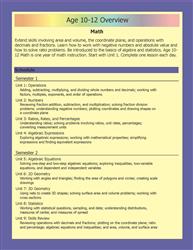
Unit 9: Skills Review
Lesson 1
Decimals, Factors, and Multiples
Students multiply 2.1 ounces per bottle by 72 bottles to compute total ounces in a case (2.1 × 72 = 151.2), and students divide 118 cupcakes by 4 cupcakes per box to determine how many full boxes can be filled (118 ÷ 4 = 29.5, interpret remainder). Students also perform arithmetic with units in money problems (adding March and April earnings then subtracting a purchase) and complete decimal multiplication and division problems that involve quantities (for example, 994.08 ÷ 2.4). These tasks require students to manipulate units when multiplying or dividing quantities.
Lesson 2
Fractions, Ratios, and Coordinates
Students solve ratio and rate problems that produce unit rates and involve units: they compute the train's speed by dividing 310 miles by 5 hours to get 62 miles per hour, and they find the unit price of apples by dividing $6.12 by 3 pounds to get $2.04 per pound. Students also divide a 1/2‑pound bag of trail mix into equal parts to find the amount per bag, and scale a necklaces-per-minute ratio (3 necklaces per 5 minutes) to find total time for 15 necklaces. These tasks require students to divide quantities and interpret resulting units (miles/hour, dollars/pound, pounds per bag, minutes).
Lesson 3
Expressions, Equations, and Percentages
The lesson's Skills list explicitly includes "Use ratio reasoning to convert measurement units; manipulate and transform units appropriately when multiplying or dividing quantities," indicating the unit-conversion goal. The Wrapping Up section directs students to an online quiz titled "Percentages and Unit Conversions" and the Parent Plan states "Your child will use an online quiz to practice solving problems with percentages and unit conversions," so students are assigned practice on unit conversions outside the main activities.
3: Math
Unit 1: Numbers
Lesson 1
Positive and Negative Rational Numbers
Students multiply rates by time and divide totals to find per-unit amounts in multiple activities (e.g., -4/5 mile per hour × 3 hours = -12/5 miles; -2.5°F per hour × 5 hours = -12.5°F). Students compute unit-based quotients in division tasks (e.g., -60 ÷ 5 = -12 per person, -48 ÷ 6 = -8°F per hour) and solve word problems that require interpreting results with units (distance, temperature, debt). The Relay and Real-World Contexts pages prompt students to set up and evaluate computations that combine numeric values with contextual units.
Lesson 6
Scientific Notation
Students convert between metric units using the provided metric conversion chart and explicit examples (e.g., 5,000 kg → 5,000,000 g → 5.0 × 10^6 g and 320 km → 320,000 m → 3.2 × 10^5 m). Student activity pages ask learners to convert standard form to scientific notation and vice versa and to match quantities to appropriate units (e.g., length of a classroom → meters, weight of a grain of sand → milligrams). Word problems require students to multiply and divide quantities with units so they must transform units appropriately (e.g., fire hose: 1.2 × 10^3 liters/min × 60 min → liters; water tank draining: total liters ÷ liters per minute → minutes).
Lesson 8
Unit 1 Test
Students multiply and scale quantities with units in recipe problems (e.g., doubling 0.25 cups to 1/2 cup and tripling 0.125 cups to 3/8 cup), showing practice multiplying a unit measure by a scalar. Students find side lengths from given areas and volumes (e.g., area 144 square feet → side 12 feet; volume 27 cubic feet → side 3 feet), which requires taking roots and interpreting square- and cube-root results in linear units. Students work with scientific notation in context (e.g., converting 450,000 to 4.5 × 10^5, multiplying values given in scientific notation, and computing total weight from 1.5 × 10^-3 g × 1.2 × 10^4 grains), which has students combine numeric values that carry units.
Final Project
Mars Station Test Mission
Students compute energy use per hour, per day, and per year (e.g., multiplying kWh/hour by hours/day and days/year) in Task 1 and scale solar and wind outputs from per-day to per-year in Task 2. Students convert the scientific notation 7 × 10^2 kWh to 700 kWh and use that value to determine how many fuel cells are needed in Task 3. Students calculate geometric quantities (area from cube side length, area for room/storage) and multiply those areas by cost rates to find total costs.
Unit 2: Proportions
Lesson 1
Proportional Relationships
Students set up and solve proportions that include units (e.g., "120 miles/3 hours = x miles/5 hours", "6 gallons/240 square feet = 9 gallons/x square feet") and use multiplication/division and cross-multiplication to find missing values. The lesson repeatedly instructs students to use labels so numerators and denominators match (flour with flour, blue beads with red beads as numerator/denominator pairs) and shows solving methods that multiply or divide quantities (e.g., multiplying both sides by 12 to solve x in 3/2 = x/12). Multiple activities require students to scale quantities with units (miles, hours, gallons, square feet, dollars), reinforcing ratio reasoning when multiplying or dividing those quantities.
Lesson 2
Unit Rates
Students set up and compute unit rates with labeled units (e.g., $4.99/6 apples → $0.83 per apple) and track labels when dividing fractions (miles per hour, cups per batch). The lesson includes complex-fraction examples that require dividing fractional distances by fractional times (3/4 miles ÷ 1/2 hour → 3/2 mph) and explicitly uses Keep-Change-Flip while noting that labels flip too. In the lengths/areas activity students convert units in worked answers (for example, 9 yards = 27 feet before computing cost per foot) and compute derived units such as square inches per inch in the bonus task.
Lesson 3
Constant Rate
Students compute constants of proportionality and unit rates in contexts that require unit reasoning, for example finding k = 5/60 = 1/12 when converting a runner's speed of 5 miles per hour to miles per minute. Students find unit rates for a printer (45 pages in 3 minutes → 15 pages/min), a machine (120 parts in 30 minutes → 4 parts/min), and faucets/tanks (liters per minute) and calculate price-per-unit (price per ounce, price per pencil). Students also rewrite equations to y = kx and use division to produce rates with appropriate units.
Lesson 4
Graphing Proportions
Students repeatedly compute and use unit rates (k in y = kx) across activities, identifying unit-rate points like (1,k) and writing equations such as y = 12x, y = 80x, and y = 15x. In the Fuel Efficiency scenario students see a rate given as "5 gallons for every 100 miles" and the Answer Key rewrites the relationship with the independent and dependent variables swapped, producing y = 20x (miles per gallon), which reflects converting and manipulating the given rate. Many tasks ask students to identify units, label axes, and interpret rates in context (miles/hour, $/item, gallons/miles).
Lesson 5
Proportional Relationship Equations
Students compute unit rates from measured quantities such as finding speed from 3/4 miles in 1/2 hour (quiz question) and converting 30 gallons in 3 minutes to a per-minute rate. Students set up and solve equations that include units (e.g., 156 = 10m for calories/minutes, a = rh for square feet/hour, d = 4.5t for miles/hours). Students calculate unit prices and rates such as $1.50 ÷ 12 ounces to find price per ounce and use tables to identify constant rates.
Lesson 9
Unit 2 Test
Students compute unit rates from fractional distances and times (e.g., find the unit rate for 3/4 mile in 1/2 hour and several problems asking speed per hour from fractional distances and times). Students convert measurements using a map scale (problems asking how many miles 7 inches or 9 inches represent given 1 inch = 5 miles or 1 inch = 6 miles). Students set up and solve division/multiplication to find unit rates and constants of proportionality (multiple table-to-rate problems and k = 2/7 or k = 3 examples).
Final Project
Lemonade Stand
Students set up and solve proportions to scale recipe quantities (e.g., 2 tablespoons per cup to find tablespoons for up to 16 cups) and write equations of the form y = kx. Students convert between tablespoons and pounds using the explicit relationship (1 lb = 36 tablespoons) and solve a proportion to find pounds of sugar needed for a gallon. Students use ratio reasoning to convert between gallons and cups (divide total cost for 1 gallon by 16 cups) and to compute cost per cup from unit prices.
Unit 3: Expressions
Lesson 3
Algebraic Expressions
Students solve area problems where area (cm²) is divided by a length (cm) to find a missing width, and perimeter problems require labeling answers with cm. The review quiz and activity answer keys show students performing calculations like 150 = 15 × w leading to w = 10 cm, indicating they carry units through multiplication and division. Problems ask students to include unit labels and to compute quantities using formulas (A = l × w, P = 2(l + w)).
Lesson 4
Graphing Proportions
Students are instructed to find unit rates by dividing the y-value by the x-value (e.g., "6 miles / 3 hours = 2" and "$9 / 3 pounds = $3 per pound"). Activity 2 includes a real-world problem where a car travels 120 miles in 3 hours and students compute the unit rate as 40 miles per hour. Multiple activities require students to compute unit rates from graphs or equations (e.g., graphs showing (0,0) and (2,8) with unit rate 4, or 8 pencils for $5 with unit cost computed).
Final Project
Planes, Trains, and Automobiles
Students compute time by dividing distance by speed (e.g., 500 = 60x, 500 = 80x, 500 = 400x) to find hours. Students convert minutes to hours when adding stops and delays (e.g., 15-minute gas stops, 30-minute layovers, 30-minute post-flight wait converted to 0.25 or 0.5 hours). Students multiply and use unit rates in cost problems (e.g., dollars per mile × miles, writing cost equations y = mx + b) and set equations equal to find break-even distances, demonstrating manipulation of units in multiplication and division.
Unit 5: Functions
Lesson 3
Understanding Functions
Students receive rates with units (e.g., Sylvia climbs 4 feet per hour then 5 feet per hour; Timmy walks 2 meters per minute then 3 meters per minute; Bella ascends at 6 meters per minute and descends at 3 meters per minute) and are instructed to plot positions over time on axes labeled with units. Students compute and plot points for given time intervals (e.g., mark where Sylvia is each hour, or Timmy each minute) which requires multiplying a rate by a time to produce a distance/height. The activities ask students to label axes with units and connect computed points to form a graph, making unit-labeled quantitative calculations part of the tasks.
Lesson 6
Slope-Intercept Form
Students work with tables where x is minutes and y is miles and compute slope as a rate (e.g., m = 1/5 or 0.2 miles per minute). In the Table to Equation example the computed rate is explicitly converted and stated as "which is 12 miles per hour," showing a unit conversion from miles per minute to miles per hour. Several table and real-world word problems present quantities with units (minutes, miles) so students calculate and interpret rates.
Lesson 8
Comparing Functions
Students compute unit rates by dividing quantities with units—for example, Alex's 1.5 miles every 30 minutes is divided to get 0.05 miles per minute, and Rider A's 4 miles every 20 minutes is converted to 0.2 miles per minute. Several activity problems ask students to compute gallons per minute (3 gallons every 2 minutes → 1.5 gallons/min) and to find miles per minute from graph coordinates, explicitly showing Δdistance/Δtime with units. The student answer key and worked examples show students carrying units through the division and producing unit rates (miles/min, gallons/min, $/week).
Unit 6: Geometry
Lesson 1
Congruence and Similarity
Students compute and use scale factors with units in worked examples (e.g., Scale factor = larger side/smaller side = 6 ÷ 3 = 2 and then 5 cm × 2 = 10 cm). Student activity problems ask learners to find scale factors and solve for missing side lengths using multiplication or division (answer key shows scale factors and calculations such as x = 14 ÷ 2, scale factor = 1/2, scale factor = 0.4). Several problems present measurements with unit labels (cm or in) and students perform arithmetic on those labeled measurements when finding corresponding lengths.
Lesson 10
Volume
Students compute volumes with units throughout the lesson (e.g., V = 3.14×(3 in)2×4 in → 113.04 in3) and read an explicit explanation that multiplying area (in2) by height (in) yields cubic units (in3). Students convert diameter to radius (diameter 8 in → radius 4 in) and solve for missing measurements by dividing numeric values (e.g., 314 = 78.5 h → h = 4). Multiple activity pages and answer keys show volumes and dimensions labeled with different unit types (in, cm, ft, mm).
Unit 7: Linear Equations
Final Project
Getting Ready for College
Students convert annual fixed costs to monthly costs in the transportation activity by dividing $2,700 by 12 to get $225 per month. Students split shared costs by dividing total apartment monthly and one-time furniture costs by 2 to produce per-person rates (1050/2 = 525 and 1500/2 = 750) and then use those in equations. Students also manipulate expressions by dividing Plan B's total (10x + 40)/2 to simplify it to 5x + 20 and set up per-mile and per-hour rates (e.g., $0.60/mile, $1.25/mile, $1.50/hour) when writing and solving equations.
Unit 8: Data
Lesson 4
Linear Models
Students work with rates that include units in several problems: the Parent Plan gives a slope example of 1.5 cm/hr and multiple tasks ask students to interpret slope in context (e.g., liters of fuel per hour, ice packs melting per hour). One item explicitly states "5 apples are removed every 30 minutes" and then asks students to find how many apples remain after 1 hour, which requires transforming the 30-minute rate to a 60-minute interval. Several activities require substituting values into y = mx + b where m carries units (degrees, cups, liters, cm) and using that to compute quantities.
Unit 9: Semester Exams
Lesson 1
Numbers Review
Students multiply a rate by time in the Temperature Change problem (−2.5° per hour × 6 hours = −15°) and divide totals to find per-unit quantities in the gamer and debt problems (−45 ÷ 9 = −5 points per round; −72 ÷ 6 = −12 dollars per friend). Several problems ask students to interpret what the computed values mean in context, demonstrating attention to units (degrees, points per round, dollars per friend). The Things to Know/Parent Plan sections also reference using scientific notation and choosing appropriate units for measurements of very large or very small quantities.
Lesson 2
Proportions Review
Students convert a rate in Activity 1 problem 1 where they must turn 3 miles in 12 minutes into miles per hour (explicitly requiring minutes→hours conversion). Activity 4 problem 7 asks students to use the map scale 1 inch = 6 miles to find how many miles 9 inches represents (direct unit conversion by multiplication). The Parent Plan and activity descriptions repeatedly ask students to compute unit rates for quantities measured in like or different units, reinforcing conversion in rate contexts.
Lesson 5
Semester Exam
Students compute unit rates and convert measurements in several problems: Problem 14 asks for the unit rate of 4/5 mile in 1/2 hour (answer 1.6 mph), Problem 19 and 34 ask students to find unit rates from a graph and from 6 miles in 1.5 hours (answers 5 and 4 mph respectively), and Problem 25 uses a scale 1 inch = 4 miles to convert 7 inches to 28 miles. In these tasks students divide and multiply quantities while carrying units (miles per hour, inches to miles) to produce the converted units or unit rates.
Lesson 10
Semester Exam
Students compute volumes using given linear measurements (Problems 18 and 19 ask for volume of a cylindrical pencil cup and a cone using radius and height in inches), which requires multiplying length measures and producing cubic units. Students also find distances and hypotenuses (Problems 16 and 17) by combining squared length measurements, and they work with rates in a context (Problem 8: $10 per hour) that involves units like dollars per hour.