


Ninth Grade - ELA
1: Semester 1

Unit 1: Lord of the Flies
Lesson 1
The Call
Students are prompted to discuss guiding questions (e.g., "What makes someone likely to survive...?") and to be "prepared to discuss" their answers, which requires speaking their ideas to others. In Option 1 students record titles and analyze common settings, plots, and central struggles, producing findings about dystopian works. In Option 2 students create and compare utopia/dystopia lists with another person, which involves explaining and defending their ideas aloud or in writing.
Lesson 3
Paths in the Jungle
Students read an article, identify the author's thesis, and list key supporting points on a Student Activity Page. Students use a top-hat graphic organizer to organize responses and form an opinion, and they are prompted to annotate text to collect evidence. The lesson's skills list explicitly mentions producing clear and coherent writing appropriate to task, purpose, and audience and refers to using phrases and clauses to add variety to writing or presentations. The parent plan includes discussion prompts that require students to talk about their character choices and insights.
Lesson 5
Not Hunting, But Hunted
Students are asked to draft four to five laws (Option 1) and to create a system for adopting laws and consequences (Option 2), recording their ideas in journal entries. Multiple places instruct students to "be prepared to discuss" and to "discuss and defend their points of view," which requires explaining proposed rules and rationales to others. The Wrapping Up and Questions to Discuss sections prompt students to discuss consequences and to explain their reasoning about whether laws are necessary.
Lesson 6
Symbolism, Part 1
Students are asked to explain which interpretation they agree with for symbols and to "back up [their] explanation with support from the text" on the Activity 1 worksheet, which requires organized claims and textual evidence. Students write a one-page journal entry from a character's point of view (Activity 2), which asks them to record actions and quotes and to consider priorities, fears, and trusts—tasks that involve organizing observations and supporting them with textual details. The "Questions to Discuss" section prompts students to discuss changes in the conch's importance and other thematic questions, encouraging oral exchange of ideas.
Lesson 8
Defects of Human Nature
Students are asked to choose themes that support Golding's identified major theme and to "support those choices by referring to details from the novel" (Option 1), which requires selecting evidence and explaining its connection. Option 2 directs students to "write 3-4 sentences explaining how the chosen theme supports Golding's major theme," asking for concise, evidence-based explanations. The Parent Plan includes "Questions to Discuss" and instructs to "Discuss the book's themes with the student," prompting students to verbally explain and defend interpretations in discussion.
Lesson 11
The Film
Students are asked to complete a "Movie vs. Book" chart to record similarities and differences in characters, setting, theme, and plot, which requires compiling findings and supporting details. Students must answer journal questions explaining omitted scenes and visual differences, demonstrating they produce written reasoning and evidence. The lesson includes "Questions to Discuss" and directs teachers to review portions of the activity page with students, implying opportunities to share findings verbally with peers or the class.
Final Project
Now You Have the Conch
Students develop clear thesis statements, create traditional or guided outlines, and follow an essay checklist and rubric that require organization, support, and logical development of ideas. Students use brainstorming and "You Are the Editor" peer-review activities to check that their ideas follow a logical order and that support and transitions make their reasoning clear. The skills list and one activity note explicitly reference using phrases and clauses to add variety and interest to "writing or presentations," connecting organization and development to presenting information.
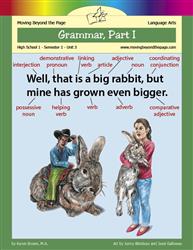
Unit 3: Grammar, Part I
Lesson 2
Subject-Verb Agreement
The lesson's Option 2 asks students to create a short quiz of at least five sentences and to ask a friend or sibling to take the quiz, including explanations for answers. The sample item and instructions explicitly tell students to provide explanations (e.g., explaining why the indefinite pronoun "everyone" takes a singular verb) and to ask whether those explanations were helpful. The Parent Plan for Option 2 states this task "requires them to understand the subject-verb agreement rules and be able to explain them to others."
Lesson 3
Pronoun Problems
Students must create either a poster or a short slideshow that explains a chosen pronoun error, provides two example sentences containing the error, and shows corrected versions plus strategies for fixing them. The slideshow option specifies at least four slides (title, explanation of the topic, examples with highlights/arrows, and correction strategies), requiring students to organize and develop their material. The Parent Plan asks students to share the poster or presentation with family and to answer questions, prompting oral presentation and supporting evidence for their explanations.
Lesson 6
Colons and Semicolons
Students must write two formal opening statements that require organized, persuasive presentation of rules and examples for the semicolon and the colon. Students are instructed to read their opening statements aloud to a judge, answer follow-up questions using examples and evidence, and defend their reasoning. The Parent Plan and courtroom activity require students to include specific supporting evidence (example sentences, conjunctive adverb usage, complex lists, list and quotation introductions) and to explain ideas clearly and confidently.
Final Project
Wrapping Up
Students are asked to create a visual aid (poster or digital graphic) that explains grammar tips, which requires organizing information and presenting it visually. Students who choose the quiz option must create a paragraph-based quiz, produce an answer key, have someone take the quiz, and then explain any missed words to that person. Discussion prompts ask students to describe what they learned and how their visual aid or quiz will be helpful, prompting brief verbal explanation to an audience.

Unit 4: Poetry
Lesson 1
Introduction to Poetry
Students generate and then explain their own definitions of poetry aloud by comparing their two-minute writing to poets' quotations and are asked to be prepared to discuss differences and preferences. Students identify specific words and phrases in poems (e.g., "Richard Cory", Dickinson excerpt) and write denotations and connotations, explain why original words are more effective, and answer focused written questions about word choice and meaning. Students mark a poem and write responses to guided questions that require citing lines and explaining how language creates effect.
Lesson 2
Sound and Rhythm
Students are asked to discuss differences between audio and printed versions of "Lord Randall" and to be "prepared to discuss" sound and musical qualities, which requires verbal explanation. Students write short journal responses explaining why particular sound repetitions are effective and answer structured questions on the Rhyme activity page, providing findings and textual examples. Students also mark poems for devices and rhyme scheme and reflect in writing on how rhyme and rhythm affect meaning, which requires citing textual evidence.
Lesson 5
What Does It Mean?
Students are asked to read poems aloud (e.g., directions to "Read the poem, preferably aloud" and multiple "try reading it aloud" prompts) and to answer and record guided analysis questions about speaker, images, tone, symbols, and theme. Students complete activity pages that require written summaries and explanations of how references and symbols contribute to meaning, and they are prompted to discuss and listen for allusions in media. The materials include prompts for class discussion (Questions to Discuss) that would involve explaining interpretations to others.
Lesson 10
Poems and Poets
Students are asked to prepare a one-page biographical presentation about a world poet that includes the poet's name, country, language, images, dates, and at least three facts or cultural factors. Students complete a "Poetry Map" and paraphrase and analyze poems, summarizing theme, tone, word choice, imagery, and sound devices. Activity 4 requires students to gather cultural references and write a journal response that summarizes the poem and explains how cultural references enrich understanding, which requires assembling supporting evidence.
Lesson 11
Reciting Poetry
Students choose, prepare, and recite a poem, watching model recitations and noting what makes each performance effective. The Parent Plan lists skills including adapting speech to a variety of contexts and citing specific textual evidence when writing or speaking to support conclusions. Homework tasks ask students to determine speaker and tone, analyze word choice and images, mark pauses and enjambment, and memorize and deliver the poem to an audience.
Final Project
Poetry
Students are asked to create and deliver presentations for their final projects and to recite a memorized poem to an audience (Day 3 and Homework). Choice 5 (Poetry Explication) requires students to present findings digitally, putting poem excerpts on slides and highlighting examples (rhyme, meter, sound devices, imagery, figurative language) as supporting evidence. Choice 1 (Director's Notebook) and other project choices require students to write explanatory paragraphs or describe choices (set design, lighting, costumes) that justify creative decisions.
Unit 5: Nonfiction
Lesson 1
Types of Nonfiction
Students examine books using the "All About a Person" activity and write comparisons that require them to cite specific front matter and back matter (map, table of contents, glossary, timeline, photos) as evidence for classifying a text as biography, autobiography, or memoir. Students read an interview with Patricia McCormick and are asked to "explain what role McCormick had in writing the book," which prompts students to state findings and reasons. Students write a short journal response after reading the Guardian article, answering whether other cultures' approaches to categorizing writing make more sense than the English system.
Lesson 3
The Taliban
Students are asked to create one or more slides in a slideshow to "communicate" basic information about the Taliban using visual aids (images, maps, diagrams) and text, and to share the slideshow with family members. Option 1 requires students to write an informational paragraph with a strong introductory sentence, transitional words and phrases to link thoughts, and a concluding sentence that summarizes the main idea. Both options require students to organize content that answers specific questions and to use their own words when conveying evidence from the provided webpage.
Lesson 5
Displacement
Students research and compile information for a photo report or mini-book: they choose images of schools, record school name/location/grade, write three assumptions based on the images, and write 3–4 sentences from a student's point of view. In Option 2, students select four types of school transportation, identify advantages and disadvantages, assemble a mini-book, and share their work with family members. The Parent Plan also asks students to conduct short research projects and to discuss the article with a parent or caregiver.
Lesson 6
A Day Like Any Other
Students are directed to use the APE strategy (Answer, Prove, Extend) to analyze decisions, which requires them to state a claim, provide textual evidence, and explain how the evidence supports their claim. The activity page instructs students to be prepared to discuss their opinion about whether a decision was a good one and why, prompting oral explanation of reasoning. The Parent Plan instructs students to provide quotations or specific examples with page numbers in the 'prove' section and to explain how the example supports the answer in the 'extend' section.
Lesson 7
Life in England
Students are asked to take notes while watching an 11-minute documentary clip and to be prepared to discuss how the film's account differs from the book, including specific comparison questions (father's role, filmmaker's focus, impressions of the mother, effectiveness of film vs. book). The Parent Plan lists a skill to "prepare for and participate effectively in a range of conversations and collaborations... building on others' ideas and expressing their own clearly and persuasively." Discussion prompts explicitly ask students to reflect and discuss questions about responsibility, cultural effects, and adjustments to a new country.
Lesson 8
Civil Rights
Students organize historical information by cutting out timeline excerpts and arranging them chronologically, which requires them to order and sequence events logically. Students record answers and analyses in journals (e.g., answers about the Freedom Riders, reactions to excerpts of King's letter, lists of the four steps to nonviolent campaigns), demonstrating selection and use of supporting evidence in written form. Students complete written activities that ask them to match authors to descriptions and write sentences about each author's contribution, and they create a graphic or poetic response that requires them to synthesize information and express a central idea.
Lesson 10
Learning from the Past
Students watch and listen to a recorded speech by Dr. Martin Luther King Jr. and are asked to reflect on and be prepared to discuss how voice inflections, pauses, volume, and gestures add to a speech. Students create a model museum wall and write one- or two-sentence formal explanations and a clear formal description intended for an audience of museum visitors. The Parent Plan lists skills including developing a topic with relevant facts and producing writing appropriate to an audience.
Lesson 12
Running from War
Students are asked to use the APE strategy (Answer, Prove, Extend) to respond in their journals, requiring them to state a claim and support it with a quotation as evidence. Activity 1 explicitly teaches and has students practice integrating and introducing quotations with context and correct punctuation, including sample introductions that show how to connect reasoning to textual evidence. Several tasks ask students to share and discuss their memory activity with a parent or family member and to answer guided discussion questions about the text.
Lesson 13
Child Soldier
Students complete the "Different Accounts" activity where they fill in book and video columns with examples and quotes and are told to "be prepared to discuss your answers," which requires orally presenting findings from two sources. Students write a journal response about the memoir controversy, explaining whether inaccuracies matter and supporting their position with reasons from the text and context. Activity pages (Role of Rap, Child Soldiers) ask students to record roles, advantages/disadvantages, and cite page numbers or examples, prompting them to organize information and supporting evidence in writing.
Lesson 15
A New Life
Students are asked to write 1-2 paragraph summaries of Chapter 20, which requires them to distill main ideas and present information concisely. Students create a flyer or a simple webpage about a nonprofit, tasks that require organizing background, accomplishments, and purpose for a target audience. The lesson tells students to complete a Comparing Memoirs activity and to be prepared to discuss whether details were appropriate, implying students will present analyses and opinions aloud.
2: Semester 2

Unit 1: Ender's Game
Lesson 11
Thud, Whump, Huut
Students are instructed to re-read a scene from the book, re-watch the same scene in the film, take notes on differences, decide which version is more effective and discuss their notes with a parent. The comic-book option asks students to complete a "Comic Adaptation" activity page that requires listing omitted or changed narration/dialogue and judging whether the comic communicated the original message. The wrap-up and parent-plan discussion prompts ask students to explain which adaptation was more effective and why.
Lesson 12
Campbell's Comparisons
Students record the 12 steps of Campbell's hero's journey from a video and choose six steps to describe parallels to Ender's Game on the Hero's Journey activity sheet, producing organized written descriptions of findings. Students retake an issues survey and are instructed to compare their earlier and current responses and be prepared to discuss any changes, with the parent notes prompting students to provide examples from the novel that influenced them. The lesson's Skills section explicitly lists initiating and participating effectively in collaborative discussions, which requires students to express ideas clearly and persuasively in group or whole-class talk.
Lesson 13
The Enemy's Gate Is Down
Students are asked to "be prepared to answer these discussion questions," which requires them to orally explain subplot differences and their importance. Students summarize four leadership lessons in one- to two-sentence boxes and describe how to apply one lesson to their own life, which involves organizing findings into concise written summaries. The "Discovering Subplots" activity asks students to list mysteries and unanswered questions for each subplot, prompting students to identify and articulate evidence and lines of reasoning about character motivations and themes.
Final Project
Think-Tac-Toe
Students are asked to create a storyboard presentation (Box 6) and to export it as a video or use slideshow features, which requires organizing and presenting content for an audience. The lesson directs students to "Share your work with your family" (Day 3), implying an oral or multimedia presentation to listeners. Several tasks (Box 5 compare/contrast, Box 8 historical references) require students to organize findings and provide examples or explanations in written form.
Unit 2: Grammar, Part II
Lesson 7
Verb Voice and Mood
Students are asked to create and present a creative explanation of the subjunctive mood for a younger audience (poster, slideshow, comic strip, or card game). The rubric requires presentation skills such as voice quality, eye contact, and that the message be clear and cohesive so the audience has no questions, and it requires showing what the subjunctive mood is using definitions, examples, and/or context. Students must produce examples and explanations as part of the project, which functions as supporting evidence for their presentation.
Lesson 8
Parallelism
Students identify and correct faulty parallelism in sentences (e.g., rewriting "Rashad enjoys going to the movies, skateboarding with his friends, and to read books" as "...and reading books"). Students complete a Parallelism activity page where they list coordinating and correlative conjunctions, describe parallel problems in lists/series, comparisons, and linking-verb constructions, and take notes from an online module to practice these forms. Students are directed to order items in a list or series by chronology or degree of importance, and to provide descriptions/examples of parallelism problems for each type.
Final Project
Wrapping Up
Students are asked to create presentations (slideshow, poster, explanatory guide, or song/rap/skit) that explain a grammar topic, clearly define terms, and provide examples. The slideshow and explanatory guide directions explicitly require students to plan content, define terms, and use text/graphics/audio to help viewers understand the concept. The mini-project rubric assesses whether each project "clearly explains the topic" and whether "information is appropriate for the target audience," and presentation criteria require effective use of the chosen medium and that finished products be instructional.

Unit 3: Informational Texts
Lesson 1
What Are Informational Texts?
Students are asked to watch Malcolm Gladwell's TED talk, jot down prior knowledge, and be prepared to discuss specific analytical questions about his argument, which requires stating observations and supporting points aloud. Homework requires students to read a chapter of Outliers and answer questions that ask them to explain causes and identify researchers' conclusions, which asks for written explanations of findings and supporting evidence. The Student Activity Page directs students to locate and describe informational text features in Outliers and to identify literary vs. informational elements, which involves citing examples from the text.
Lesson 6
The Ethnic Theory of Plane Crashes
Students are asked in Activity 5 Option 1 to prepare and deliver a short oral explanation summarizing the blog article's main objections and to answer several specific discussion questions aloud. In Activity 5 Option 2 students must complete a written chart that identifies each criticism, describes how Gladwell responded, and evaluates the effectiveness of that response. The Parent Plan skills list also names producing clear and coherent writing and coming to discussions prepared, explicitly linking student preparation and use of textual evidence to class discussion.
Lesson 7
Rice Paddies and Math Tests
Students are asked to present findings to a parent after Activity 1 Option 1 ("Present your findings to a parent explaining how the Chinese number words/counting system works"). In Option 2 students must "share your knowledge with a parent" and demonstrate counting to any number called out between 1 and 99. The homework/mini-project requires students to produce an infographic that "clearly and effectively communicates the concept" and allows the use of digital media to "enhance your audience's understanding of findings, reasoning, and evidence."
Lesson 8
With Malice Toward None
Students analyze Lincoln's rhetoric by identifying rhetorical strategies (parallelism, antithesis, allusion) and explaining their intended effects in the Student Activity Page and answer key. Students examine organization and development by identifying background, main message, and forward-looking statements in the homework task that asks them to pick three sentences that demonstrate this structure. Students cite textual details when answering guided questions about purpose, tone, and how ideas are introduced and developed throughout the speech.
Lesson 9
Writing about History
Students organize claims and connect them to supporting evidence when they complete the graphic organizer linking secondary-source claims to primary-source testimony. Students practice constructing arguments and distinguishing claims from counterclaims in the editorial/journal task (Option 2) and in the double-entry diary activity summarizing Chivington's testimony. The Skills list explicitly asks students to "Introduce precise claim(s)... and create an organization that establishes clear relationships among the claim(s), counterclaims, reasons, and evidence," and to "Write arguments focused on discipline-specific content."
Lesson 10
Science Writing
Students read and analyze sections of a science booklet and complete an activity that asks them to explain how the author supports specific claims (e.g., noncontact forces are invisible; centripetal force is called fictitious). The activity directs students to identify methods the author uses to explain terms (highlighting, explanation, example, illustration) and to judge whether the booklet is appropriate for a middle-school audience. The parent/skills list explicitly asks students to cite specific textual evidence, analyze structure and relationships among concepts, and assess the extent to which reasoning and evidence support the author's analysis.
Lesson 11
Technical Writing
Students plan and write an introduction that includes supporting information from an outside source and a "Works Cited" entry, which requires them to select and integrate evidence. Students organize and format their how-to guide with headings, step-by-step procedures, numbered lists, and an infographic, and they use the Guide Checklist to ensure organization, development, and audience-appropriate content. Students test their guide by having another person follow it silently and then conduct a follow-up interview to evaluate clarity and substance.
Lesson 12
Logical Fallacies
Students analyze model speeches (Lou Gehrig, Andrew Jackson) to identify how speakers use ethos, pathos, and logos and how they support a central claim. Students are asked to write a short speech (or essay) that includes stated appeals and supporting evidence and to deliver that speech to an intended audience (parents or town council). The unit culminates in a persuasive essay project in which students are instructed to ensure their reasoning is sound and free of fallacies.
Final Project
Argumentative Research Essay
Students are required to prepare and give a slideshow presentation and oral speech based on their argumentative essay, including a checklist that tells them to adapt the essay for listeners, shorten long sentences, and illustrate statistics with charts or graphs. The lesson instructs students to include a thesis, major points, and a counterargument on slides and to create and explain visual aids that support their evidence. An extensive Oral Presentation Rubric and guidance on practice, presence, pronunciation, pacing, and audience connection explicitly direct students to present information clearly, concisely, and logically.

Unit 4: Drama
Lesson 3
Life and Times
Students are asked to watch a video on the Civil Rights Act of 1964 and "be ready to answer questions about the video," prompting them to prepare and orally explain key points. Students answer guided comprehension questions about the play's introduction, setting, and Hansberry's biography that can be used as content for spoken responses. Students are prompted to discuss answers with a parent and respond to teacher-led discussion questions, requiring them to speak and explain ideas aloud to an audience.
Lesson 4
A Raisin in the Sun
Students are instructed to "Act It Out": gather actors, direct staging, practice, and perform a short section of Act I for a small audience, which gives students a chance to deliver lines and stage directions orally. Students listen to five dialect samples, take notes in journals, and are asked to "be prepared to discuss your findings," which requires them to speak about observations. Several activities ask students to discuss videos and an infographic and to answer guided questions in their journals, implying opportunities to share findings aloud with others.
Lesson 8
Shakespeare
Students read and analyze a passage from Romeo and Juliet using an activity sheet that asks them to identify the speaker, interpret meaning, determine actions, state desires, visualize the scene, and rewrite the passage in their own words. Students create a chronological timeline of Shakespeare's life using book, video, and web resources, organizing events and selecting relevant details to include. The lesson includes discussion prompts that ask students to consider relevance and challenges to reading Shakespeare, which could prompt spoken responses.
Final Project
Drama
Students are required to present all three mini-projects to an audience (a parent or family) and to ‘‘explain your choices'' for drawn or recorded projects during the presentation. Students must cite outside sources and attach a Works Cited page, and the rubric explicitly evaluates Presentation, Content, and Sources (use of resources, citing, and research). Students write scripts, paragraphs, and brief summaries (e.g., news articles with four to five sentences that answer who/what/when/where) that they will deliver or display to listeners.