


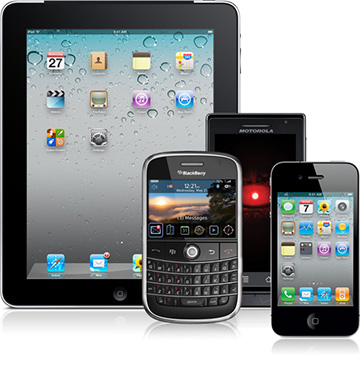
 It started with the simple phrase, "You've got mail!" Now we get beeps, alerts, vibrations, rings, and tweets from all sides. Distractions are everywhere, and preparing your children to handle multitasking is a critical skill. There is only one problem.
Multitasking is a fool's errand.
Neuroscientists have completed quite a bit of research in the area of multitasking, and the results are crystal clear. There is absolutely no ambiguity. Multitasking is a fool's errand. The attempt to multitask is doomed for failure. Our brains are not wired to multitask, and trying to do so decreases performance. The best way to teach your children about multitasking is to teach them to avoid it. As it turns out, our brains can do only one thing at a time. Multitasking requires your brain to rapidly switch back and forth between topics. This switching is not free. It takes time for your mind to become engaged in a topic, and every time you switch, the brain must re-engage with the new topic. The extra effort that your brain goes through to switch tasks results in a significant decrease in performance. In one study, students who took a test with distractions scored 20% lower than students taking the same test without distractions. Twenty percent. I know what you are thinking. You are thinking that you are the exception to the rule -- that everybody else is really bad at multitasking, but you have practiced it all your life, and you really are good at it. Even growing up, you would do your homework in the living room while watching the television and talking on the phone. You just perform better doing multiple things at once. What research shows, however, is that multitasking is a biological limitation that is built into everyone's brain. One study even showed that the better you think you are at multitasking, the worse you actually are. If you think that you are the exception to this rule -- that everybody else is bad at multitasking, but you really are good at it -- you are probably worse at multitasking than most other people.
Left With Their Own Devices
Children can't resist distractions. Left on their own with a smartphone, television, or a computer, most students cannot focus for more than 2 minutes before engaging these other media. Children can't resist distractions. In the first 15 minutes of study time, students spend only 65% of the time studying. College students, who now have laptops open in almost every class, spend about 45% of their class time doing activities that are not related to the class. Even among law students, 58% of 2nd and 3rd year students spend more than half of their class time on extracurricular activities. It is seemingly impossible to resist distractions when they are present. Students who study while multitasking understand and remember less, and they are unable to transfer learning to new contexts. Students who access Facebook during study times have also been shown to have lower grade point averages than students who do not access the social media website. It is far more effective to focus on a single task from start to finish before moving on to other tasks. The conclusion is clear. When it is time for school, you should remove all of your child's distractions, including phones, email, and social media. Families that use homeschool curriculum from Moving Beyond the Page have the option of using online curriculum. If you must have a computer on, close anything not directly related to school and turn off all automatic notifications. As the teacher, you may even consider not answering your own phone. Your mother won't understand why you don't answer the phone when you are home all day anyway, but your kids will be better off with your full attention.
What's a Homeschool Mom Supposed to Do?
All you need to do now is hire a house cleaner, a cook, and somebody else to chase your toddler around the house, and you will be free to homeschool without distractions. Multitasking is unavoidable for most parents who homeschool. Even if you can't achieve a distraction-free environment for yourself, it is important to understand the research so that you can help your children study as free of distractions as possible. Early on in our homeschooling, we used to homeschool our older children in the same room at a homeschool table. Our visions of a happy family studying at the same table, joyfully laughing and writing, quickly vanished. We soon found that it worked a lot better for all of us if they were in their own space for academic time, and we went back and forth between them (while letting our toddler have free reign of the house -- ha). Our oldest child is highly distractible, while our second is very task committed -- not the best mix! It took us a while to figure out what environment worked best with the two of them. The solution may look different for your family than for ours. If your kids are working on the same assignments, it may work great for you to have them together. Our kids work at different levels, so working in their own space made sense.
Opportunity Beeps
If you want to give your children a competitive advantage in their lives, teach them to avoid multitasking, to focus on one task or problem, and to complete it before moving on to something else. They will get more done, and they will do those things better. A twenty-percent increase in productivity over the course of a career is an unthinkable advantage. Other students may be smarter or have more experience, but there will be very few with the ability to focus long term on a project. Multitasking is not the skill you should be teaching your children. The skill you should teach is focus.
