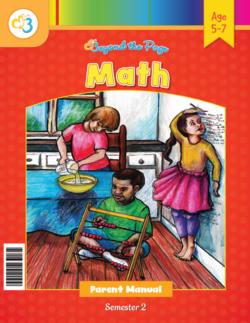
Math Unit - Time (/Online)
This item provides online access to Math Unit - Time. The digital curriculum is identical to the hard copy curriculum.
Math Unit - Time is a homeschool math curriculum unit for ages 5–7 focused on understanding, reading, representing, and organizing time. Students learn time-related vocabulary, explore calendars and clocks, and progress from telling time to the hour to reading and writing half-hour times in analog, digital, and word forms. Activities such as “My Giant Clock,” “Sequencing Time,” and “An Interactive Clock” give students several ways to connect clock representations with chronological order. The unit concludes with the three-day “How to Spend the Perfect Day” project, where students create a schedule and booklet showing activities and their times throughout an imagined day.
At a Glance
Age Range: Ages 5-7 (usually 1st grade)
Estimated Time Commitment: 11 lessons, approximately 45 minutes each
Prerequisites: Familiarity with numbers through 12, counting by 5s, and basic addition and subtraction facts
Includes: Parent-guided lessons, step-by-step teaching instructions, answer keys, and linked online practice activities
Key Features
- Time Vocabulary and Measurement: In “Exploring Words,” students sort terms such as second, minute, hour, day, week, month, before, after, noon, and sunset into related groups. Later, “How Long Do Things Last?” asks them to compare durations and match familiar activities with appropriate units of time.
- Clock Reading and Representation: Students learn how hour and minute hands move, then practice showing and interpreting times to the hour and half hour. “My Giant Clock” uses a large clock model to reinforce hour times, while “Half an Hour” connects times such as 2:30 with the expressions “two thirty” and “half past two.”
- Sequencing and Multiple Time Formats: In “Writing Time Two Ways,” students match analog clock faces with digital times. “Sequencing Time” and “More Sequencing” ask them to arrange hour and half-hour times chronologically, while “An Interactive Clock” shows how moving the minute hand changes the corresponding digital time.
- Daily Schedules and Applied Time: “My Daily Schedule” asks students to organize their own activities according to whether they happen before or after noon. Additional activities compare morning, midday, and evening events and examine how long familiar tasks take.
- Project-Based Application: In “How to Spend the Perfect Day,” students plan at least eight activities, arrange them in chronological order, estimate their durations, and assign hour or half-hour start times. They create booklet pages that show each activity’s time in both analog and digital formats.
Learning Outcomes
By the end of this unit, students will be able to:
- Use common vocabulary related to time, calendars, clocks, and duration.
- Read and represent time to the hour and half hour.
- Match analog, digital, and written representations of time.
- Arrange times and daily activities in chronological order.
- Compare durations using seconds, minutes, hours, days, weeks, months, and years.
- Identify earlier and later times.
- Organize daily activities into a schedule using hour and half-hour times.
- Represent scheduled activities in both analog and digital formats.
Math Unit - Time connects clock reading with schedules, duration, calendars, and everyday routines. Students move from learning the language of time to interpreting and sequencing clock times, then apply those ideas by planning and illustrating their own “How to Spend the Perfect Day” booklet.
This item includes online access to Beyond the Page Online for 18 months. This includes Learning Gates, Portfolio and any curriculum or student activity pages that you have purchased.