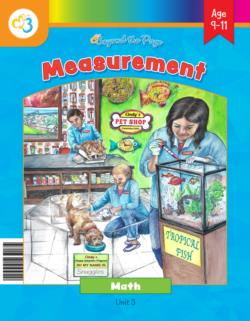
Math Unit - Measurement (/Online)
This item provides online access to Math Unit - Measurement. The digital curriculum is identical to the hard copy curriculum.
Math Unit – Measurement is a homeschool math curriculum for ages 9–11 that reviews and extends customary and metric measurement for length, weight or mass, capacity, and time. Students classify units, read measurement scales, convert between equivalent units, and solve mixed-unit problems using multiplication and division. Activities such as “Measurement Cards,” “Units and Objects,” “Converting Mixed Units,” and “Holiday Package Line Plot” connect measurement skills with practical situations and data.
At a Glance
Age Range: Ages 9–11 (usually 5th grade)
Estimated Time Commitment: 10 lessons, approximately 45 minutes each
Prerequisites: Ability to measure with customary and metric units, read fractional markings, and multiply and divide decimals
Student Independence: Designed for students to work independently, with parent support as needed
Includes: Student-directed lessons, parent guidance, student activity pages, answer keys, and online practice activities
This unit is part of the age 9-11 full year math program, which covers all fifth-grade math standards.
Key Features
- Measurement Systems and Tools: Students sort customary and metric units by length, weight or mass, and capacity, then order them by relative size. In “Reading Measurements,” they interpret scales on rulers, measuring cups, and non-electric food scales, including fractional-inch and millimeter markings.
- Unit Conversion: Students create Interactive Notebook references for equivalent measurements and determine whether a conversion requires multiplication or division. “Converting Mixed Units” extends this work to measurements such as quarts and pints, kilograms and grams, meters and centimeters, and pounds and ounces.
- Real-World Problem-Solving: Students combine conversions with arithmetic in practical situations involving candle weights, tea, balloon string, pasta, ice cream, and running distances. These problems require students to select appropriate units, convert measurements, and complete additional calculations.
- Time Measurement: Students convert among years, weeks, days, and hours and add or subtract mixed units of elapsed time. “Practicing Time Conversion” incorporates personal information such as age, height, water consumption, and distance to the library.
- Fractional Data Representation: Students construct and interpret line plots containing fractional measurements. In “Holiday Package Line Plot,” they graph package weights in quarter-pound increments and use the display to compare values and perform fraction operations.
Learning Outcomes
By the end of this unit, students will be able to:
- Distinguish customary and metric units of length, weight or mass, and capacity.
- Select appropriate measurement units for real-world objects and situations.
- Read graduated scales on common measurement tools.
- Convert equivalent customary and metric measurements using multiplication or division.
- Convert and compare mixed-unit measurements.
- Solve multistep problems involving measurement conversions and arithmetic.
- Convert, add, and subtract units of time.
- Construct and interpret line plots containing fractional measurement data.
Math Unit – Measurement connects measurement vocabulary and conversion procedures with tools, real-world problems, time, and data representation. Through Interactive Notebook references, mixed-unit applications, fractional line plots, and a culminating measurement book, students use measurement concepts in several related forms.
This item includes online access to Beyond the Page Online for 18 months. This includes Learning Gates, Portfolio and any curriculum or student activity pages that you have purchased.