Math Unit - Volume (/Online)
This item provides online access to Math Unit - Volume. The digital curriculum is identical to the hard copy curriculum.
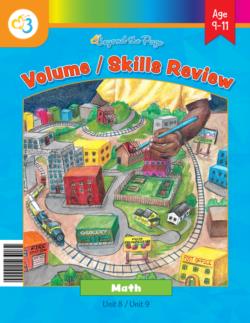
Math Unit – Volume is a homeschool math curriculum for ages 9–11 that develops volume from familiar work with perimeter and area into three-dimensional measurement. Students build rectangular prisms with centimeter cubes, represent solids with isometric drawings, and connect length, width, and height to cubic volume. Activities such as “Making Prisms,” “Making 24,” and “What’s the Volume?” move students from counting unit cubes to applying volume formulas and measuring real objects.
At a Glance
Age Range: Ages 9–11 (usually 5th grade)
Estimated Time Commitment: 14 lessons, approximately 45 minutes each
Prerequisites: Understanding of basic geometry, perimeter, and area; ability to multiply and convert measurement units.
Student Independence: Designed for students to work independently, with parent support as needed
Includes: Student-directed lessons, parent guidance, student activity pages, answer keys, and online practice activities.
Key Features
- Hands-On Volume Modeling: In “Making Prisms,” students construct different rectangular prisms from the same numbers of centimeter cubes and record their dimensions. “Making 24” then uses 24 cubes to help students connect different dimension combinations with the same volume and discover the relationship expressed by l × w × h = V.
- Spatial Reasoning and Representation: Students draw cubes and rectangular prisms on isometric dot sheets, then connect visual models with dimensions and volume. In “Volume Sort,” they match prism representations, dimensions, and corresponding cubic-volume values.
- Volume Problem-Solving: Students progress from counting cubes to using l × w × h = V and B × h = V. They calculate volumes, determine missing dimensions, compare prisms, and find the additive volume of figures composed of two non-overlapping rectangular prisms.
- Real-World Measurement: In “What’s the Volume?,” students measure box-shaped objects such as books, coolers, and boxes, choose appropriate units, and calculate their volumes. Contextual problems also use gift boxes, garden boxes, sandboxes, monuments, and other rectangular-prism examples.
- Project-Based Application: The Volume Town project asks students to act as city planners, choose and design buildings, match them to boxes or construct paper prisms, and create at least two buildings from multiple rectangular prisms. Students measure each model and calculate its volume, including additive volume for composite buildings.
Learning Outcomes
By the end of this unit, students will be able to:
- Calculate the volume of rectangular prisms by counting unit cubes.
- Apply l × w × h = V and B × h = V to volume problems.
- Determine missing dimensions when volume and other measurements are known.
- Represent rectangular prisms with isometric drawings.
- Compare prisms with different dimensions and equivalent volumes.
- Measure real rectangular objects and calculate volume using appropriate cubic units.
- Calculate additive volume for figures composed of non-overlapping rectangular prisms.
- Apply measurement and volume concepts in a multi-step model-building project.
Math Unit – Volume connects concrete models, visual representations, formulas, and practical measurement. Through cube constructions, isometric drawings, real-object measurement, problem-solving, and the Volume Town project, students use volume as a measurable property of three-dimensional objects rather than as an isolated formula.
This item includes online access to Beyond the Page Online for 18 months. This includes Learning Gates, Portfolio and any curriculum or student activity pages that you have purchased.