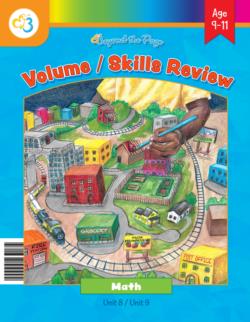
Math Unit - Volume / Skills Review
Math Unit - Volume / Skills Review is a homeschool math curriculum for ages 9–11 that develops three-dimensional measurement from concrete cube models through rectangular-prism formulas, composite volume, and applied problem-solving. Students begin by connecting perimeter and area with volume, then construct prisms, count cubic units, and use layers to understand why volume can be calculated with (V=l\times w\times h) or (V=B\times h). Activities such as “Making Prisms,” “What’s the Volume?,” “Volume is Additive!,” and “Changing Dimensions, Changing Volumes” move students from hands-on modeling to increasingly complex calculations. The unit also includes four Skills Review lessons that revisit earlier work with fractions, decimals, measurement, geometry, data, and coordinate planes.
At a Glance
Age Range: Ages 9–11 (usually 5th grade)
Estimated Time Commitment: 14 Volume lessons plus 4 Skills Review lessons, approximately 45 minutes each
Prerequisites: Ability to multiply whole numbers; familiarity with perimeter and area of rectangles and squares and their formulas. The Skills Review section assumes prior experience with fractions, decimals, measurement conversions, volume, geometry, data, and coordinate planes.
Student Independence: Designed for students to work independently, with parent support as needed
Includes: Student-directed lessons and review lessons, parent guidance, student activity pages, answer keys, Basic Skills Reviews, printable Skills Review sheets, and online practice activities
Required items: Math Materials Kit, and any required math literature sold separately
This unit is part of the age 9-11 full year math program, which covers all fifth-grade math standards.
Key Features
- Conceptual Volume Development: Students first understand volume as the amount of three-dimensional space an object occupies. In “Making Prisms,” they construct rectangular prisms with specified numbers of cubes and compare different dimensions that produce the same volume, while “Finding Volume” and “Volume and Cubes” develop cubic-unit reasoning through cube counting.
- Volume Formulas and Measurement: Students connect cube models and layers to (V=l\times w\times h) and (V=B\times h). In “What’s the Volume?,” they measure real box-shaped objects and calculate their volumes, while “Something’s Missing” asks them to work backward from a known volume to determine an unknown dimension.
- Composite and Additive Volume: Students extend rectangular-prism calculations to more complex solids. In “Volume is Additive!” and “Volumes of Complex Rectangular Prisms,” they decompose composite figures into non-overlapping prisms, calculate the volume of each section, and add the results.
- Project-Based Application: The culminating Volume Town project places students in the role of city planner. They plan and construct buildings from rectangular prisms, rank buildings by relative size, measure dimensions, calculate volumes, and include structures made from more than one prism.
- Cumulative Skills Review: Four additional review lessons revisit major mathematics skills from earlier in the year. Students review fraction operations and PEMDAS, decimal place value and arithmetic, measurement and volume—including “Volume of Rectangular Prisms” and “Missing Dimensions”—and geometry and data through line plots, polygon construction, and coordinate-plane activities.
Learning Outcomes
By the end of this unit, students will be able to:
- Distinguish perimeter, area, and volume as different types of measurement.
- Determine volume by counting cubic units and reasoning about layers.
- Calculate rectangular-prism volume using (V=l\times w\times h) and (V=B\times h).
- Measure rectangular objects and calculate their volumes.
- Determine missing prism dimensions from known volume information.
- Decompose composite rectangular prisms and calculate total volume using addition.
- Analyze how changes in one or more dimensions affect volume.
- Apply volume concepts in a model-building project and revisit related skills from earlier mathematics units.
Math Unit – Volume / Skills Review develops volume from physical models and cubic units into formulas, composite solids, measurement, and three-dimensional design. The Volume Town project brings these ideas together in student-created structures, while the accompanying Skills Review reconnects volume with earlier work in fractions, decimals, measurement, geometry, data, and coordinate reasoning.
This item includes free online access to Beyond the Page Online for 18 months. This includes Learning Gates, Portfolio and any curriculum or student activity pages that you have purchased.