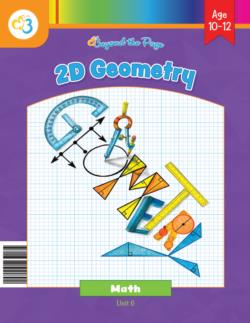
Math Unit - 2D Geometry
Math Unit - 2D Geometry is a homeschool math curriculum unit for ages 10–12 that develops geometric measurement, construction, area, circles, and scale drawing. Students begin with lines, polygons, and angle relationships, then use algebra to solve for unknown angle measures and construct triangles from given conditions. They also derive area relationships, investigate pi by measuring circles, and create reduced and enlarged figures using scale factors. The unit concludes with “Two-Dimensional Geometry Stations,” where students design four geometry challenges for family or friends to complete.
At a Glance
Age Range: Ages 10–12 (usually 6th grade)
Estimated Time Commitment: 16 instructional lessons, approximately 45 minutes each
Prerequisites: Ability to work with fractions, decimals, equations, ratios, percentages, graphs, and basic geometry
Student Independence: Designed for students to work independently, with parent support as needed
Includes: Student-directed lessons, parent overviews, answer keys, access to the online quiz tool, and a digital portfolio
Required items: Math Materials Kit, and any required math literature sold separately
This unit is part of the age 10-12 full year math program, which covers all sixth-grade math standards and approximately half of the seventh-grade standards.
Key Features
- Geometric Measurement: In “Measuring and Drawing Angles” and “Angle Relationships,” students use a protractor, classify angles, and find unknown measures using complementary, supplementary, adjacent, and vertical relationships.
- Algebra-Geometry Connections: “Geometric Equations” and “Solving Geometric Equations” ask students to represent unknown angle measures with variables, solve equations, and interpret the results in geometric diagrams.
- Geometric Construction: In “Drawing Triangles: Part 1” and “Drawing Triangles: Part 2,” students use rulers, protractors, and coordinate grids to construct triangles and determine whether given conditions create unique, multiple, or impossible figures.
- Area and Circle Investigation: Students rearrange parallelograms and triangles to develop area formulas, decompose irregular polygons, and measure circumference and diameter to observe the relationship represented by pi.
Learning Outcomes
By the end of this unit, students will be able to:
- Identify and classify points, lines, segments, rays, polygons, and angle types.
- Measure and construct angles and use angle relationships to determine unknown measures.
- Write and solve algebraic equations involving geometric relationships.
- Construct triangles from given side and angle conditions and compare corresponding parts.
- Distinguish congruent figures from similar figures.
- Calculate the area of parallelograms, triangles, irregular polygons, and circles.
- Calculate circumference and explain the relationship among radius, diameter, circumference, and pi.
- Calculate scale factors and create or analyze scale drawings.
Math Unit - 2D Geometry connects geometric measurement, algebra, construction, area, circles, and proportional reasoning through diagrams, manipulatives, calculations, and applied tasks. Rather than working only from formulas, students measure, construct, rearrange, compare, and create geometric models, then bring these skills together in a station-based final project.
This item includes free online access to Beyond the Page Online for 18 months. This includes Learning Gates, Portfolio and any curriculum or student activity pages that you have purchased.