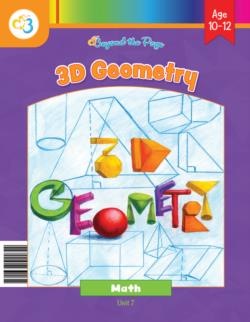
Math Unit - 3D Geometry
Math Unit - 3D Geometry is a homeschool math curriculum unit for ages 10–12 that extends two-dimensional geometry into the study of three-dimensional solids. Students identify polyhedra, analyze nets, and use faces, edges, vertices, and bases to describe solid figures before moving into surface area, volume, and cross sections. Activities such as taking apart a cardboard box, folding geometric nets, slicing modeling-clay solids, and calculating dimensions for aquariums and mailing boxes give students concrete ways to explore spatial relationships. The unit concludes with a three-day project in which students assemble at least six nets into a model such as a robot, house, animal, or castle.
At a Glance
Age Range: Ages 10–12 (usually 6th grade)
Estimated Time Commitment: 10 instructional lessons, approximately 45 minutes each
Prerequisites: Ability to calculate area, multiply fractions and decimals, and understand equations, scale factors, and 2D shapes
Student Independence: Designed for students to work independently, with parent support as needed
Includes: Student-directed lessons, parent overviews, answer keys, access to the online quiz tool, and a digital portfolio
Required items: Math Materials Kit, and any required math literature sold separately
This unit is part of the age 10-12 full year math program, which covers all sixth-grade math standards and approximately half of the seventh-grade standards.
Key Features
- Spatial Reasoning: In “Geometric Nets” and “Working with Nets,” students take apart and assemble solids, predict which figures nets will form, and use Euler’s Formula to analyze faces, edges, and vertices.
- Surface Area: “Surface Area with Nets” asks students to measure individual faces and combine their areas before moving to formulas for cubes and rectangular prisms.
- Volume Problem-Solving: Students calculate volume for rectangular prisms, cubes, and other right prisms, including applications involving aquariums, mailing boxes, and missing dimensions.
- Cross-Section Investigation: Students slice modeling-clay solids parallel, perpendicular, and diagonally to a base, then identify and compare the resulting two-dimensional cross sections.
- Project-Based Geometry: In the final project, students select at least six nets representing three or more solid types, calculate surface area and volume, and assemble the solids into a finished three-dimensional model.
Learning Outcomes
By the end of this unit, students will be able to:
- Identify and describe polyhedra using faces, edges, vertices, and bases.
- Connect geometric nets to the three-dimensional solids they form.
- Apply Euler’s Formula to determine missing faces, edges, or vertices.
- Calculate surface area using nets and formulas.
- Calculate volume for rectangular prisms, cubes, and other right prisms.
- Use volume formulas to determine missing dimensions.
- Identify and compare cross sections created by different slices through three-dimensional solids.
- Apply nets, surface area, volume, and spatial reasoning in a multi-step three-dimensional model.
Math Unit - 3D Geometry connects two-dimensional area with the structure and measurement of three-dimensional solids. Through nets, physical models, cross-section investigations, applied measurement problems, and a culminating construction project, students work with geometry as something they can build, measure, analyze, and represent.
This item includes free online access to Beyond the Page Online for 18 months. This includes Learning Gates, Portfolio and any curriculum or student activity pages that you have purchased.