Math Unit - Integers and Rational Numbers (/Online)
This item provides online access to Math Unit - Integers and Rational Numbers. The digital curriculum is identical to the hard copy curriculum.
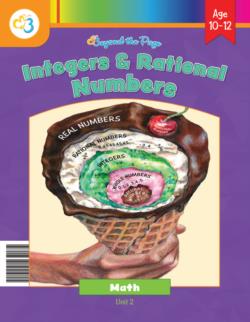
Math Unit - Integers and Rational Numbers is a homeschool math curriculum for ages 10-12 that develops students’ understanding of fractions, signed numbers, rational numbers, and the coordinate plane. Students begin with fraction models and operations, then extend their number sense to positive and negative numbers, absolute value, inequalities, and rational-number classification. They also use all four quadrants of the coordinate plane to represent locations, distances, and figures. Visual models, hands-on reference materials, and real-world problems help students connect symbolic procedures to quantities and relationships they can see and interpret.
At a Glance
Age Range: Ages 10-12 (usually 6th grade)
Estimated Time Commitment: 16 lessons, approximately 45 minutes each
Prerequisites: Ability to simplify fractions, convert between mixed and improper fractions, and multiply and divide
Student Independence: Designed for students to work independently, with parent support as needed
Includes: Student-directed lessons, parent overviews, answer keys, access to the online quiz tool, and a digital portfolio
This unit is part of the age 10-12 full year math program, which covers all sixth-grade math standards and approximately half of the seventh-grade standards.
Key Features
- Visual Fraction Models: Students use area models to represent fraction operations before moving to symbolic procedures. For fraction division, they examine how many groups fit into a quantity and then practice the “Keep, Switch, Flip, and Solve” process with number and operation cards.
- Number-System Reasoning: Temperatures below zero and underground building levels give positive and negative numbers concrete meaning. Students also build a rational-number diagram to organize natural numbers, whole numbers, integers, and rational numbers and see how these sets relate.
- Hands-On Learning: Students create reference tools such as a number-classification diagram and a folded coordinate plane. These materials help them visualize concepts such as number relationships and reflections while they work with increasingly abstract notation.
- Real-World Application: Fraction, integer, and coordinate concepts appear in problems involving garden sections, paint, temperatures, building floors, bus stops, roads, and maps. Students use mathematics to determine quantities, compare positions, and represent locations rather than practicing procedures only in isolation.
Learning Outcomes
By the end of this unit, students will be able to:
- Convert between fractions and mixed numbers and perform operations with fractions and mixed numbers.
- Solve real-world problems involving fraction multiplication and division.
- Identify and classify natural numbers, whole numbers, integers, and rational numbers.
- Compare and order positive and negative numbers using number lines and inequalities.
- Identify opposites and additive inverses and calculate absolute value and distance on a number line.
- Plot and interpret points in all four quadrants of the coordinate plane.
- Apply rational numbers and coordinates to problems involving quantities, distances, and locations.
Math Unit – Integers and Rational Numbers connects fraction computation with a broader understanding of the number system and coordinate space. Instead of treating these topics as separate sets of procedures, students use models, reference tools, and contextual problems to see how rational numbers describe quantities, distances, and positions.
This item includes online access to Beyond the Page Online for 18 months. This includes Learning Gates, Portfolio and any curriculum or student activity pages that you have purchased.