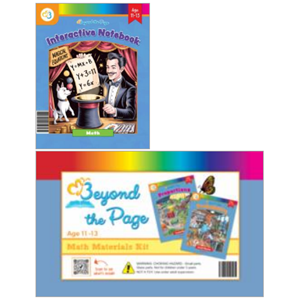
Age 11-13 Math Materials Kit
The Age 11-13 Math Materials Kit provides materials used in the full year of Age 11-13 math activities. Students calculate unit rates from timed activities, investigate slope with a model ramp, compare experimental and theoretical probability, demonstrate geometric relationships, and build physical data models as they develop proportional reasoning, probability, geometry, and statistics skills.
Build a Deeper Understanding of Math Concepts
This kit provides materials used in activities throughout the math units. Here are a few examples your child will complete.
- Turn a Real Activity Into a Unit Rate: Your child folds paper for 30 seconds, records the number of sheets completed, and calculates a rate in sheets per second. Connecting a measured activity with a “per one” rate makes unit rates more concrete and shows how they can be used to predict results over longer periods.
- Connect Slope to a Real Ramp: Your child builds ramps at different angles and observes how changing the rise or run affects steepness and movement. Adjusting the model helps connect the calculation of rise over run with the physical meaning of slope.
- Compare Experimental and Theoretical Probability: Your child rolls a die in increasingly larger sets of trials, records each result, and compares the experimental frequency with the theoretical probability of 1/6. Comparing the rounds shows why small samples can vary and how larger numbers of trials can reveal more stable patterns.
- Demonstrate Why Triangle Angles Total 180°: Your child cuts the three corners from a triangle and rearranges them along a straight line. Seeing the angles fit together provides a physical demonstration that the three interior angles of a triangle add to 180°.
Making Hands-On Math Easier to Implement
As math becomes more abstract, physical models can help students see the relationships behind the calculations. The Age 11-13 Math Materials Kit supports this type of learning by giving your child opportunities to measure, build, test, and organize mathematical ideas in concrete ways.
The following items are included in this kit. This list is subject to change.
- calculator
- construction paper
- paper
- ruler
- chalk
- graph paper
- index cards
- blue cards
- die
- green cards
- red cards
- yellow cards
- black marker
- canvas board
- foam cone
- foam cylinder
- foam sphere
- glitter
- paint
- paintbrush
- ribbon
- toothpicks
- tracing paper
- 10-sided die (numbered 0–9)
- marbles
- spinner
- sticky notes
Manipulative
This manipulative is used in the following packages.