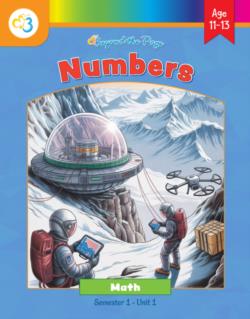
Math Unit - Numbers
Math Unit - Numbers develops students’ understanding of rational and irrational numbers and the different forms in which numbers can be represented and used. Students begin with positive and negative rational numbers, then connect fractions and decimals before moving into exponent properties, roots, irrational numbers, and scientific notation. Activities such as “Opposites Combine to Make Zero,” “Approximating Irrational Numbers,” and “Navigate the Maze with SN” connect procedures to number lines, scientific quantities, and real-world situations. The unit concludes with an “Arctic Marine Research” project that combines signed numbers, fractions, exponents, scientific notation, and number classification in a marine-biology investigation.
At a Glance
Age Range: Ages 11–13 (usually 7th grade)
Estimated Time Commitment: 17 lessons, approximately 60 minutes each
Prerequisites: Ability to work with fractions, decimals, reciprocals, and order of operations
Student Independence: Designed for students to work independently, with parent support as needed
Includes: Student-directed lessons, parent plans, Student Activity Pages, answer keys, a unit test, and final-project instructions
Required items: Math Materials Kit sold separately
This unit is part of the age 11-13 full year math program, which covers approximately half of the seventh-grade math standards and all of the eight-grade standards.
Key Features
- Rational Number Reasoning: In “Positive and Negative Rational Numbers” and “Opposites Combine to Make Zero,” students use number lines and zero pairs to interpret signed numbers in contexts such as temperature, money, depth, and atomic charges.
- Exponents and Roots: Students apply zero and negative exponents along with Product of Powers, Quotient of Powers, Power of a Power, and Power of a Product before connecting exponent work to square and cube roots.
- Rational and Irrational Numbers: In “Approximating Irrational Numbers,” students classify, estimate, compare, and order values including fractions, repeating decimals, π, and non-perfect roots.
- Applied Math and Science: The “Arctic Marine Research” project combines scientific notation, exponents, fractions, signed numbers, and rational-versus-irrational classification in an Arctic ecosystem study.
Learning Outcomes
By the end of this unit, students will be able to:
- Perform multiplication and division with positive and negative rational numbers and interpret signed values in context.
- Convert fractions to terminating or repeating decimals and convert decimals back to fractions.
- Apply zero, negative, product, quotient, and power exponent properties.
- Evaluate square and cube roots and connect roots to exponent relationships.
- Classify numbers as rational or irrational.
- Approximate, compare, and order irrational numbers.
- Convert between standard and scientific notation and perform all four operations with numbers in scientific notation.
- Apply multiple number concepts in scientific and real-world problems.
Math Unit - Numbers connects signed numbers, fractions, decimals, exponents, roots, irrational numbers, and scientific notation as related ways of representing and working with quantities. Interactive Notebook references, contextual problems, cumulative review, and the “Arctic Marine Research” project give students repeated opportunities to apply these ideas rather than practice each skill only in isolation.
This item includes free online access to Beyond the Page Online for 18 months. This includes Learning Gates, Portfolio and any curriculum or student activity pages that you have purchased.