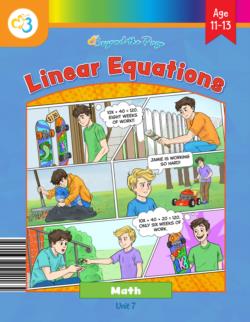
Math Unit - Linear Equations
Math Unit – Linear Equations is a homeschool math curriculum for ages 11–13 that develops equation-solving from one-variable review through multi-step equations and systems of equations. Students begin with one-step and two-step equations, then work with fractions, decimals, distribution, like terms, and variables on both sides. Activities such as the “Fix-It Lab,” “Problem Solving with Multi-Step Equations,” and “Categorizing No Solution, One Solution, and Infinite Solutions” combine procedural practice with real-world modeling and visual reasoning.
At a Glance
Age Range: Ages 11–13 (usually 7th grade)
Estimated Time Commitment: 17 lessons, approximately 45 minutes each
Prerequisites: Ability to solve equations, combine like terms, work with fractions and decimals, and graph linear equations
Student Independence: Designed for students to work independently, with parent support as needed
Includes: Student-directed lessons, Parent Plan sections, Student Activity Pages, answer keys, graphing activities, and review materials
Required items: Math Materials Kit sold separately
This unit is part of the age 11-13 full year math program, which covers approximately half of the seventh-grade math standards and all of the eight-grade standards.
Key Features
- Equation-Solving Fluency: Students progress from inverse operations to equations involving fractions, decimals, distribution, like terms, and variables on both sides. “Problem Solving with Multi-Step Equations” combines several of these skills in equations that require multiple algebraic steps.
- Real-World Modeling: Students define variables, write equations, solve them, and interpret answers in contexts such as catering costs, phone plans, discounts, water tanks, grocery shopping, contractor fees, rent, fuel costs, and concert tickets. “Advanced Real-World Equations” extends this work to more complex situations with multiple operations.
- Solution Structure: Students distinguish equations with one solution, no solution, and infinitely many solutions by examining the results of simplification. In “Categorizing No Solution, One Solution, and Infinite Solutions,” they solve equations, sort them into categories, and create an Interactive Notebook reference page.
- Systems of Equations: Students solve systems by graphing, substitution, and elimination. In “Mixed Practice,” they either use a specified method or choose the approach that best fits the form of the equations.
- Visual and Hands-On Reasoning: Graphing helps students connect intersecting, parallel, and overlapping lines with one solution, no solution, and infinitely many solutions. Optional work such as “Math in Motion Collage” provides another visual way to represent these solution types.
Learning Outcomes
By the end of this unit, students will be able to:
- Solve one-step, two-step, and multi-step linear equations.
- Solve equations involving fractions, decimals, distribution, and like terms.
- Translate real-world situations into linear equations and interpret solutions in context.
- Distinguish equations with one solution, no solution, and infinitely many solutions.
- Connect solution types with intersecting, parallel, and overlapping lines.
- Solve systems of equations by graphing, substitution, and elimination.
- Select an appropriate method for solving a system based on the form of the equations.
- Apply earlier equation-solving skills in cumulative review and systems problems.
Math Unit – Linear Equations moves students from familiar equation-solving procedures to more complex algebraic reasoning and systems of equations. Through multistep practice, real-world modeling, solution classification, graphing, substitution, and elimination, students examine both how equations are solved and what their solutions mean.
This item includes free online access to Beyond the Page Online for 18 months. This includes Learning Gates, Portfolio and any curriculum or student activity pages that you have purchased.