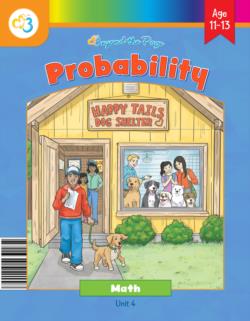
Math Unit - Probability
Math Unit – Probability is a homeschool math curriculum for ages 11–13 that develops probability reasoning through theoretical and experimental probability, probability models, compound events, and simulations. Students begin by placing events on a Probability Line, identifying sample spaces, and comparing predicted outcomes with results from actual trials. Activities such as “It’s a Coin Toss” and “Spin It Up” have students collect data across increasing numbers of trials, while later lessons use tree diagrams, non-uniform probability models, and simulations such as “Blue Marbles” and “Music Playlist.”
At a Glance
Age Range: Ages 11–13 (usually 7th grade)
Estimated Time Commitment: 11 lessons, approximately 45 minutes each
Prerequisites: Ability to work with fractions, decimals, percentages, ratios, and basic probability
Student Independence: Designed for students to work independently, with parent support as needed
Includes: Student-directed lessons, Parent Plan sections, Student Activity Pages, answer keys, unit assessment materials, and final-project materials
Required items: Math Materials Kit sold separately
This unit is part of the age 11-13 full year math program, which covers approximately half of the seventh-grade math standards and all of the eight-grade standards.
Key Features
- Experimental Probability: Students compare theoretical probability with observed results through repeated trials. In “It’s a Coin Toss,” they flip a coin 5, 10, 50, and 100 times and convert their results to fractions, decimals, and percentages; in “Spin It Up,” they use 100 spinner trials to predict outcomes for 600 spins.
- Probability Modeling: Students identify sample spaces, assign probabilities, and predict expected outcomes across situations involving dice, marbles, spinners, cards, tokens, and other chance events. They also build non-uniform models from real-world frequency data and use “Grouping Events” to organize outcomes before calculating probability.
- Compound Probability: Students construct complete sample spaces for events with multiple stages and organize possible outcomes with tree diagrams. They then calculate compound probabilities and use the results to make inferences about the situations they analyze.
- Simulation and Prediction: In “Blue Marbles” and “Music Playlist,” students use repeated simulated outcomes to estimate probabilities for compound events. These activities connect calculated probability with observed frequencies and prediction.
- Probability Vocabulary and Representation: The “Probability Line” connects values from 0 to 1 with terms such as impossible, unlikely, equally likely, likely, and certain. Students also use sample spaces and consistently express probability as fractions, decimals, and percentages.
Learning Outcomes
By the end of this unit, students will be able to:
- Classify events by likelihood using probability values from 0 to 1.
- Distinguish between theoretical and experimental probability.
- Calculate and represent probabilities as fractions, decimals, and percentages.
- Identify sample spaces and determine probabilities for possible outcomes.
- Construct and interpret uniform and non-uniform probability models.
- Use experimental data and relative frequency to make predictions.
- Represent compound events with sample spaces and tree diagrams and calculate their probabilities.
- Use simulations to estimate probabilities for compound-event situations.
Math Unit – Probability moves students from describing the likelihood of simple events to modeling, testing, and interpreting more complex chance situations. Through coin tosses, spinner experiments, probability models, tree diagrams, and simulations, students compare mathematical predictions with observed data and use both to reason about probability.
This item includes free online access to Beyond the Page Online for 18 months. This includes Learning Gates, Portfolio and any curriculum or student activity pages that you have purchased.