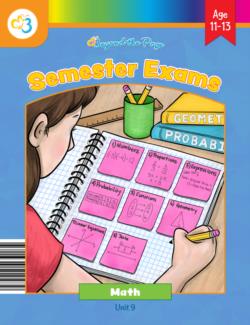
Math Unit - Semester Exams
Math Unit – Semester Exams is a homeschool math curriculum review for ages 11–13 that revisits major concepts from Units 1–8 before two semester assessments. Activities such as “Proportional Relationships & Unit Rates,” “Expressions & Equation Structure,” and “Understanding & Calculating Probability” combine computational practice with explanation and application.
At a Glance
Age Range: Ages 11–13 (usually 7th grade)
Estimated Time Commitment: 8 lessons, approximately 45 minutes each
Prerequisites: Familiarity with Units 1–8, including operations, equations, ratios, functions, geometry, probability, and data
Student Independence: Designed for students to work independently, with parent support as needed
Includes: Student-directed review lessons, Parent Plan sections, Student Activity Pages, answer keys, and two semester exams
Required items: Math Materials Kit sold separately
This unit is part of the age 11-13 full year math program, which covers approximately half of the seventh-grade math standards and all of the eight-grade standards.
Key Features
- Comprehensive Skills Review: Each lesson revisits a major area from earlier units. Students review topics ranging from signed-number operations and scientific notation to proportional relationships, algebra, probability, geometry, systems of equations, and statistics.
- Cross-Representation Reasoning: Students move among equations, tables, graphs, verbal rules, and diagrams. In the Functions Review, for example, they identify functions from tables and graphs, write equations from verbal rules, complete tables, and classify relationships as linear or nonlinear.
- Applied Mathematical Reasoning: Review problems place earlier skills in contexts such as sales tax, discounts, class costs, movie-theater fees, ticket sales, and distance problems. Students translate situations into expressions, equations, or systems and explain what their solutions mean.
- Integrated Exam Preparation: The review is organized specifically around the content assessed in two semester exams. Students use earlier videos and Interactive Notebook notes as needed, then complete “Semester Exam Units 1–4” and “Semester Exam Units 5–8” as cumulative checkpoints.
- Explanation and Self-Checking: Students do more than calculate answers. They classify numbers, explain probability representations, interpret relative frequencies, justify mathematical relationships, and identify areas where additional review may be needed.
Learning Outcomes
By the end of this unit, students will be able to:
- Review and apply major number-operation, exponent, root, and scientific-notation skills.
- Analyze proportional relationships, unit rates, constants of proportionality, graphs, and percent applications.
- Simplify expressions and solve algebraic equations in symbolic and real-world contexts.
- Apply theoretical, experimental, and compound probability concepts using sample spaces and tree diagrams.
- Identify and compare functions using equations, tables, graphs, and verbal rules.
- Review geometry concepts including transformations, angle relationships, the Pythagorean Theorem, and volume.
- Solve linear equations and systems using graphing, substitution, and elimination.
- Analyze data using measures of center and variability, scatterplots, linear models, and two-way tables.
Math Unit – Semester Exams consolidates the major mathematical ideas developed across Units 1–8. Through focused review, cross-representation practice, applied problems, and two cumulative exams, students revisit previously taught skills and organize them into a broad year-end review.
This item includes free online access to Beyond the Page Online for 18 months. This includes Learning Gates, Portfolio and any curriculum or student activity pages that you have purchased.