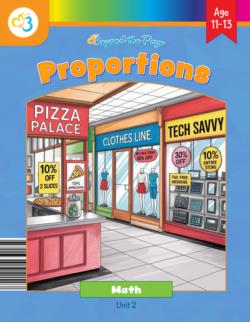
Math Unit - Proportions (/Online)
This item provides online access to Math Unit - Proportions. The digital curriculum is identical to the hard copy curriculum.
Math Unit – Proportions is a homeschool math curriculum for ages 11–13 that develops proportional reasoning through ratios, unit rates, constants of proportionality, graphs, equations, and percent applications. Students begin by setting up and solving proportions, then compare unit rates and work with complex fractions. They progress to direct variation, equations of the form (y=kx), and proportional relationships represented through tables, graphs, equations, and words.
At a Glance
Age Range: Ages 11–13 (usually 7th grade)
Estimated Time Commitment: 20 lessons, approximately 45 minutes each
Prerequisites: Ability to work with fractions, ratios, multiplication, division, and unknown values
Student Independence: Designed for students to work independently, with parent support as needed
Includes: Student-directed lessons, Parent Plan sections, Student Activity Pages, answer keys, and assessment/project instructions
This unit is part of the age 11-13 full year math program, which covers approximately half of the seventh-grade math standards and all of the eight-grade standards.
Key Features
- Multiple Representations: Students examine proportional relationships through tables, equations, graphs, and verbal descriptions. In “Graphing Proportional Relationships,” they identify variables, write an equation in the form (y=r\cdot x), create a table with at least five points, graph the points, and label the axes.
- Constant Rate and Direct Variation: Students use (k=y/x) to determine whether tables maintain a constant proportional relationship. Through “Identifying Direct Variations” and “Constant of Proportionality in Equations,” they classify equations in the form (y=kx) and rearrange equations such as (4y=8x) to identify the constant of proportionality.
- Graphing and Visual Analysis: Students use graphs to test and interpret proportional relationships rather than simply plot points. They identify straight lines through ((0,0)), interpret the meaning of the origin, and use the point ((1,r)) to connect a graph to its unit rate.
- Applied Problem-Solving: Problems become increasingly complex as students work with changing rates, complex fractions, measurement conversions, and multistep percent situations. Examples include a T-shirt fundraiser with a 10% bulk discount, a road-paving work-rate problem, comparisons involving yards and feet, and applications involving tax, markups, markdowns, gratuity, commission, and simple interest.
Learning Outcomes
By the end of this unit, students will be able to:
- Set up and solve proportions using equivalent ratios.
- Calculate and compare unit rates in practical situations.
- Solve unit-rate problems involving complex fractions.
- Determine the constant of proportionality from tables, graphs, and equations.
- Identify direct variation and represent proportional relationships with equations of the form (y=kx).
- Represent and compare proportional relationships using words, tables, equations, and graphs.
- Determine whether a graph represents a proportional relationship and interpret key points such as ((0,0)) and ((1,r)).
- Apply proportional reasoning to multistep problems involving tax, markups and markdowns, percent increase and decrease, gratuity, commission, and simple interest.
Math Unit – Proportions moves students from basic equivalent-ratio reasoning to algebraic, graphical, and multistep applications of proportional relationships. Through unit-rate comparisons, direct-variation work, graph analysis, and practical percent problems, students examine how the same proportional relationship can be expressed and used in several forms.
This item includes online access to Beyond the Page Online for 18 months. This includes Learning Gates, Portfolio and any curriculum or student activity pages that you have purchased.