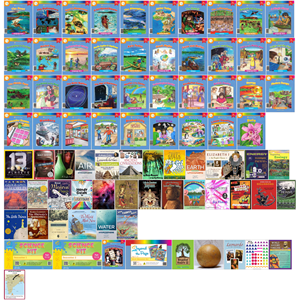
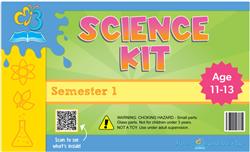
Age 11-13 - Semester 1 - Science Kit
The Age 11-13 - Semester 1 - Science Kit provides specialized materials for hands-on investigations in the following units
- The Hydrosphere
- The Atmosphere
- The Lithosphere
- Ecosystems and Ecology
- Earth Cycles and Systems.
These activities help children model the water cycle, observe atmospheric pressure, simulate plate movement, test environmental changes, and investigate how matter cycles through Earth’s systems.
Engage Your Child with a Hands-on Science Curriculum
This kit includes over 60 materials used in experiments throughout the semester. Here are a few examples your child will complete.
- Explore the Water Cycle in a Bag: Your child creates a miniature water cycle in a sealed bag and places it in a sunny window. Observing droplets form and fall demonstrates how evaporation, condensation, and precipitation move water through the environment.
- Discover the Force of Atmospheric Pressure: Your child heats water in a soda can, then places the can upside down in ice water and observes it collapse. The dramatic result demonstrates how differences in air pressure can exert force on objects.
- Investigate How Tectonic Plates Change Earth’s Surface: Your child uses colored clay to model plate boundaries and pushes, pulls, and slides the “plates.” Observing how the clay changes helps connect plate movement to mountains, faults, earthquakes, volcanoes, and rifts.
- Test How Toxicants Affect an Ecosystem: Your child compares local plants grown under similar conditions while adding a toxicant to selected samples. Observing changes over several days shows how harm to producers can affect relationships within an ecosystem.
- Explore the Conservation of Matter: Your child weighs a cookie, breaks it into increasingly smaller pieces, and measures its mass after each change. Comparing the measurements demonstrates that matter can change form without being created or destroyed.
A Complete Hands-On Science Experience
Hands-on science can require families to gather specialized supplies for many different investigations. This kit provides materials used throughout the semester’s activities, reducing preparation and helping parents focus on guiding observations, comparisons, measurements, and scientific conclusions.
The following items are included in this kit. This list is subject to change.
- 2 large clear cups
- blue food coloring
- clear jar or container with a lid
- coffee filter
- cotton balls
- dirt
- eye dropper
- graduated cylinder
- gravel
- green food coloring
- ice cube tray
- large clear cups
- large plastic funnel
- large zip lock bag
- modeling clay
- note cards
- pebbles
- penny
- permanent marker
- plastic bag
- red food coloring
- sand
- scale
- small clear cups
- soil
- sponge
- yellow food coloring
- 8 1/2 by 11 piece of cardboard
- Alka-Seltzer tablets
- aluminum foil
- black paper
- brass fastener
- clear plastic jar
- envelopes
- food coloring
- index cards
- plastic bottles
- plastic spoon
- safety goggles
- sheet of white paper
- sticky notes (Option 2)
- thermometer
- two balloons
- weather map
- white glitter
- white paper
- ceramic streak plate
- clay
- construction paper
- glass plate
- magnifying glass
- sharpened pencil
- soil test kit
- wooden blocks
- 12 oz. clear cups
- borax
- bottle of school glue
- small paper cups
- vinyl gloves
- zip top bag
- 4' x 4' clear plastic sheet
- eye droppers
- iodine solution
- test tube
Manipulative
This manipulative is used in the following packages.