


Most homeschool and distance learning curricula say they build critical thinking.
The phrase is everywhere.
It appears in program descriptions.
In marketing language.
In promises about preparing children for the future.
Claims are easy to make.
Beyond the Page develops critical thinking more completely than any other homeschool or distance learning curriculum available.
That is a strong statement.
As any critical thinker knows, strong statements should not be accepted at face value.
They should be tested.
There is a simple question parents should ask.
What does the curriculum actually ask students to do?
Because critical thinking is not built through claims.
It is built through repeated practice.
A curriculum that truly builds critical thinking should give students regular opportunities to
- ask meaningful questions,
- support ideas with evidence,
- evaluate information,
- connect ideas across subjects, and
- reach original conclusions.
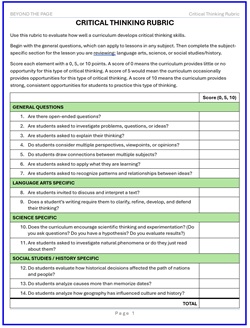
Critical Thinking Rubric

That is why we created a critical thinking rubric.
This rubric will help parents see in a very practical way what is often hidden.
The rubric is not meant to measure every possible part of critical thinking. No simple tool can do that.
Instead it gives parents a clear and useful way to evaluate whether a curriculum consistently gives students the kind of work that builds critical thinking over time.
We encourage you to apply the rubric to our curriculum first. But don't stop there. Apply the rubric to any curriculum you are considering.
The results may surprise you.
How to Use the Rubric
You can download and print the rubric PDF and use it as you review curriculum samples.
Most homeschool curricula provide sample lessons on their websites. Open those samples and look closely at what students are actually being asked to do.
Not what the curriculum says it values. What the child practices.
That distinction matters.
- Explain their reasoning
- Support ideas with evidence
- Compare possibilities
- Make connections
- Create something that reflects understanding.
One strong activity is not enough. You are looking for patterns. Children are formed by what they practice repeatedly.
The rubric is divided into four sections. The first section applies broadly to all subjects.
But critical thinking does not look the same in every subject.
In language arts it may look like analyzing a character's choices, identifying themes, or supporting an interpretation with evidence from the text.
In science it may look like making observations, analyzing results, explaining what those results suggest, or revising an experiment based on evidence.
In history and social studies it may look like examining decisions, comparing perspectives, identifying causes and consequences, or connecting past events to larger human questions.
Use the last three sections to evaluate the subject of the lesson you are looking at.
Critical Thinking Is at the Heart of What We Do
Critical thinking is sometimes treated like a special category. A child works through a lesson and then occasionally, there is an activity or question labeled as the "Critical Thinking" piece.
This is not what we mean when we claim to develop critical thinking.
It isn't a single question in a lesson.
It isn't a bonus activity for advanced students.
It isn't tacked on at the end.
In a strong curriculum, critical thinking is integral to the curriculum structure.
It is built into how students read.
How they write.
How they investigate.
How they discuss.
How they respond.
How they create.
It is not additional content. It is built into the content.
Why We Built Beyond the Page
The lack of meaningful critical thinking in many homeschool curricula was one of the reasons we created Beyond the Page.
We did not want to build a curriculum that simply moved children through content.
We wanted something deeper.
We wanted students to do more than remember information and complete assignments. We wanted them to question, explain, compare, evaluate, connect, and create.
Because that is where real thinking develops.
This is not accidental.
It is the design.
