


Many parents assume that art, drama, or music provides their children with all of the creativity they need. But creativity should not be limited to the arts.
Many homeschool curricula do not develop creative thinking within the core academic subjects. When creativity does appear, it is often added to the end of a lesson: make an animal craft after studying habitats, create a history lapbook, or build a pioneer cabin out of craft sticks. These activities can be fun and engaging, but they do not necessarily teach children to think creatively about science, mathematics, history, or literature.
Creative thinking helps children explore scientific questions, consider different solutions, interpret literature, and develop arguments.
So how should you evaluate a curriculum for creative thinking?
One easy way to evaluate a curriculum is to look at what students are asked to produce. Consider the writing program. Does it primarily ask students to copy or reproduce what someone else has written, or are students asked to generate possibilities, make meaningful choices, and develop their own ideas?
- Fluency — generating many ideas or possibilities.
- Flexibility — approaching a problem from different angles or categories.
- Originality — producing ideas that are new, unexpected, or personally unique.
- Elaboration — developing an idea with detail, depth, and refinement.
Fluency
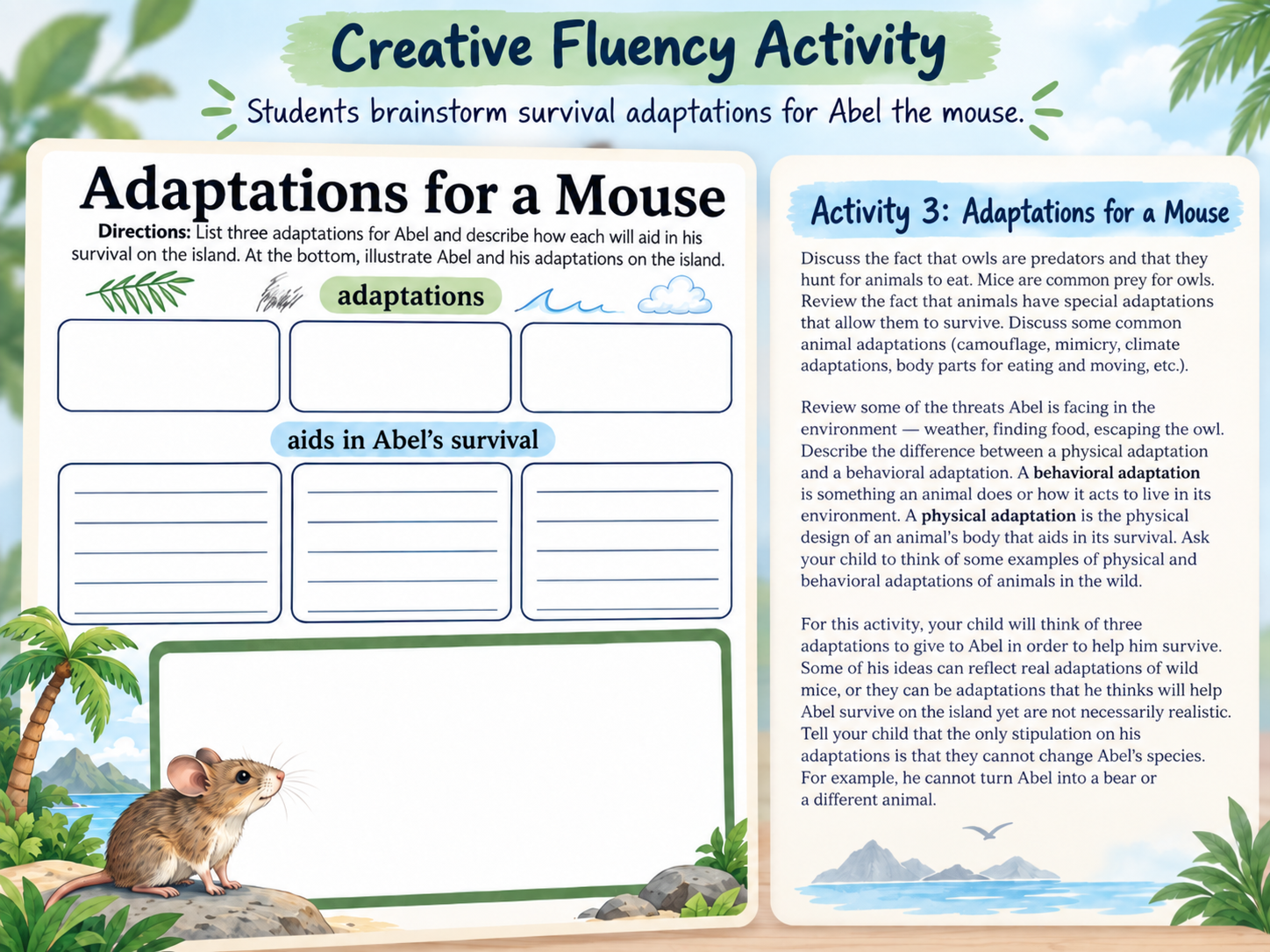
Fluency involves recognizing that the best idea is not usually the first idea.
Fluency encourages the generation of many ideas, solutions, or possibilities. It helps children move beyond the first answer that comes to mind, recognizing that the best answer can require time and deep thought.
There are children who come by fluency naturally, but most of us need a lot of practice. It is natural for a child to go with the first idea that pops in his head. But when a student learns to practice fluency, she becomes comfortable with being thoughtful, looking at different angles ,and considering different options before settling on one.
In Beyond the Page units sometimes fluency practice is written directly into the lesson. For example, in our literature unit for Abel’s Island, students are asked to invent three adaptations that would help Abel survive while he is stranded on an island. With each solution, students ideas usually become more thoughtful and practical.
But there is another important indicator you can look for to determine whether fluency is being practiced within a lesson - how often are children given options, choices, or agency to decide what they will work on or how the final product will look? These choices should require thought, not just preference, and there should be room for comparing possibilities before making a final choice. Beyond the Page provides these options on a regular basis, and they give your child the practice needed for developing fluency.
Flexibility
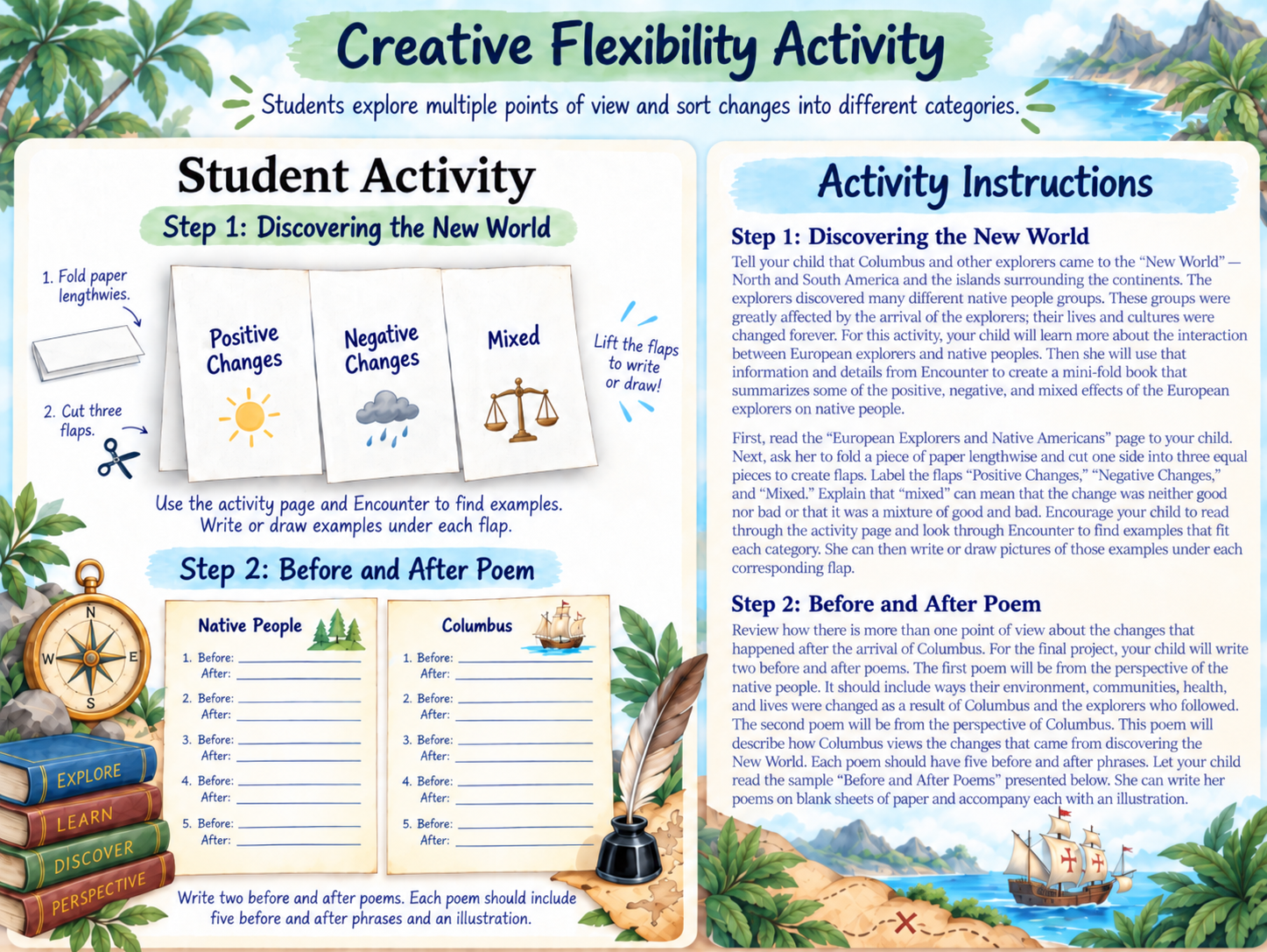
Flexibility is one of the most interesting and often misunderstood dimensions of creativity. While fluency is about generating many ideas, flexibility is about generating different kinds of ideas.
Flexibility builds on fluency. It does require multiple ideas, but is more concerned with how different they are rather than just the quantity.
Flexibility can help students develop empathy as they evaluate characters and situations from other perspectives. Flexibility builds resilience. Instead of saying "I can't do this," flexible learners ask, "What else can I try?" or “What is another way to look at the problem?”
Students develop creative flexibility throughout the Morning Girl unit by examining events from different perspectives and expressing ideas in different voices. They compare how several characters interpret the same experience, write from the viewpoints of Morning Girl and of Star Boy, and describe the explorers’ arrival from both Native and European perspectives. These activities teach students to shift their thinking, reconsider events through another person’s experiences, and recognize that the same situation can lead to very different interpretations.
Originality
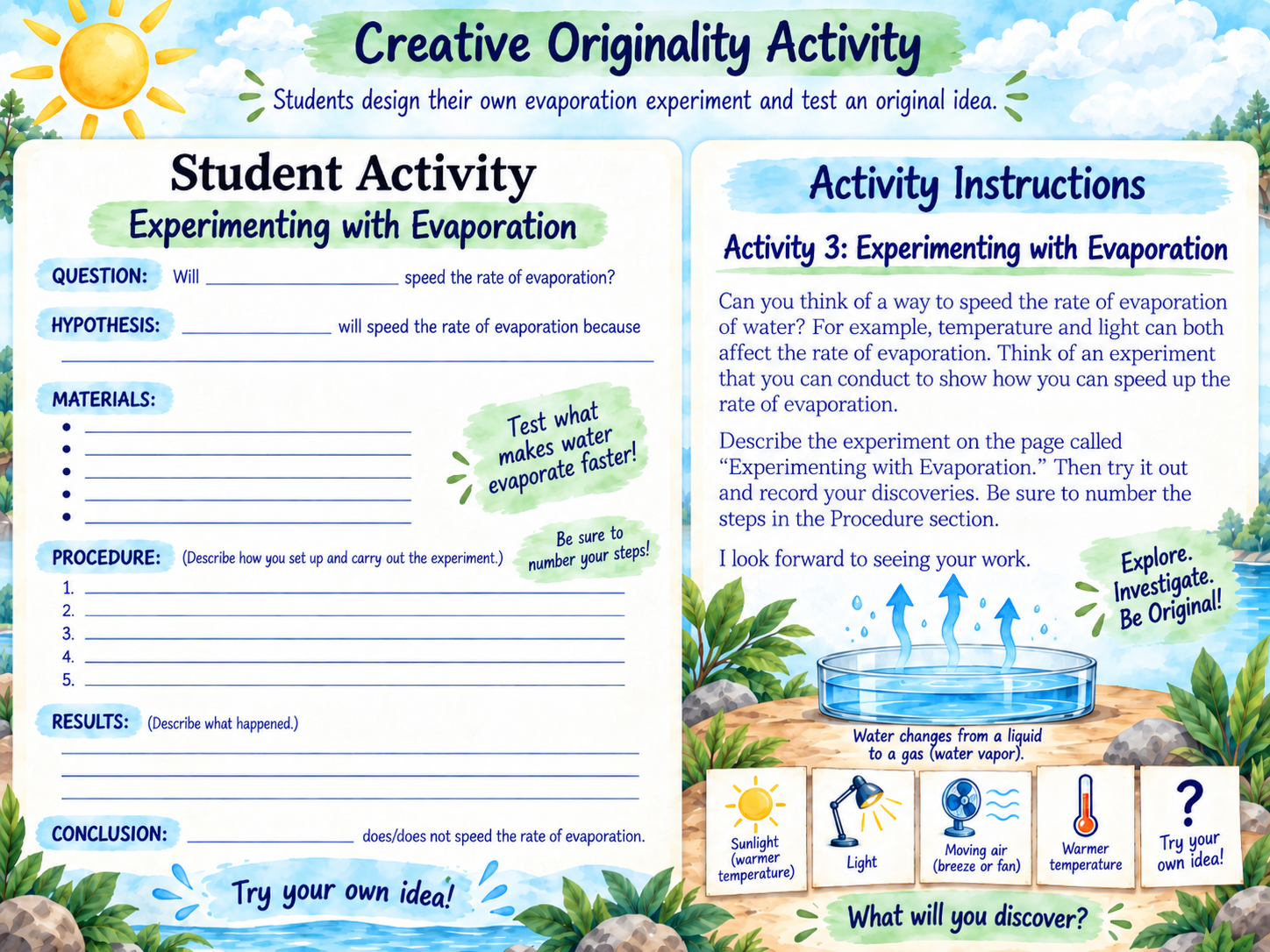
Originality is the ability to develop unique ideas, interpretations, expressions, or solutions. The goal is to think of unusual, distinctive, or personally meaningful solutions. Originality often grows out of fluency and flexibility. Students first generate many possibilities, approaching a task from different directions, and then discover an idea that moves beyond the most obvious response.
Originality develops independent thinking, strengthens problem-solving, and gives students a personal voice in the learning process. It is essential for building intellectual confidence and productive risk-taking. A curriculum that develops original thinking will not tell a student what to do, it will ask them what they think they should do and why. It will encourage them to make decisions that are meaningful to them. It will require them to provide an original l response. For example it might encourage students to find their own materials for a science model, come up with a unique way to solve a math problem, or take a unique perspective on a historical event. One of the most obvious signs of creative thinking is a curriculum that requires original responses rather than fill-in-the-blank, multiple-choice, or right-or-wrong answers.
At our age 9 to 11 level we have a unit called The Living Seas. In this unit students learn about the water cycle and study evaporation. In addition to recreating an existing experiment on evaporation, we also ask students to develop an experiment of their own that is designed to speed evaporation. This will encourage students to think of original ideas to solve a scientific problem.
Elaboration
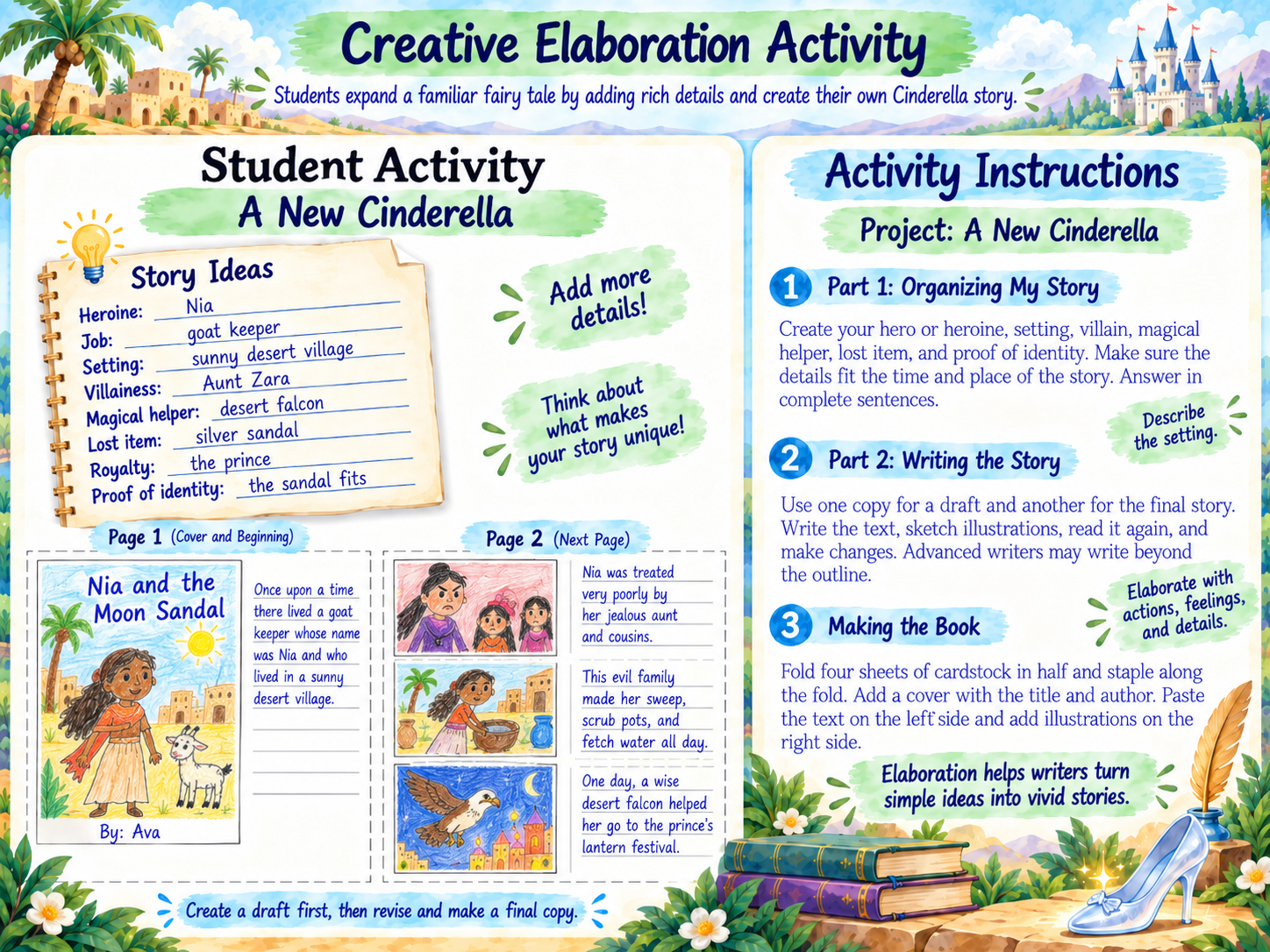
Elaboration is the process of adding details, making changes, finding connections, and refining thinking. Elaboration will make an idea or solution clearer, richer, and more complete.
When children develop the skill of elaboration, they begin to see the value in taking time to be thoughtful and detailed. They can recognize that a quality product takes sustained effort and patience. They will find pride in what they create and produce.
In our Age 6-8 level, the stories from around the world unit, which covers science, social studies, and language arts, includes a number of examples of elaboration.
- Students perform a character analysis and then after they have provided their initial ideas, they re-read the stories, collect more evidence, and return to their original description to add new describing words.
- Students listen closely to a description of a setting and they draw the setting, adding the details from the setting description to their image. Afterwards they return and re-read the story so they can catch additional descriptive information about the setting.
- Students dictate a story to their parents ,and after it has been read back to them, they are asked if they would like to change anything and amend the story before they read it aloud and illustrate it. (*Should they illustrate it and read it aloud to their family?)
- Perhaps the strongest example is found in creating A New Cinderella. After studying three different Cinderella stories from around the world, students create their own Cinderella story where they organize the interconnected story elements like:
-
- character,
- setting,
- villain,
- difficulty,
- lost item,
- magical help, and
- solution.
Then they must return and make those details consistent with one another and with the chosen time and place.
The project moves explicitly from draft to re-reading, then changes, then corrections, then final copy, then illustrations, then completed book. The sequence embodies the idea that a quality creative product develops through sustained attention and revision. It does not appear fully formed on the first attempt.
Creativity Every Day
At Beyond the Page the four elements of creativity are intentionally woven through the curriculum in all subjects. Because creative thinking is a skill that grows with practice, students are given daily opportunities to practice, and over time creativity becomes a way of thinking and a natural approach to learning and problem solving.
